
What Is the Difference Between Habit and Prior Acts Evidence?
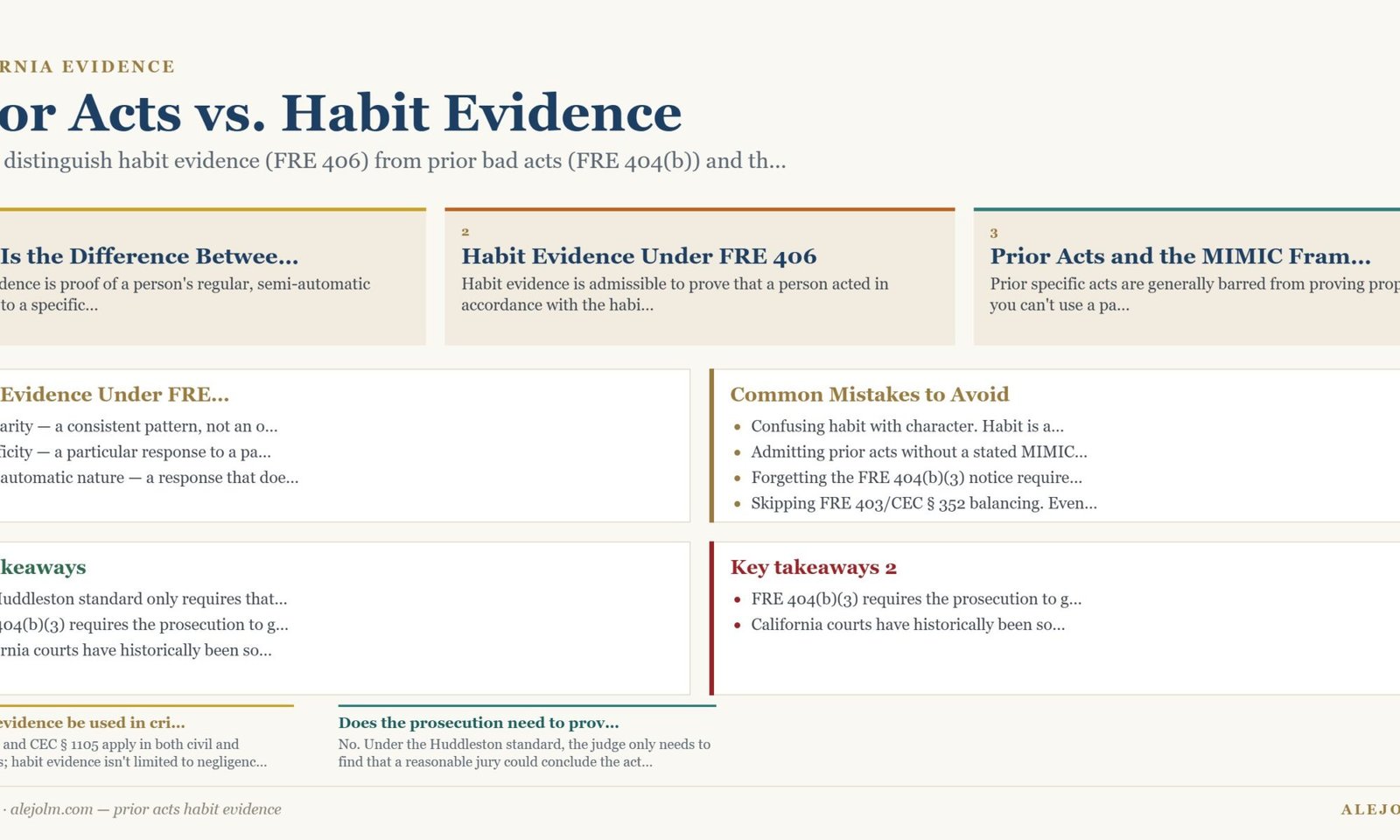
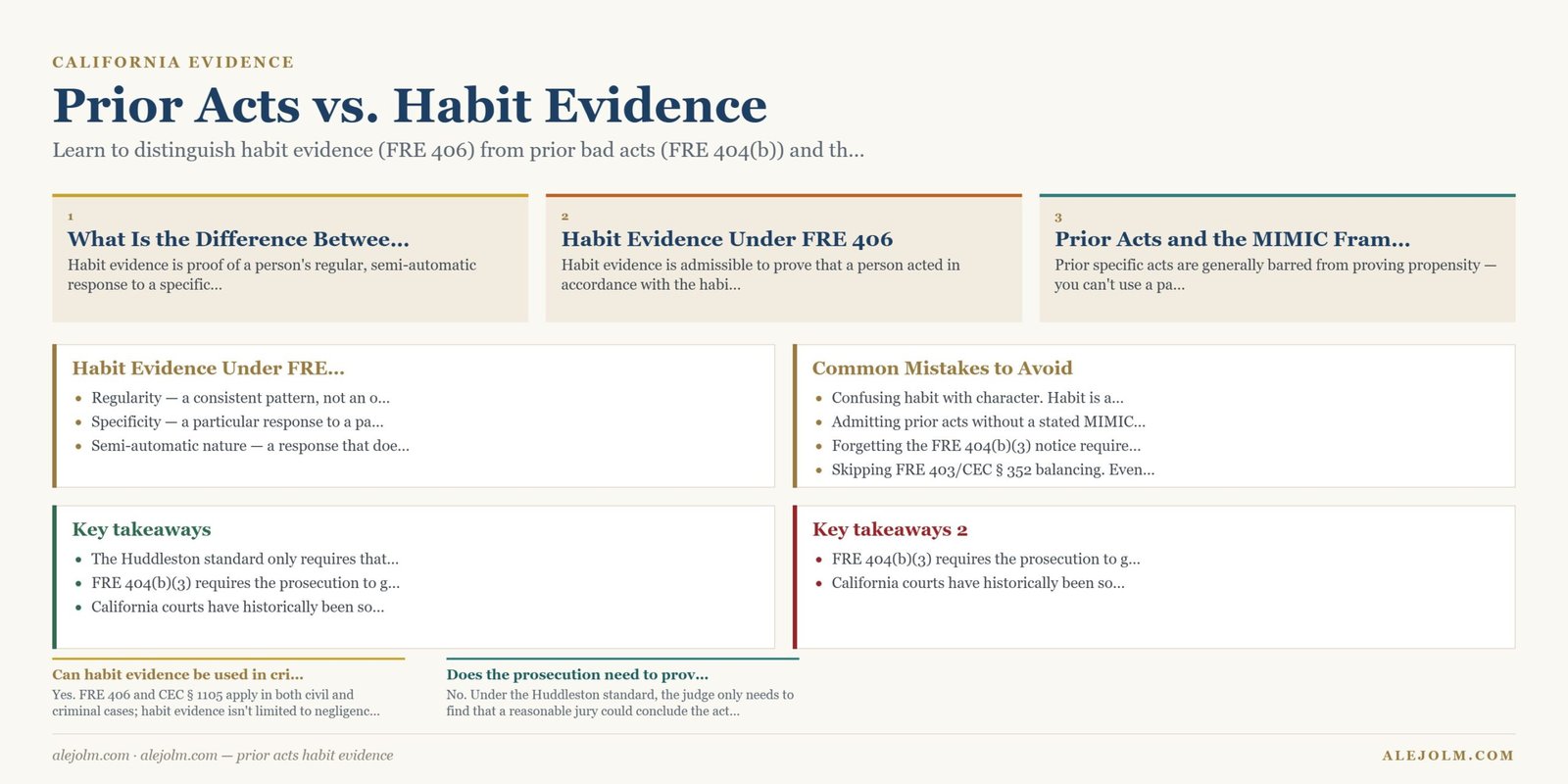
Habit evidence is proof of a person’s regular, semi-automatic response to a specific, repeated situation — like always checking a mirror before backing out of a driveway. Prior acts evidence is proof of a specific past act offered to show something other than general character, such as motive or identity. Both can be admissible where character evidence alone would be barred, but they rest on very different theories.
Bar examiners test this pairing constantly because the line between “habit” and “character trait” is genuinely blurry, and prior acts evidence sits right next to the propensity rule that trips up so many students.
Habit Evidence Under FRE 406
Habit evidence is admissible to prove that a person acted in accordance with the habit on a specific occasion. Unlike character evidence, it doesn’t require a moral judgment about the person — it’s simply a description of a semi-automatic, regular response to a repeated stimulus. The classic case, Halloran v. Virginia Chemicals Inc., distinguishes admissible habit (regular, specific, unreflective) from inadmissible general character or propensity evidence.
To qualify as habit, the conduct generally needs:
- Regularity — a consistent pattern, not an occasional occurrence
- Specificity — a particular response to a particular stimulus, not a broad tendency
- Semi-automatic nature — a response that doesn’t involve deliberation each time
“He’s a careless driver” is a character trait. “He habitually checks his phone every time he stops at a red light” is habit evidence.
Prior Acts and the MIMIC Framework
Prior specific acts are generally barred from proving propensity — you can’t use a past bad act to argue “he did it before, so he probably did it again.” But FRE 404(b) and California’s CEC § 1101(b) both allow prior acts for non-propensity purposes, commonly remembered by the acronym MIMIC: motive, intent, mistake (absence of), identity, and common plan or scheme. Courts also recognize opportunity, preparation, and knowledge as related non-propensity purposes.
The admission standard comes from Huddleston v. United States: the trial judge admits the evidence if a reasonable jury could conclude the defendant committed the prior act — no conviction is required, and the prosecution doesn’t need to prove the act beyond a reasonable doubt at the admissibility stage.
CEC § 1105 vs. FRE 406: California’s Habit Evidence Rule
California’s CEC § 1105 largely mirrors FRE 406, but the two jurisdictions apply the doctrine with slightly different rigor.
| Feature | Federal Rule (FRE 406) | California (CEC § 1105) |
|---|---|---|
| Core standard | Regular, semi-automatic response to a specific stimulus | Same regularity requirement |
| Corroboration required | No — habit alone suffices | No |
| Organizational routines | Recognized, but federal courts often scrutinize specificity closely | California courts have been comparatively more permissive in recognizing business routines |
| Relationship to character evidence | Distinct doctrine; no moral judgment required | Same distinction preserved |
| Notice requirement | None under FRE 406 itself | None under CEC § 1105 itself |
The takeaway for exam purposes: don’t assume federal and California habit analysis are identical just because the statutory language looks similar. California’s more permissive treatment of organizational routine evidence can turn an inadmissible-under-strict-federal-analysis fact pattern into an admissible one under CEC § 1105.
The Notice Requirement for Prior Acts (FRE 404(b)(3))
When the prosecution wants to use prior acts evidence under FRE 404(b), it must provide reasonable written notice of the specific non-character purpose it intends to argue, before trial. This notice requirement prevents surprise and forces the prosecution to commit to a theory — motive, identity, plan, etc. — rather than dumping prejudicial history on the jury and hoping something sticks.
Even after admission, the evidence typically comes with a limiting instruction: the jury may consider the prior act only for the stated non-propensity purpose, not as proof the defendant is the type of person who commits such acts.
Worked Example: The Texting Driver
Marco is sued after his car strikes a pedestrian while he was allegedly texting. The plaintiff wants to introduce testimony from Marco’s coworker that Marco “always texts at red lights and often continues typing as the light turns green.”
Walk through the analysis:
- Is this character evidence? No — it’s not a general claim that Marco is careless. It describes a specific, repeated behavior triggered by a specific stimulus (a red light).
- Regularity and specificity: The coworker’s testimony describes a consistent pattern (“always,” “often”) tied to a discrete trigger, satisfying FRE 406/CEC § 1105.
- Semi-automatic quality: Continuing to text as the light turns green suggests an unreflective, habitual response rather than a deliberate choice each time.
- Conclusion: This is admissible habit evidence, not inadmissible character evidence, in both federal and California court.
Compare this to a witness who simply says “Marco is a careless texter” — that’s a character trait, and it would need to clear the much higher bar of FRE 404/405 or CEC § 1101, not FRE 406.
Common Mistakes to Avoid
- Confusing habit with character. Habit is a specific, semi-automatic response to a repeated stimulus; character is a general trait. Only habit gets FRE 406’s easier path to admission.
- Admitting prior acts without a stated MIMIC purpose. Prior acts offered “because they’re similar” without articulating motive, intent, mistake, identity, or plan risk being pure propensity evidence.
- Forgetting the FRE 404(b)(3) notice requirement. The prosecution can’t ambush the defense with unnoticed prior acts evidence at trial.
- Skipping FRE 403/CEC § 352 balancing. Even a properly noticed, MIMIC-qualified prior act can be excluded if the risk of propensity reasoning substantially outweighs its probative value.
FAQ
Can habit evidence be used in criminal cases?
Yes. FRE 406 and CEC § 1105 apply in both civil and criminal cases; habit evidence isn’t limited to negligence disputes.
Does the prosecution need to prove the prior act happened before it’s admitted?
No. Under the Huddleston standard, the judge only needs to find that a reasonable jury could conclude the act occurred — not that it’s proven beyond a reasonable doubt.
Is a single incident ever enough to establish habit?
Generally no. Habit requires a pattern of regular, specific conduct. A one-time act is closer to a prior bad act analyzed under MIMIC, not habit evidence under FRE 406.
Key Takeaways
- Habit evidence (FRE 406 / CEC § 1105) requires a regular, specific, semi-automatic response and needs no moral judgment about character.
- Prior acts evidence is barred for propensity but admissible for non-character purposes under the MIMIC framework: motive, intent, mistake, identity, common plan.
- The Huddleston standard only requires that a reasonable jury could find the prior act occurred — not proof beyond a reasonable doubt.
- FRE 404(b)(3) requires the prosecution to give written notice of its non-propensity purpose before trial.
- California courts have historically been somewhat more permissive than federal courts in recognizing organizational habit evidence under CEC § 1105.
This article is educational and is not legal advice. Consult a licensed California attorney about your situation.
Related guides
- relevance and probative value in California
- best evidence rule in California
- confrontation clause and hearsay