
What Is Fee Splitting Between Lawyers in California?
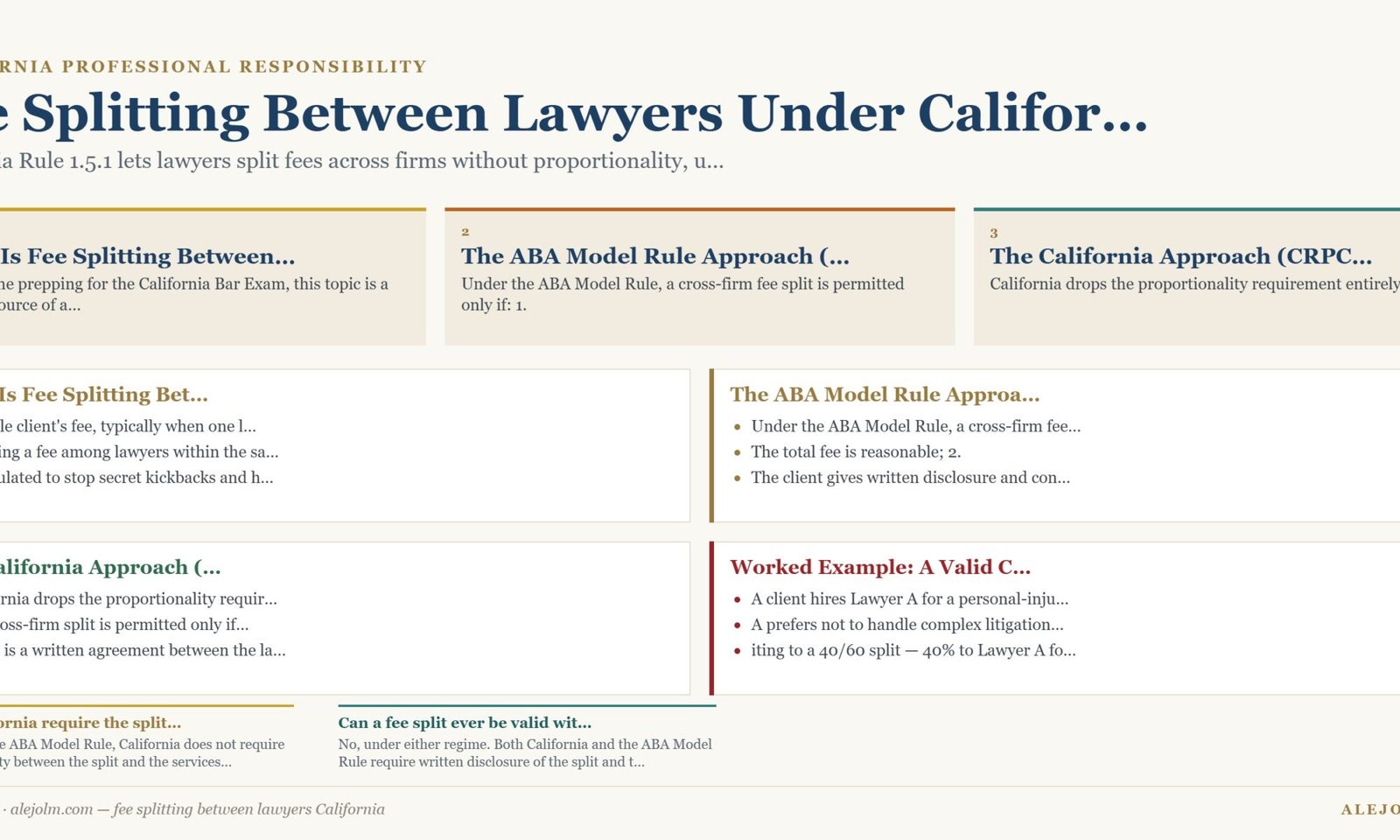
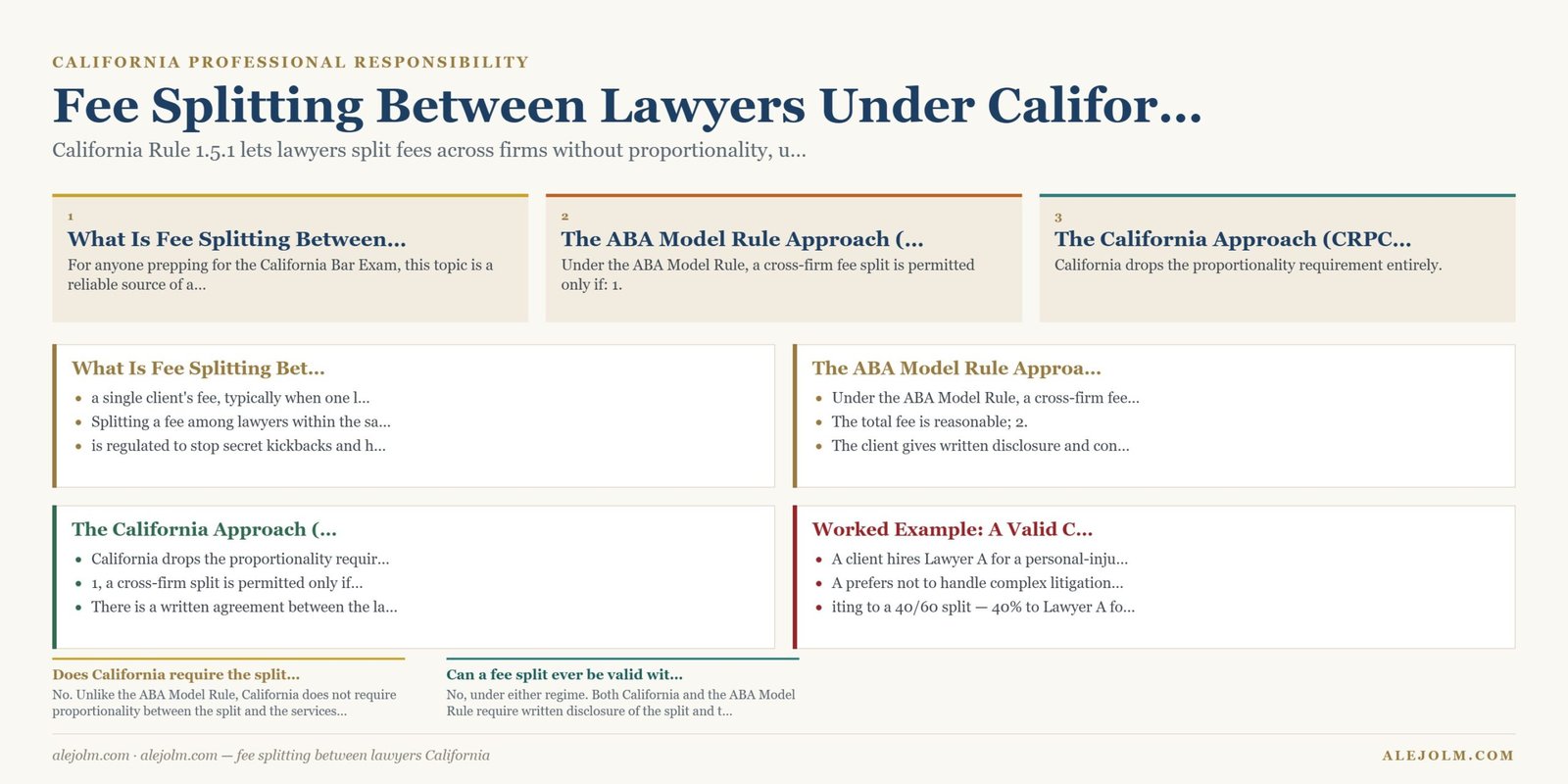
Fee splitting between lawyers refers to lawyers at different firms dividing a single client’s fee, typically when one lawyer refers a case or partners with another for specific expertise. Splitting a fee among lawyers within the same firm is always permitted with no special procedure. Splitting across firms is regulated to stop secret kickbacks and hidden referral arrangements from creeping into the client’s bill.
For anyone prepping for the California Bar Exam, this topic is a reliable source of a specific, testable distinction: California’s approach differs meaningfully from the ABA Model Rule.
The ABA Model Rule Approach (Rule 1.5(e))
Under the ABA Model Rule, a cross-firm fee split is permitted only if:
- The total fee is reasonable;
- The client gives written disclosure and consent; and
- The division is either in proportion to the services each lawyer performs, or each lawyer assumes joint responsibility for the matter.
The California Approach (CRPC 1.5.1)
California drops the proportionality requirement entirely. Under CRPC 1.5.1, a cross-firm split is permitted only if:
- There is a written agreement between the lawyers dividing the fee;
- The client consents in writing after full written disclosure of the fact of the division, the identity of every lawyer or firm involved, and the terms of the division; and
- The total fee does not increase solely because of the split.
The single most tested distinction: California does not require proportionality or joint responsibility. Two lawyers can agree to almost any split — 90/10, 50/50, whatever they negotiate — as long as it’s disclosed, consented to in writing, and doesn’t inflate what the client pays.
| Issue | ABA Model Rule | California Rule |
|---|---|---|
| Written agreement between lawyers | Not separately required | Required |
| Client consent | Written disclosure and consent | Written consent after full written disclosure of fact, identities, and terms |
| Proportionality or joint responsibility | Required (one or the other) | Not required |
| Total fee increase | Not directly addressed | Fee may not increase solely because of the split |
Worked Example: A Valid California Split
A client hires Lawyer A for a personal-injury case in California. Lawyer A prefers not to handle complex litigation, so she brings in Lawyer B, a trial specialist at a different firm. They agree in writing to a 40/60 split — 40% to Lawyer A for intake and settlement negotiation, 60% to Lawyer B for trial work. They disclose to the client, in writing, the fact of the split, both lawyers’ identities, and the 40/60 terms. The client signs off.
Even though the 40/60 split doesn’t perfectly mirror how much work each lawyer eventually performs, California allows it — the total fee ($30,000 on a $100,000 settlement, for example) isn’t increased by the division. Under the ABA rule, this same arrangement might fail unless the split tracks the actual work or both lawyers accept joint responsibility.
Worked Example: The Secret Split (Always Invalid)
A referring lawyer identifies a complex commercial case, hands it to a litigation specialist at another firm, and the two verbally agree the referring lawyer gets a cut of the fee. They never tell the client. When the client eventually finds out, both the ABA and California rules are violated — not because of the split’s terms, but because there was no written disclosure and consent at all. Secrecy alone is fatal, regardless of jurisdiction.
Worked Example: The Inflated Fee
A referring lawyer and a handling firm split a $60,000 fee 50/50, even though a single firm doing all the work would reasonably charge $40,000–$45,000. The client is now paying $60,000 for work worth $40,000–$45,000. Under CRPC 1.5.1, this fails even with full written disclosure and client consent, because the rule independently forbids inflating the total fee solely because of the division.
Common Mistakes on the California Bar Exam
- Assuming California requires proportionality like the ABA. It doesn’t — this is the exam’s favorite trap.
- Treating verbal disclosure as sufficient. Both regimes require written disclosure and consent.
- Missing the anti-inflation rule. California independently bars a split that pushes the total fee above what a single firm would reasonably charge.
- Forgetting the written-agreement-between-lawyers requirement. California requires this in addition to client consent; the ABA doesn’t separately demand it.
- Confusing within-firm and cross-firm splits. Dividing fees among partners or associates in the same firm never needs client disclosure or consent.
FAQ
Does California require the split to match the work performed?
No. Unlike the ABA Model Rule, California does not require proportionality between the split and the services rendered, nor does it require joint responsibility — only written agreement, written client consent with full disclosure, and no fee inflation.
Can a fee split ever be valid without telling the client?
No, under either regime. Both California and the ABA Model Rule require written disclosure of the split and the client’s written consent; a secret arrangement is invalid from the start regardless of how reasonable the terms are.
What happens if a fee split makes the total fee higher than normal?
In California, that violates CRPC 1.5.1 even if the client consented in writing — the rule independently forbids increasing the total fee solely because of the division between lawyers.
Key Takeaways
- Fee splitting within one firm is always allowed; splitting across firms triggers special rules.
- California requires a written agreement between the lawyers, full written disclosure to the client, written client consent, and no fee inflation.
- California does not require proportionality or joint responsibility, unlike the ABA Model Rule.
- Secret fee splits violate both regimes regardless of how fair the split is.
- A split that inflates the client’s total fee is independently prohibited in California.
This article is educational and is not legal advice. Consult a licensed California attorney about your situation.
Related guides
- California referral fee rules for lawyers
- Fee splitting with non-lawyers under California Rule 5.4
- California’s hot-potato rule for dropping clients