
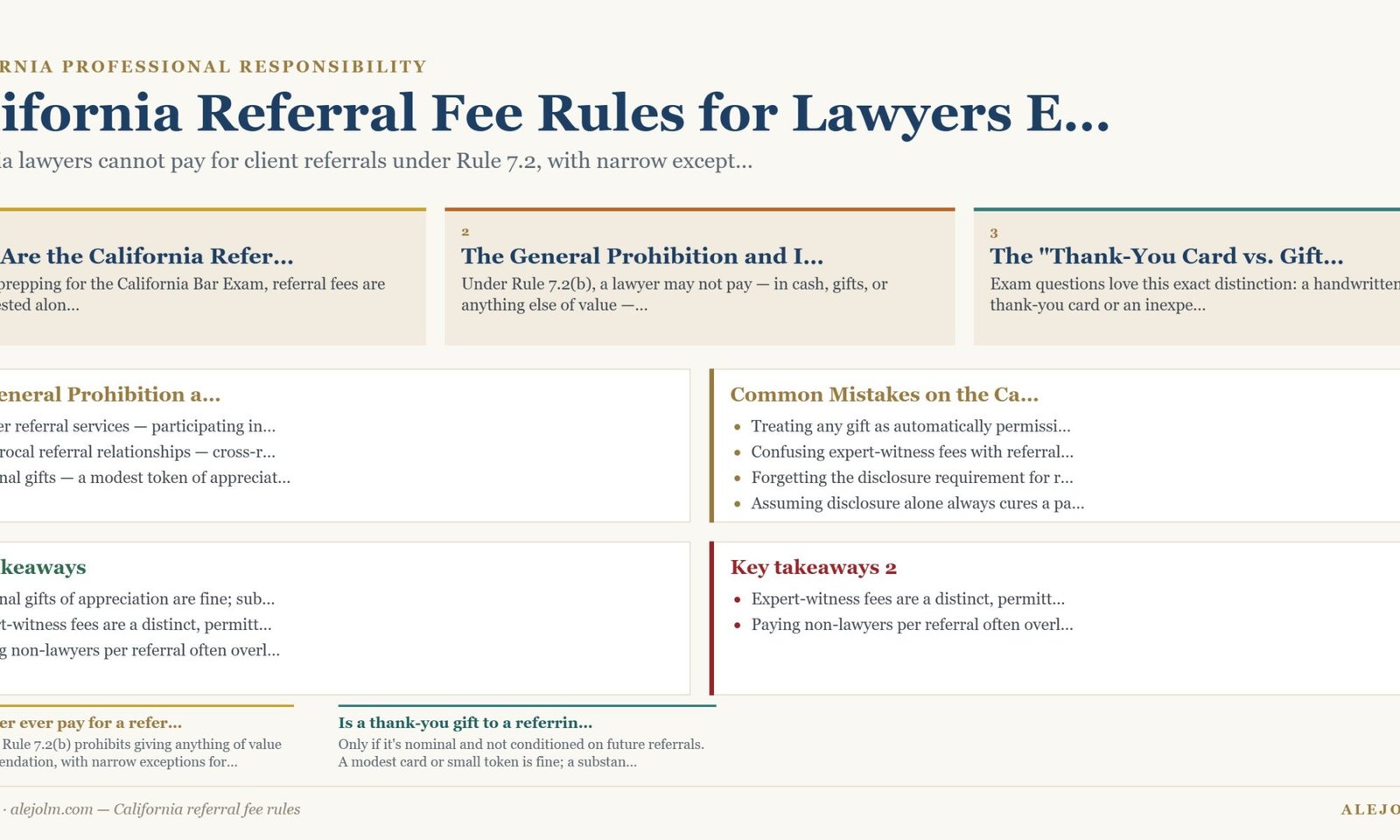
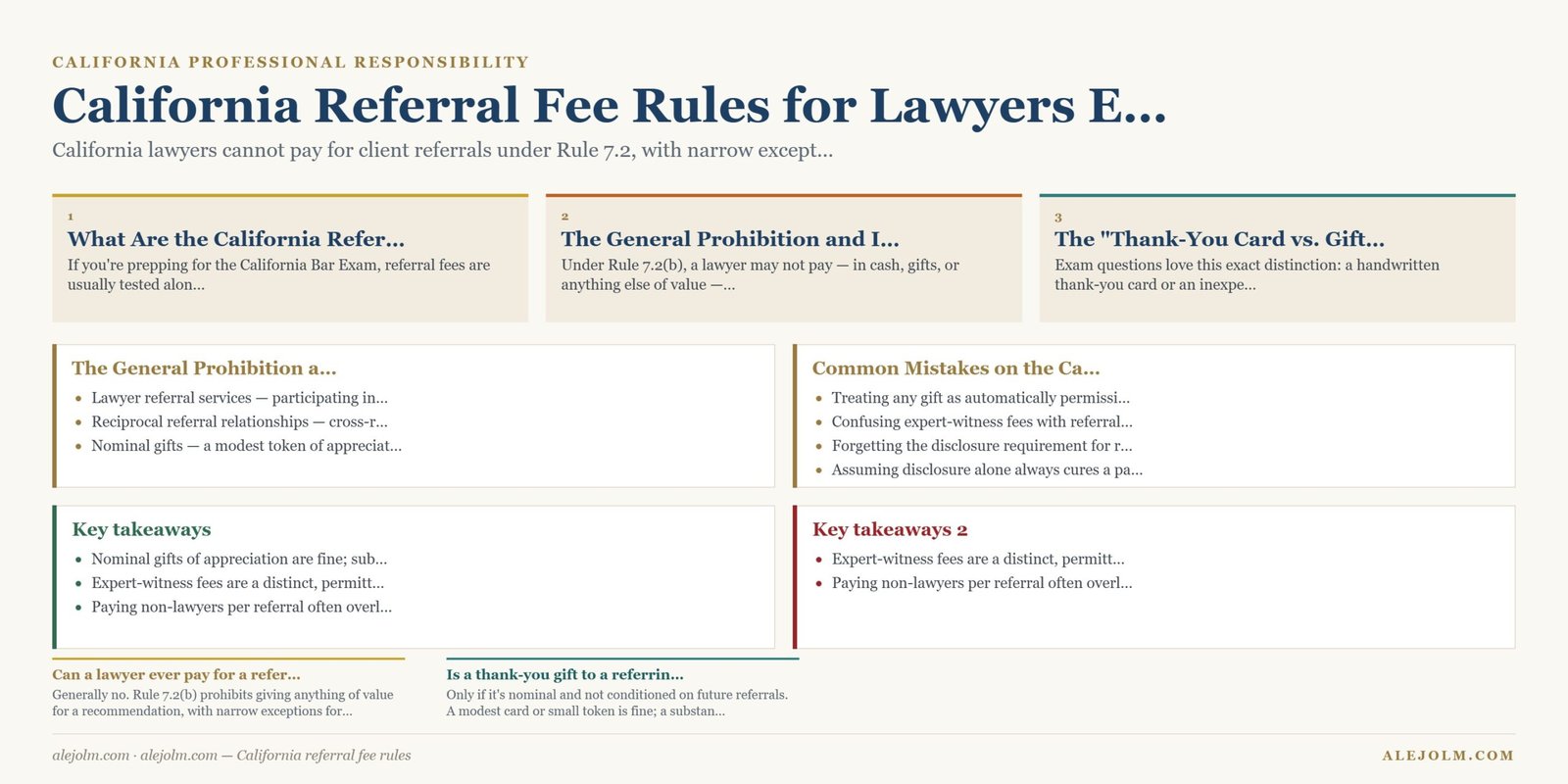
What Are the California Referral Fee Rules for Lawyers?
California referral fee rules generally prohibit a lawyer from giving anything of value to a person in exchange for recommending the lawyer’s services. The concern mirrors the ban on fee-splitting with non-lawyers: outside referral sources shouldn’t be able to turn client steering into a paid commodity, because that risks putting a middleman’s financial interest ahead of the client’s.
If you’re prepping for the California Bar Exam, referral fees are usually tested alongside advertising and solicitation, because all three regulate how lawyers can lawfully attract clients.
The General Prohibition and Its Narrow Exceptions
Under Rule 7.2(b), a lawyer may not pay — in cash, gifts, or anything else of value — for a recommendation of her services. The exceptions are narrow:
- Lawyer referral services — participating in a qualified, consumer-oriented referral service (nonprofit or a prepaid legal-services plan) is fine.
- Reciprocal referral relationships — cross-referring with another lawyer (must be disclosed to the client) or a non-lawyer professional (must be non-exclusive and explained to the client). Critically, no money can change hands for the referral itself.
- Nominal gifts — a modest token of appreciation is fine, as long as it isn’t payment for the referral and isn’t an inducement for future referrals.
The “Thank-You Card vs. Gift Certificate” Line
Exam questions love this exact distinction: a handwritten thank-you card or an inexpensive pen is a permissible nominal gift. A $500 gift certificate, on the other hand, is compensation for the referral — it crosses into a prohibited referral fee. The test asks whether anything of real value changed hands specifically because of the referral, and whether it looks like an inducement for more referrals down the line.
💭 A California nuance you may see in older bar answers: some treat a referral payment as not per se unethical if it’s disclosed to the client, the client consents, and the total fee isn’t increased — echoing the fee-splitting framework rather than a flat ban. Know the general prohibition first; this nuance is secondary.
Worked Example: The Gift Certificate That Crosses the Line
A personal-injury lawyer sends truthful, compliant professional announcements to local physicians. One physician later refers a patient. Grateful, the lawyer sends the physician a $500 restaurant gift certificate with a note thanking him “for referring this client” and hoping for “more referrals.” This violates Rule 7.2(b) — the certificate’s value and its explicit tie to future referrals turn a token of appreciation into compensation. Separately, if that same physician testifies as an expert witness in a different case, the lawyer may pay him a reasonable expert-witness fee — that’s a different, permitted payment entirely, as long as it’s not conditioned on favorable testimony.
Worked Example: The Permissible Reciprocal Relationship
A family-law lawyer and an estate-planning lawyer, practicing at different firms, agree to send each other clients who need the other’s services. No money ever changes hands. Both lawyers disclose the arrangement to their respective clients and make clear the client is free to decline the referral and find independent counsel. This fits Rule 7.2(b)’s reciprocal-referral exception cleanly: the two safeguards — no payment, and disclosure — are both satisfied.
Worked Example: The Paid Marketing Consultant
A lawyer pays a non-lawyer marketing consultant $200 for every new client the consultant brings in. The consultant actively meets prospective clients and persuades them to hire the lawyer. This is a straightforward Rule 7.2(b) violation — a per-referral cash payment to a non-lawyer creates a direct financial incentive to steer clients toward the lawyer regardless of fit, which is exactly what the rule exists to prevent.
| Scenario | Payment Involved? | Disclosed to Client? | Permitted? |
|---|---|---|---|
| $500 gift certificate to a referring physician | Yes | No | No |
| Reciprocal referrals between two lawyers | No | Yes | Yes |
| $200 per-client payment to a marketing consultant | Yes | N/A | No |
| Nominal thank-you card for a referral | No (nominal) | N/A | Yes |
Common Mistakes on the California Bar Exam
- Treating any gift as automatically permissible. Size, frequency, and the explicit tie to a referral all matter — a $100 gift card sent regularly can become compensation.
- Confusing expert-witness fees with referral fees. Paying an expert for testimony is different from paying someone for sending you a client.
- Forgetting the disclosure requirement for reciprocal referrals. Even a no-money arrangement between two lawyers must be disclosed to the affected clients.
- Assuming disclosure alone always cures a payment. The general rule is a payment prohibition, not just a disclosure requirement — the older, more permissive California nuance is the exception, not the default rule.
- Paying non-lawyers per-referral without recognizing the overlap with Rule 5.4. A per-client cash arrangement with a non-lawyer can implicate both the referral-fee rule and the fee-splitting-with-non-lawyers rule at once.
FAQ
Can a lawyer ever pay for a referral in California?
Generally no. Rule 7.2(b) prohibits giving anything of value for a recommendation, with narrow exceptions for qualified referral services, reciprocal (no-money) arrangements disclosed to the client, and truly nominal tokens of appreciation.
Is a thank-you gift to a referring source always safe?
Only if it’s nominal and not conditioned on future referrals. A modest card or small token is fine; a substantial gift like a $500 gift certificate is treated as compensation and violates the rule.
What’s the difference between a referral fee and an expert-witness fee?
A referral fee pays someone for sending a client; it’s prohibited. An expert-witness fee pays a professional for testimony or consulting work in a case and is permitted, as long as it isn’t tied to the content or favorability of the testimony.
Key Takeaways
- California lawyers generally may not give anything of value in exchange for a client referral.
- Reciprocal referral relationships are permitted if no money changes hands and the arrangement is disclosed to clients.
- Nominal gifts of appreciation are fine; substantial gifts tied to referrals are treated as prohibited compensation.
- Expert-witness fees are a distinct, permitted payment separate from referral fees.
- Paying non-lawyers per referral often overlaps with the separate ban on fee-splitting with non-lawyers.
This article is educational and is not legal advice. Consult a licensed California attorney about your situation.
Related guides
- California lawyer advertising rules explained
- California solicitation Rule 7.3 for lawyers
- Fee splitting between lawyers under California Rule 1.5.1