
What Happens When a California Spouse Dies Without a Will?
Not everyone gets around to writing a will, and when a married Californian dies intestate, the state’s default distribution scheme takes over. For community property purposes, this is one of the cleanest — and most commonly tested — rules in the entire subject, precisely because it’s so different from the sliding scale used for separate property.
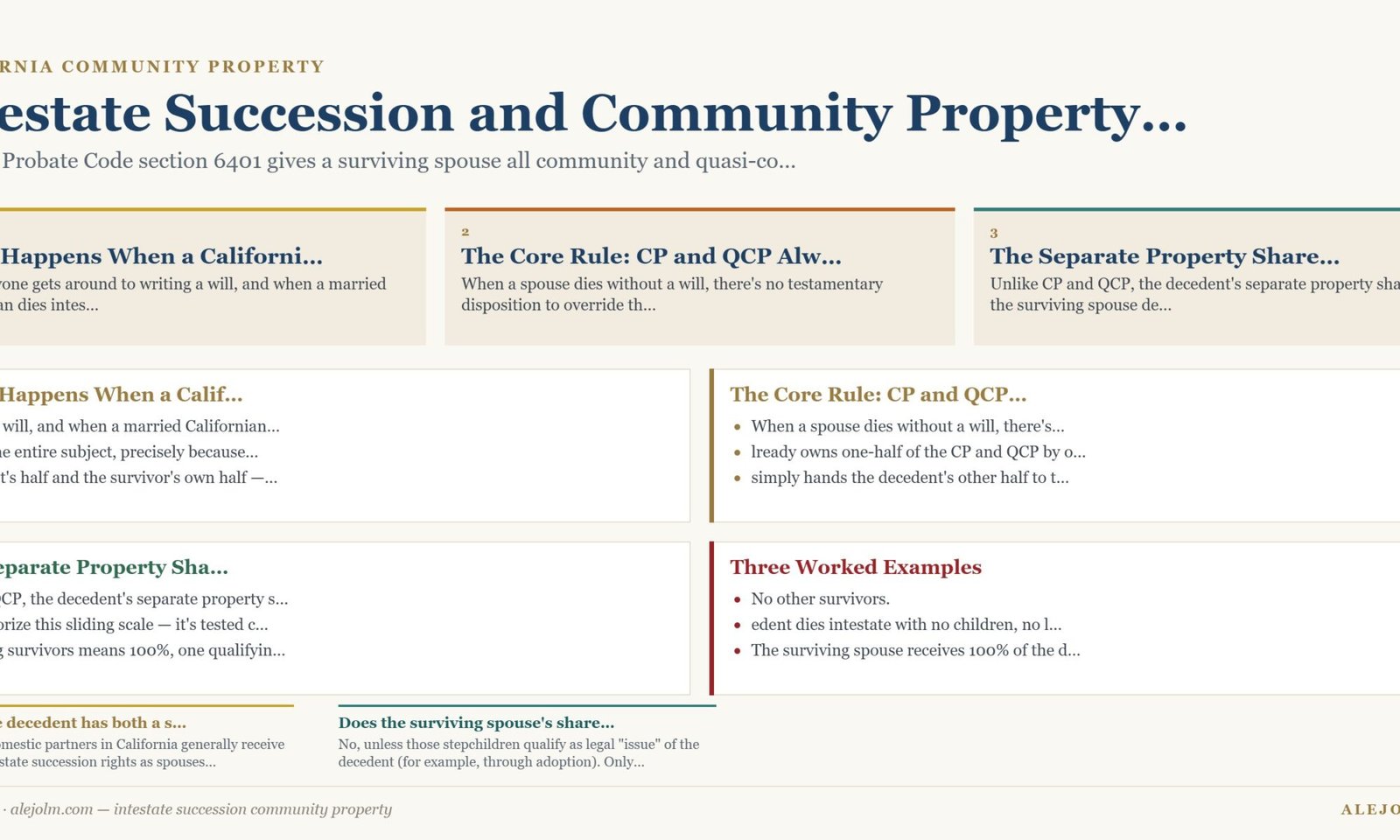
Intestate succession under Probate Code § 6401 gives the surviving spouse the entire community property and quasi-community property estate — both the decedent’s half and the survivor’s own half — because no will exists to give the decedent’s share to anyone else. The decedent’s separate property, by contrast, is split according to who else survives.
The Core Rule: CP and QCP Always Go 100% to the Surviving Spouse
When a spouse dies without a will, there’s no testamentary disposition to override the default. The surviving spouse already owns one-half of the CP and QCP by operation of law — that part isn’t even part of the probate question. Intestate succession under § 6401 simply hands the decedent’s other half to the same surviving spouse, since a spouse is always a statutory heir.
The result: the surviving spouse ends up owning the entire community and quasi-community estate, regardless of how many children, parents, or siblings also survive the decedent. This is the single most commonly missed distinction on this topic — students instinctively want to apply the sliding scale (below) to CP too, and that’s wrong.
The Separate Property Share: The 0/1/2 → 100%/1/2/1/3 Mnemonic
Unlike CP and QCP, the decedent’s separate property share for the surviving spouse depends on exactly who else survives. Memorize this sliding scale — it’s tested constantly.
| Surviving Relatives (Besides Spouse) | Spouse’s Share of SP | Spouse’s Share of CP/QCP |
|---|---|---|
| None (no issue, no parents, no issue of parents) | 100% | 100% |
| One issue, OR parents, OR issue of parents | 1/2 | 100% |
| Two or more issue | 1/3 | 100% |
The “0/1/2” mnemonic tracks the number of qualifying relative categories: zero other qualifying survivors means 100%, one qualifying survivor (or category) means 1/2, and two or more issue means 1/3.
Three Worked Examples
No other survivors. A decedent dies intestate with no children, no living parents, and no siblings or nieces/nephews (issue of parents). The surviving spouse receives 100% of the decedent’s SP, plus 100% of CP, plus 100% of QCP — the entire estate.
One child. A decedent dies intestate survived by one child and a spouse. The surviving spouse receives one-half of the decedent’s SP (the child takes the other half), plus 100% of CP and QCP.
Two children. A decedent dies intestate survived by two children and a spouse. The surviving spouse receives one-third of the decedent’s SP (the children split the remaining two-thirds), plus 100% of CP and QCP.
Notice the pattern across all three: the CP/QCP column never moves. Only the SP column changes.
Why California Has No Elective Share
Common-law states often give a surviving spouse an “elective share” — a guaranteed minimum percentage of the estate the spouse can claim against the will, protecting against total disinheritance. California doesn’t need that mechanism for CP, because the surviving spouse automatically receives the full community estate by operation of law regardless of what a will says (subject to the widow’s election doctrine when a will overreaches).
Interestingly, the QCP rule functions somewhat like a common-law elective share in its own right: the surviving spouse always gets half of the decedent’s QCP no matter what, while the decedent’s estate never has any claim to the survivor’s own QCP. That asymmetry is baked into the statute, not bargained for by election.
Don’t Conflate the Two Rules
It’s worth restating because the exam relies on this confusion: the surviving spouse’s share of the decedent’s one-half of CP/QCP is fixed at 100%. It does not vary with the number of children, parents, or other heirs. Only the SP share follows the sliding 100%/1/2/1/3 scale. Keep these as two entirely separate calculations when you work through a fact pattern.
Common Mistakes to Avoid
- Assuming a surviving spouse can be left with nothing. This scenario can’t happen under intestacy — a spouse is always a statutory heir, always receiving 100% of the decedent’s CP/QCP, and at least some (often all) of the SP.
- Applying the sliding scale to CP/QCP. The 100%/1/2/1/3 scale applies only to separate property. Community and quasi-community property go entirely to the surviving spouse no matter how many children survive.
- Forgetting that “issue of parents” counts as a triggering category. Surviving siblings, nieces, and nephews (issue of parents) trigger the one-half SP share, just like a single surviving child or surviving parents would.
Frequently Asked Questions
What if the decedent has both a surviving spouse and a domestic partner?
Registered domestic partners in California generally receive the same intestate succession rights as spouses under the Family Code — always confirm the domestic partnership was validly registered before applying spousal intestacy rules.
Does the surviving spouse’s share of CP change if there are stepchildren?
No, unless those stepchildren qualify as legal “issue” of the decedent (for example, through adoption). Only the decedent’s own issue, parents, or issue of parents affect the separate property calculation, and none of them affect the CP/QCP calculation at all.
Can a decedent’s creditors reach the surviving spouse’s intestate CP share?
Community debts can be charged against community property under the estate administration rules, but the analysis is distinct from the intestate distribution scheme itself — debts get sorted out during administration before final distribution.
Key Takeaways
- Probate Code § 6401 gives the surviving spouse 100% of the decedent’s CP and QCP in every intestate case, no matter who else survives.
- The decedent’s separate property share follows a sliding scale: 100% with no other qualifying heirs, 1/2 with one issue/parents/issue-of-parents, 1/3 with two or more issue.
- California has no common-law elective share for CP, because the surviving spouse already owns the community estate by operation of law.
- QCP functions like a built-in elective share: the survivor always gets half, and the decedent’s estate has no claim to the survivor’s own QCP.
- Never apply the SP sliding scale to CP/QCP — that’s the most common error on this topic.
This article is educational and is not legal advice. Consult a licensed California attorney about your situation.
Related guides
- testamentary power over community property
- widow’s election
- trustee duties
- community property presumptions