
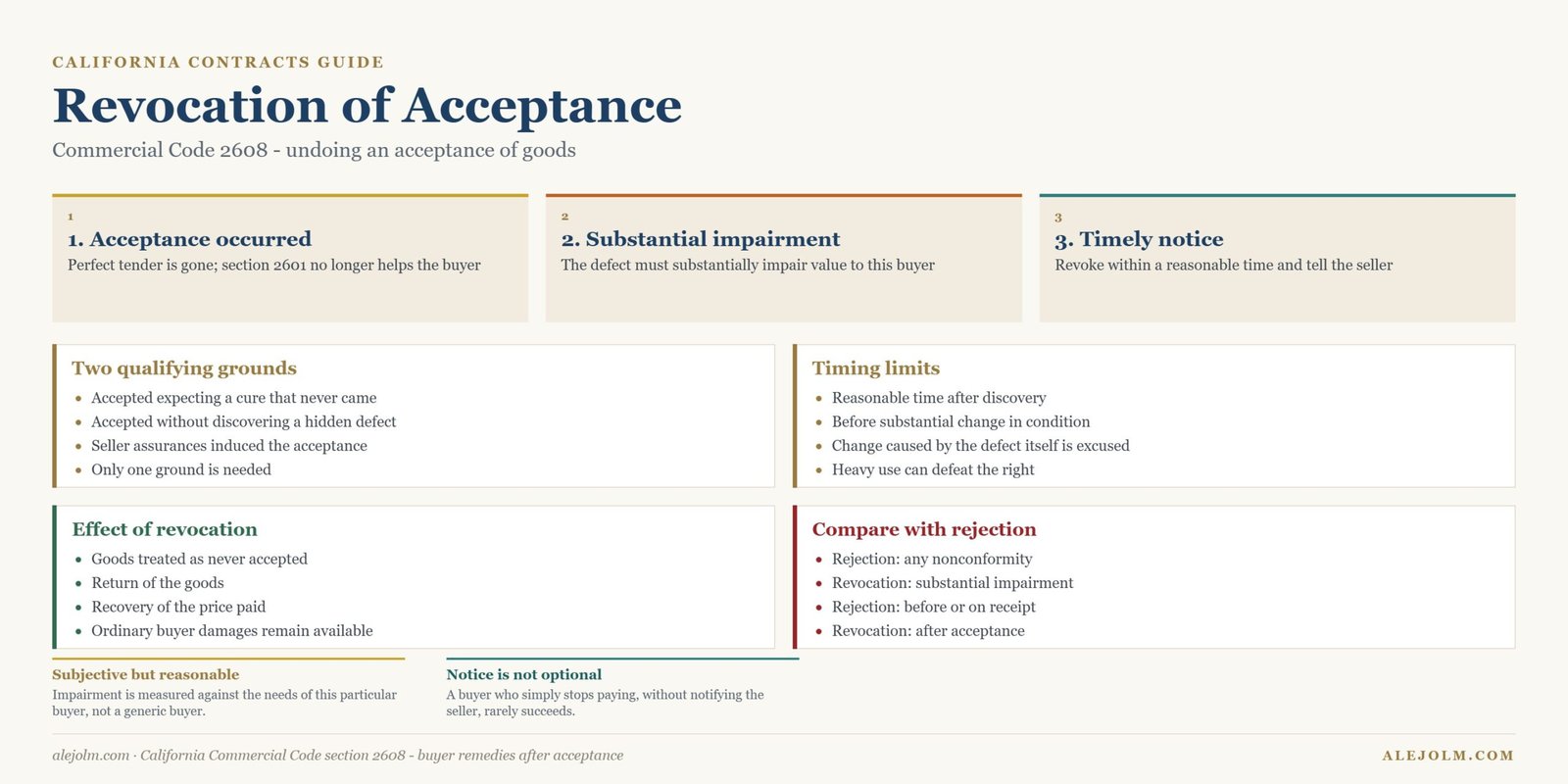
Revocation of acceptance is the narrow route a buyer of goods takes to undo an acceptance that has already happened. Once a buyer has accepted, the generous perfect tender standard disappears, and California Commercial Code section 2608 substitutes a much harder test: the nonconformity must substantially impair the value of the goods to that buyer, and one of two qualifying grounds must also be satisfied.
This guide explains how California courts approach revocation of acceptance, how it differs from a simple rejection, what the timing and notice requirements look like in practice, and how the doctrine plays out in commercial disputes across Los Angeles County. It covers the elements, a worked example, the mistakes that most often sink a revocation claim, and answers to the questions buyers and sellers ask most.
What revocation of acceptance means
Acceptance of goods is a legal event with consequences. A buyer accepts by signalling that the goods conform, by failing to make an effective rejection after a reasonable opportunity to inspect, or by acting in a way inconsistent with the seller ownership. After acceptance the buyer must pay the contract price, bears the burden of proving any breach, and loses the ability to walk away simply because the tender was imperfect.
Revocation is the statutory escape hatch. It allows a buyer, in defined circumstances, to treat the goods as though acceptance had never occurred. Because it unwinds a completed transaction, the threshold is deliberately high and the procedural requirements are strictly applied.
The elements a buyer must establish
A California buyer seeking to revoke should be able to point to each of the following, in order. Missing any one of them is usually fatal to the claim.
- Acceptance already occurred. If the buyer never accepted, the analysis belongs under rejection and perfect tender instead.
- A nonconformity exists. The goods must fail to conform to the contract, whether through defect, wrong quantity, or breach of warranty.
- Substantial impairment of value. The nonconformity must substantially impair the value of the goods to this buyer, judged against the buyer own documented needs.
- A qualifying ground. Either the buyer accepted on the reasonable assumption the defect would be cured and it was not seasonably cured, or the buyer accepted without discovering the defect because it was hard to detect or because the seller gave assurances.
- Reasonable timing. Revocation must follow within a reasonable time after the buyer discovered or should have discovered the problem.
- Notice to the seller. The buyer must communicate the revocation; silence or unilateral non-payment is not enough.
Substantial impairment in practice
The impairment test is often described as subjective but reasonable. It looks at what the particular buyer needed the goods for, provided that purpose was communicated or objectively apparent. A printing press bought for a specific production line may be substantially impaired by a defect that would be trivial for a hobbyist. Courts still require objective evidence, so purchase orders, specifications, and correspondence about intended use carry real weight.
The two qualifying grounds
The first ground covers the buyer who took delivery knowing something was wrong but relying on a promised repair. If the promised cure arrives promptly, revocation is defeated. The second ground covers the buyer who accepted in ignorance, either because the defect was latent or because the seller talked the buyer out of investigating. Assurances by the seller matter enormously here, which is why buyers should preserve emails and service notes.
Rejection compared with revocation
The two doctrines are frequently confused. The table below sets out the practical differences that decide most disputes.
| Feature | Rejection | Revocation of acceptance |
|---|---|---|
| Timing | Before or promptly upon receipt | After acceptance, within a reasonable time of discovery |
| Trigger | Any nonconformity | Nonconformity that substantially impairs value |
| Burden of proof | Seller must show conforming tender | Buyer must prove the breach |
| Condition of goods | Usually unused | Must not have substantially changed |
| Effect | Goods never accepted | Goods treated as if never accepted |
A worked example
A commercial printer in Vernon buys a used industrial press. The buyer notices a persistent grinding noise at delivery, and the seller assures the buyer that the noise is normal and will not affect performance. Relying on that assurance the buyer accepts the press and puts it into production. Three weeks later the press fails completely because of a structural defect that the noise had in fact signalled. The buyer notifies the seller immediately and revokes. The claim is strong: the failure substantially impairs the value of the press to a production business, acceptance occurred without discovery of the true defect, the seller assurances excuse the non-discovery, and notice was prompt.
Change the assurance. Suppose the seller said nothing, the noise was obvious, and an ordinary pre-purchase inspection would have revealed the structural defect. Now the buyer accepted with a reasonable opportunity to inspect and no excuse for non-discovery. Revocation fails, and the buyer is left with a damages claim for breach of warranty measured by the difference in value.
Revocation of acceptance in California and Los Angeles County in 2026
California codified the sales article in the Commercial Code, so the operative provision is section 2608 rather than the uniform numbering used in study materials. Los Angeles County handles a very high volume of commercial goods disputes, from equipment leasing in the Inland corridor to wholesale apparel in the downtown district, and the practical questions that recur are almost always about timing, continued use, and the adequacy of notice.
Buyers who keep operating equipment after purporting to revoke create the biggest problems for themselves. Continued commercial use tends to look like acceptance rather than revocation, although courts do allow limited use where returning the goods immediately would be commercially unreasonable and the buyer accounts for the value of that use.
- Document the intended use early. Specifications in the purchase order make substantial impairment far easier to prove.
- Send written notice. A dated letter or email revoking acceptance, describing the defect, beats a phone call every time.
- Stop or limit use. Continued heavy use undermines the claim and may amount to a substantial change in condition.
- Preserve the goods. Hold them available for the seller and avoid modifications or third-party repairs.
- Track the discovery date. The reasonable time clock runs from discovery, so record when the defect became apparent.
- Plead alternatively. Combine revocation with warranty damages so the case survives if the impairment threshold is not met.
For 2026, confirm the current California authority on revocation of acceptance, continued use, and notice directly with current authority, since these continue to develop.
Common mistakes to avoid
- Using perfect tender after acceptance. Section 2601 stops helping once the buyer has accepted the goods.
- Treating any defect as enough. Substantial impairment is a materially higher bar than any nonconformity.
- Stopping at impairment. One of the two qualifying grounds must also be established.
- Waiting too long. Delay after discovery converts a viable revocation into a damages claim at best.
- Revoking silently. Withholding payment without notifying the seller is not a revocation.
- Ignoring a prompt cure. If the buyer accepted expecting repair and the seller repaired seasonably, the right disappears.
Frequently asked questions
How long does a buyer have to revoke acceptance in California?
There is no fixed deadline. The statute requires a reasonable time after the buyer discovers or should have discovered the nonconformity. What is reasonable depends on the goods, the sophistication of the buyer, and how quickly the defect could be diagnosed.
Can a buyer keep using the goods after revoking?
Generally the buyer should stop. Limited continued use may be excused where stopping would be commercially unreasonable, but the buyer will usually have to account for the value of that use and risks having the revocation treated as ineffective.
Does revocation require returning the goods immediately?
The buyer must hold the goods with reasonable care and make them available to the seller. Immediate shipment back is not always required, particularly for large equipment, but the buyer cannot treat the goods as their own.
Is revocation available for a defect the buyer knew about?
Only where the buyer accepted on the reasonable assumption that the defect would be cured and no seasonable cure followed. Accepting a known defect without any expectation of repair generally waives the right to revoke.
What remedies follow a valid revocation?
The buyer may recover the price paid and pursue ordinary buyer remedies, including cover damages, market-price damages, and incidental and consequential losses, as though the goods had never been accepted.
Related guides
- The Perfect Tender Rule in California Sales Contracts
- The Right to Cure in California Sales of Goods Law
- Material Breach of Contract in California Explained
- Anticipatory Repudiation in California Contract Law
- Risk of Loss in California Sales of Goods Contracts
- UCC Statute of Limitations in California Sales Law
- Express Warranty Claims in California Explained
- Implied Warranties in California Sales of Goods
Next steps
If you are weighing a revocation, start by separating the acceptance question from the breach question. Our guide to the perfect tender rule explains what the buyer could have done before acceptance, and the right to cure explains when a seller can defeat the claim by fixing the problem in time.
For primary sources, read California Commercial Code section 2608 and the civil jury instructions published by the Judicial Council of California.