
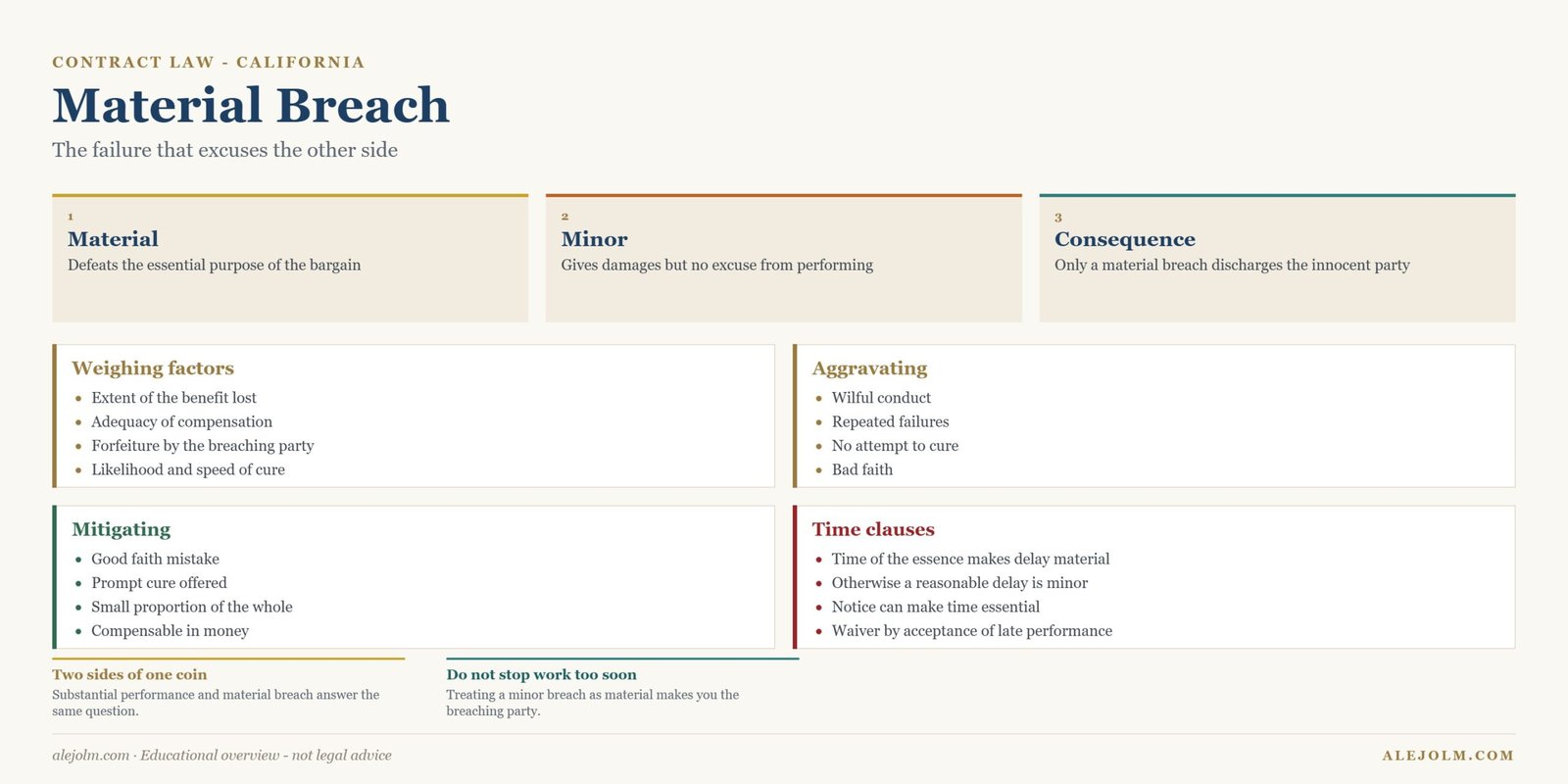
A material breach is a failure of performance serious enough to defeat the essential purpose of the contract. It matters because only a material breach excuses the innocent party from its own remaining obligations. A minor breach entitles that party to damages but leaves it bound to carry on performing.
California approaches the question through a weighing exercise rather than a bright line rule, and the same facts can be framed either as an inquiry into whether the defaulting party substantially performed or as an inquiry into whether the breach was material. This guide sets out the factors, the effect of time of the essence clauses, and the serious risk of stopping work too early.
The weighing factors
- The benefit lost. How far the innocent party has been deprived of what it reasonably expected.
- Adequacy of money. Whether damages can properly compensate for the shortfall.
- Forfeiture. How much the breaching party stands to lose if the breach is treated as material.
- Cure. Whether the defect can be and is likely to be put right quickly.
- Good faith. Whether the conduct was a wilful default or an honest error.
- Proportion. How much of the total performance the failure represents.
Time of the essence
Delay is the most litigated form of breach and the one most affected by drafting. Where the contract states that time is of the essence, any failure to meet the date is treated as material, and the innocent party may terminate. Where it does not, a delay is judged like any other failure and a short good faith delay is usually minor.
Making time essential later
A party faced with continuing delay under a contract that did not originally make time essential can often serve a notice fixing a new and reasonable date and stating that time will be of the essence. Conversely, a party that accepts late performance without objection may waive the benefit of an existing time clause.
The relationship with substantial performance
A party that has substantially performed has committed at most a minor breach, and the other side must still pay, subject to an offset for the shortfall. A party that has not substantially performed has committed a material breach and the other side is discharged. The two doctrines are the same question asked from opposite ends.
| Facts | Classification | Consequence |
|---|---|---|
| Trivial specification deviation, good faith | Minor | Pay less the diminution in value |
| One week delay, no time clause | Minor | Pay less any actual loss |
| One week delay, time of the essence | Material | Innocent party discharged |
| Half the work abandoned | Material | Innocent party discharged |
| Defect promptly cured | Minor | Damages for the delay only |
A worked example
A contractor renovating a kitchen in Burbank finishes a week after the stated date because a supplier let it down, and the work otherwise conforms exactly to the specification. The contract says nothing about time being of the essence. The owner has lost little, can be compensated in money, and the contractor would forfeit a large payment if the breach were treated as material. The breach is minor, and the owner must pay less any actual loss from the delay.
Change the drafting. Suppose the contract stated that time was of the essence because the kitchen was needed for a booked event. Now the same week of delay is material as a matter of the parties own agreement, and the owner is entitled to treat itself as discharged and to claim damages.
Material breach in California and Los Angeles County in 2026
Construction disputes in Los Angeles County turn on this question more often than any other. The recurring pattern is an owner withholding the final payment over an incomplete punch list, and a contractor treating that withholding as itself a material breach and walking off site. Both may be wrong, and the party that stops performing first is frequently the one held liable.
The disciplined approach is to document the defect, demand cure within a reasonable and stated period, and only then consider termination. California contracts commonly build in notice and cure provisions precisely to convert an uncertain common law judgement into a defined process.
- Do not stop work unilaterally. Follow the notice and cure procedure first.
- Give a written cure notice. State the defect and a reasonable deadline.
- Value the shortfall. A quantified offset is stronger than a blanket refusal to pay.
- Say whether time is essential. The clause decides most delay disputes.
- Do not waive by acceptance. Accepting late performance without protest can waive the point.
- Keep a contemporaneous record. Materiality is fact specific and evidence heavy.
For 2026, confirm the current California authority on material breach, cure and time of the essence directly with current authority, since these continue to develop.
Common mistakes to avoid
- Treating every breach as material. Most are not, and the consequences of getting it wrong are severe.
- Withholding the whole price for a small defect. The offset should match the shortfall.
- Ignoring an offer to cure. A prompt cure weighs heavily against materiality.
- Assuming a missed date is fatal. Without a time clause it usually is not.
- Overlooking waiver. Accepting late or defective performance can forfeit the objection.
- Confusing materiality with an express condition. Express conditions demand strict compliance regardless.
Frequently asked questions
When can I stop performing because of the other side breach?
Only when the breach is material, meaning that it defeats the essential purpose of the contract. A minor breach gives you damages but not an excuse.
Is a missed deadline a material breach?
Usually not, unless the contract makes time of the essence or the delay itself substantially deprives you of the benefit of the bargain.
Does an offer to fix the problem matter?
Yes, a great deal. The likelihood of a prompt cure is one of the strongest factors weighing against a finding of materiality.
Can I withhold the whole payment?
Only if the breach is material. Otherwise you must pay, offsetting the value of the shortfall the breach caused.
What is the difference between material breach and substantial performance?
They are the same question from opposite directions. A party that substantially performed has committed at most a minor breach.
Related guides
- Substantial performance
- Anticipatory repudiation
- Remedies for breach of contract
- Conditions precedent
- The perfect tender rule
- Installment contracts
- Damages for breach of contract
- Good faith and fair dealing
Next steps
Before you stop performing, write down exactly what you have lost and whether money would put it right. Our guides to substantial performance and remedies for breach explain what follows from each answer.
For primary sources, read California Civil Code section 1439 and the civil jury instructions published by the Judicial Council of California.