
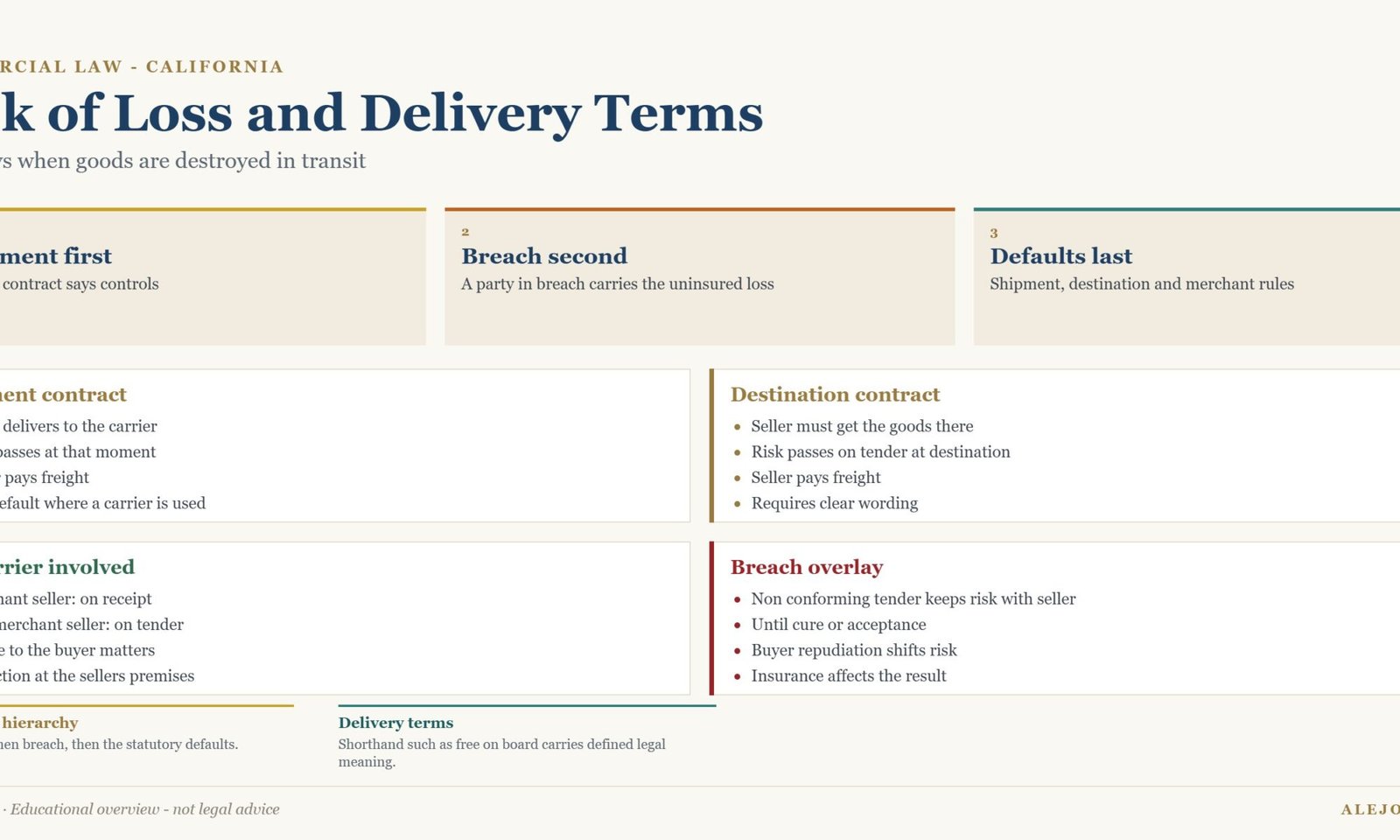
Risk of loss decides who bears the cost when goods are damaged or destroyed without the fault of either party. It is not the same question as ownership, and the two can sit in different places at the same time. The California Commercial Code supplies default rules that turn on how delivery was arranged and whether the seller is a merchant.
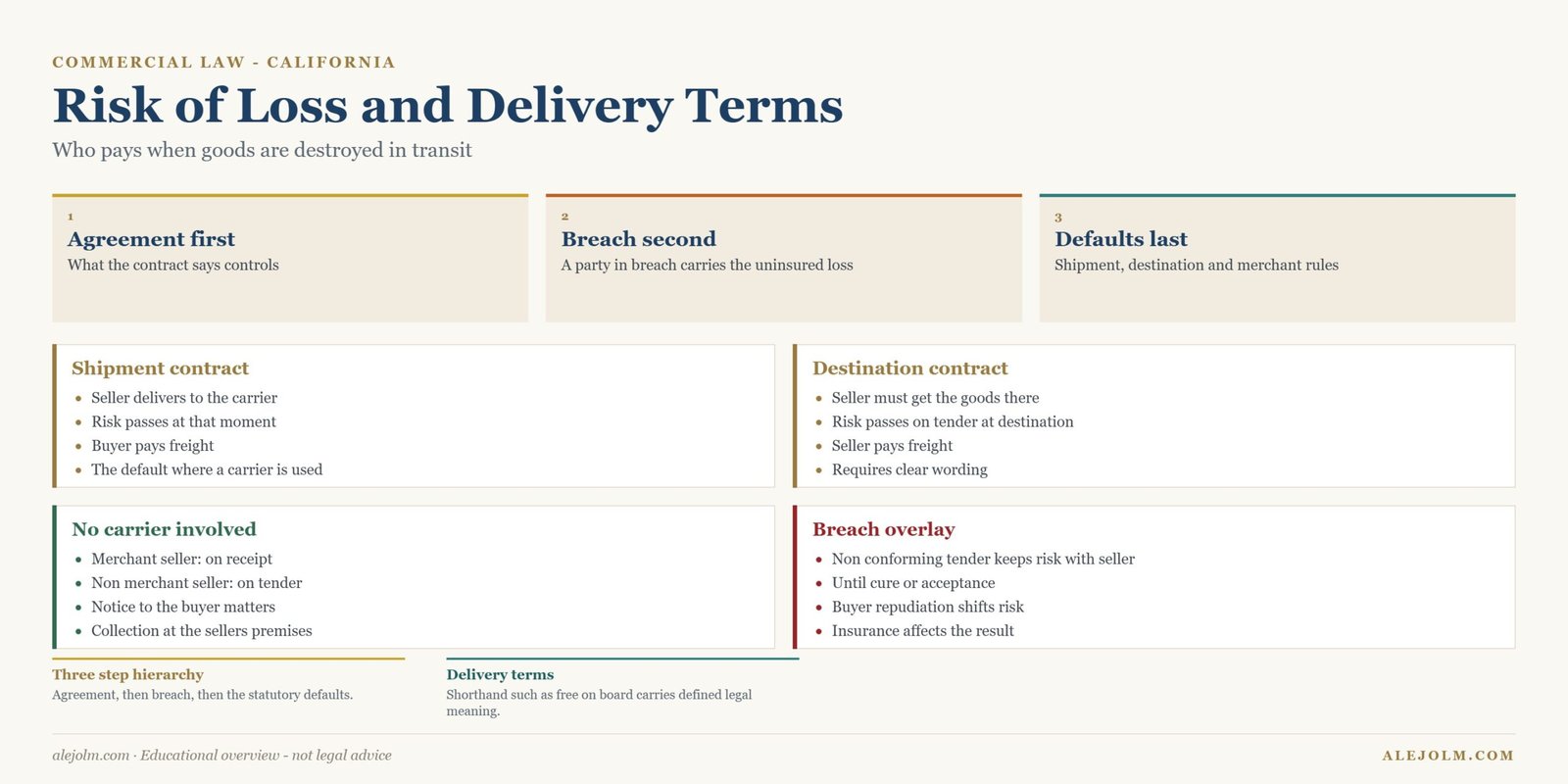
The analysis proceeds in a strict order. First, what did the parties agree. Second, was either party in breach, because a party in breach carries the uninsured loss regardless of what the default rules would say. Only then do the statutory defaults for shipment contracts, destination contracts and collections apply. This guide works through each stage.
Step one: the agreement
Parties are free to allocate risk as they wish, and most commercial contracts do so through delivery shorthand. A term placing delivery free on board at the seller location creates a shipment contract. The same term naming the buyer location creates a destination contract. Terms covering cost, insurance and freight allocate expense but generally leave the shipment risk rules in place.
Step two: the breach overlay
Where the seller tenders goods that do not conform, the risk remains on the seller until the defect is cured or the buyer accepts the goods despite it. That is true even if the loss has nothing to do with the defect. The mirror image applies to a buyer who repudiates or breaches after the goods have been identified to the contract: the seller may treat the risk as resting on the buyer for a commercially reasonable time, to the extent of any deficiency in the seller insurance.
Step three: the default rules
- Shipment contract. Risk passes when the seller duly delivers conforming goods to the carrier and gives any required notice.
- Destination contract. Risk passes when the goods are tendered at the named destination so the buyer can take delivery.
- Presumption. Where a carrier is used but the wording is unclear, a shipment contract is presumed.
- Merchant seller, no carrier. Risk passes when the buyer actually receives the goods.
- Non merchant seller, no carrier. Risk passes on tender of delivery, even before collection.
- Goods held by a bailee. Risk passes on acknowledgement of the buyer right to possession.
| Arrangement | Risk passes when | Freight paid by |
|---|---|---|
| Free on board seller location | Delivery to the carrier | Buyer |
| Free on board buyer location | Tender at destination | Seller |
| Merchant seller, buyer collects | Buyer takes receipt | Not applicable |
| Private seller, buyer collects | Tender of delivery | Not applicable |
| Goods in a warehouse | Bailee acknowledges the buyer right | As agreed |
A worked example
A furniture maker in Gardena sells a dining set on terms placing delivery free on board its own warehouse, and arranges shipment by a common carrier. It packs conforming goods properly, hands them to the carrier and notifies the buyer. The lorry is destroyed in transit. Because this is a shipment contract and the seller performed its obligations, the loss falls on the buyer, whose recourse lies against its insurer or the carrier.
Change the conformity. Suppose part of the consignment was the wrong grade. The tender was non conforming, so the risk stayed with the seller until cure or acceptance, and the seller bears the loss of the entire shipment even though the fire had nothing to do with the grading error.
Risk of loss in California and Los Angeles County in 2026
The volume of goods moving through the ports and warehouses of Los Angeles County makes this an intensely practical topic. Disputes typically arise where the paperwork is ambiguous about whether the seller was merely obliged to ship or was obliged to deliver, and where the parties assumed that whoever paid the freight also carried the risk. Those are separate questions.
Insurance practice matters as much as the legal default. Cargo cover, marine open policies and carrier liability limits determine who is genuinely out of pocket, and the statutory rule about the breaching party carrying the uninsured loss makes the extent of cover directly relevant to the outcome.
- State the delivery term precisely. Name the location as well as the shorthand.
- Do not equate freight with risk. They are allocated separately.
- Inspect promptly. A non conforming tender keeps risk with the seller only until acceptance.
- Insure to the point of transfer. Cover should overlap rather than leave a gap.
- Document the handover. Carrier receipts fix the moment of transfer.
- Check bailee acknowledgements. Warehouse goods transfer differently.
For 2026, confirm the current California authority on risk of loss, delivery terms and the effect of breach directly with current authority, since these continue to develop.
Common mistakes to avoid
- Assuming risk follows title. Ownership and risk are separate concepts under the Commercial Code.
- Skipping the breach step. It overrides the default rules entirely.
- Treating merchant status as always relevant. It matters only where no carrier is involved.
- Ignoring the shipment presumption. Ambiguous carrier terms default to shipment.
- Confusing payment terms with risk. Paying in advance does not keep the risk with the seller.
- Overlooking acceptance. Once goods are accepted the risk generally sits with the buyer.
Frequently asked questions
If I paid in advance, does the seller still bear the risk?
Not necessarily. Payment terms and risk allocation are independent, and in a shipment contract risk passes once conforming goods reach the carrier.
What does free on board actually mean?
It is a defined delivery term. Naming the seller location makes it a shipment contract; naming the buyer location makes it a destination contract, with corresponding freight and risk consequences.
Who bears the loss if the goods were defective?
The seller. A non conforming tender keeps the risk on the seller until the defect is cured or the buyer accepts the goods.
What if the goods are sitting in a warehouse?
Risk generally passes when the bailee acknowledges the buyer right to possession, or when the buyer receives a negotiable document of title.
Does insurance change the legal position?
It does not change who bears the risk, but the statutory rule about a breaching party carrying the uninsured loss means the extent of cover can determine the practical outcome.
Related guides
- The perfect tender rule
- The right to cure
- Revocation of acceptance
- Implied warranties
- Express warranties
- Damages for breach of contract
- Installment contracts
- The battle of the forms
Next steps
Before your next shipment, check that the delivery term, the insurance and the inspection process all transfer risk at the same point. Our guides to the perfect tender rule and the right to cure explain what happens when the goods arrive in the wrong condition.
For primary sources, read California Commercial Code section 2509 and the civil jury instructions published by the Judicial Council of California.