
Acceptance is the offeree manifestation of assent to the terms proposed, given in the manner the offer invites. California puts the point bluntly in the Civil Code: an acceptance must be absolute and unqualified, or it must accept precisely the terms that the offer allowed to be varied. Anything less is a counterproposal wearing the clothes of agreement.
That single sentence hides a great deal of practical difficulty. Who may accept, whether silence can ever do it, when assent takes effect, and what happens when a seller responds by shipping goods rather than by writing back are all questions with settled but counterintuitive answers. This guide works through each of them with California practice in mind.
The three requirements
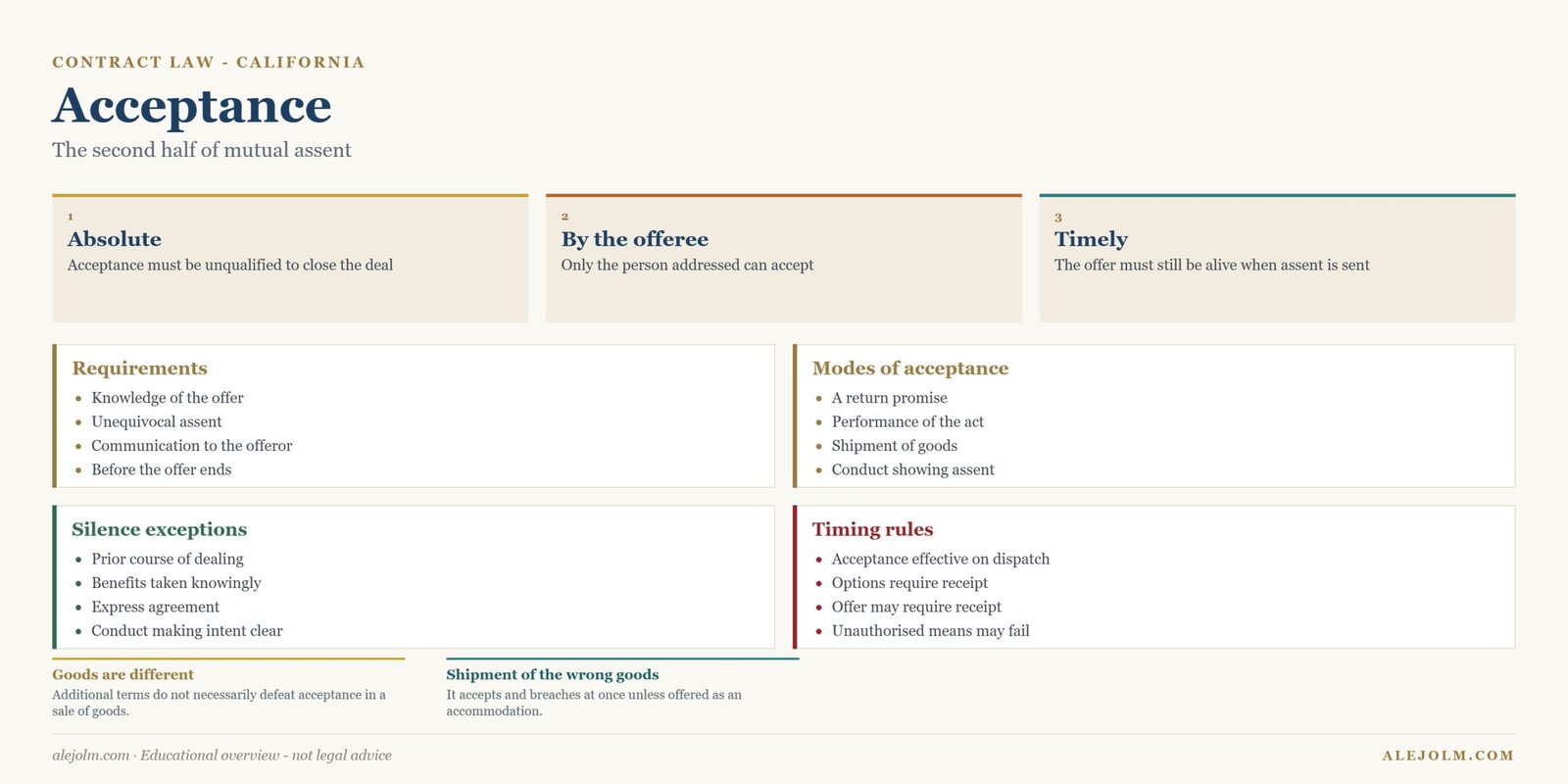
An acceptance must come from someone who knows of the offer, it must express agreement without equivocation, and it must be communicated to the offeror while the offer still stands. Each element is independently fatal. A person who performs the requested act without ever hearing of the offer has accepted nothing. A reply that agrees in principle while reserving a term has not accepted either.
Only the offeree may accept
An offer is personal to the person addressed and cannot be handed to someone else. The exception is an option supported by consideration, which is a contract in its own right and is generally assignable unless its terms say otherwise.
Absolute and unqualified
California requires the acceptance to be absolute. In a services, employment or land transaction a reply that changes any term, however small, is a counteroffer rather than an acceptance. The rule is unforgiving by design, and it protects an offeror who has taken care to specify what it is willing to do.
Silence, conduct and shipment
Silence is generally not acceptance. An offeror cannot manufacture a contract by announcing that it will treat no reply as agreement. Four situations qualify that principle: where a prior course of dealing gives silence a settled meaning, where the offeree takes the benefit knowing it is offered on terms, where the offeree conduct otherwise makes the intention to accept clear, and where the parties have expressly agreed that silence will bind.
- Course of dealing. Years of shipping on unanswered orders can make silence eloquent.
- Taking the benefit. Using goods with a reasonable chance to reject them signals assent.
- Express agreement. Parties may agree in advance that silence operates as acceptance.
- Shipment of conforming goods. In a sale of goods this is itself an acceptance.
- Shipment of the wrong goods. It accepts and breaches simultaneously.
- Accommodation notice. A prompt notice converts a non conforming shipment into a counteroffer.
| Reply | Common law result | Sale of goods result |
|---|---|---|
| Exact agreement | Contract formed | Contract formed |
| Agreement plus an extra term | Counteroffer | Usually a contract |
| Agreement conditional on new terms | Counteroffer | No contract on the writings |
| Shipment of conforming goods | Depends on the offer | Acceptance |
| Silence | Usually nothing | Usually nothing |
A worked example
A restaurant group in Santa Monica emails a produce supplier ordering a fixed weekly quantity at a stated price. The supplier does not reply but begins delivering the following Monday. In a sale of goods that shipment is an acceptance, and the contract is on the terms of the order. The absence of any letter changes nothing.
Change the subject matter. The same email engages a design consultancy for a stated fee, and the consultancy responds that it accepts but will begin a fortnight later than requested. Under the common law that reply is a counteroffer, no contract exists on the original terms, and the restaurant group is free to walk away or to accept the new date by conduct.
Acceptance in California and Los Angeles County in 2026
Electronic dealing has made the mechanics of acceptance both easier and more contentious. Los Angeles County courts routinely consider whether a click, a portal confirmation or a reply in a messaging thread amounted to unqualified assent, and California recognises electronic records and signatures for the purpose. What has not changed is the requirement that the assent be unambiguous and communicated.
Consumer facing businesses should expect close attention to how terms were presented. A design that requires an affirmative step next to a clear statement of what is being agreed is far more defensible than one that infers agreement from continued browsing or from a link in a footer.
- Make the assent step visible. An affirmative action beats an inference every time.
- Reply without adding terms. If you mean to accept, accept and negotiate separately.
- Watch the deadline. Assent must be sent before the offer lapses or is withdrawn.
- Use the invited method. An offer that specifies a channel should be answered through it.
- Confirm shipment acceptances. A short acknowledgement avoids arguments about what was agreed.
- Give accommodation notice promptly. Late notice will not save a non conforming delivery.
For 2026, confirm the current California authority on electronic assent, acceptance by conduct and shipment as acceptance directly with current authority, since these continue to develop.
Common mistakes to avoid
- Adding a term while meaning to accept. At common law this destroys the offer.
- Relying on silence. Outside the narrow exceptions it accepts nothing.
- Applying the dispatch rule to an option. Acceptance of an option must usually be received in time.
- Assuming any channel will do. An offer may prescribe how assent must be given.
- Ignoring the knowledge requirement. Performance in ignorance of the offer is not acceptance.
- Forgetting that the wrong goods still accept. The seller becomes both party and breaching party.
Frequently asked questions
Can I accept an offer by starting work?
Often yes. Beginning the requested performance can be acceptance where the offer invites it, and in a sale of goods a prompt shipment of conforming goods accepts the order.
Does an acceptance have to be in writing?
Only where a writing requirement applies to the underlying contract or where the offer itself demands one. Otherwise oral or electronic assent is effective.
When exactly does the contract form?
Generally when the acceptance is dispatched by an authorised means. An option is the main exception, since acceptance there usually must be received within the option period.
Is an acknowledgement of order an acceptance?
It depends on what it says. A document that confirms the deal is an acceptance; one that expressly conditions agreement on new terms is not.
Can someone else accept on my behalf?
An authorised agent can, but a stranger cannot. Offers are personal to the offeree unless the offer or an option says otherwise.
Related guides
- What counts as an offer
- The mirror image rule
- The battle of the forms
- The mailbox rule
- Revocation and rejection
- Contract formation in California
- Unilateral and bilateral contracts
- The perfect tender rule
Next steps
If you are unsure whether your reply closed a deal or reopened negotiations, read it beside the offer and mark every difference. Our guides to the mirror image rule and the battle of the forms explain what each difference does.
For primary sources, read California Civil Code section 1585 and the civil jury instructions published by the Judicial Council of California.