
An offer is a manifestation of present willingness to be bound, made in terms definite enough to be enforced and communicated to an identified offeree. It hands the offeree a power: the power to close the deal simply by saying yes. Nothing that falls short of that, however enthusiastic, creates the same power.
California insists that the parties agree upon the same thing in the same sense, and it measures that agreement by what a reasonable person would have understood. This guide explains the three requirements of a valid offer, why most advertising is not an offer, the narrow exception that flips a promotion into a binding commitment, the five ways an offer terminates, and the four situations in which it cannot be withdrawn.
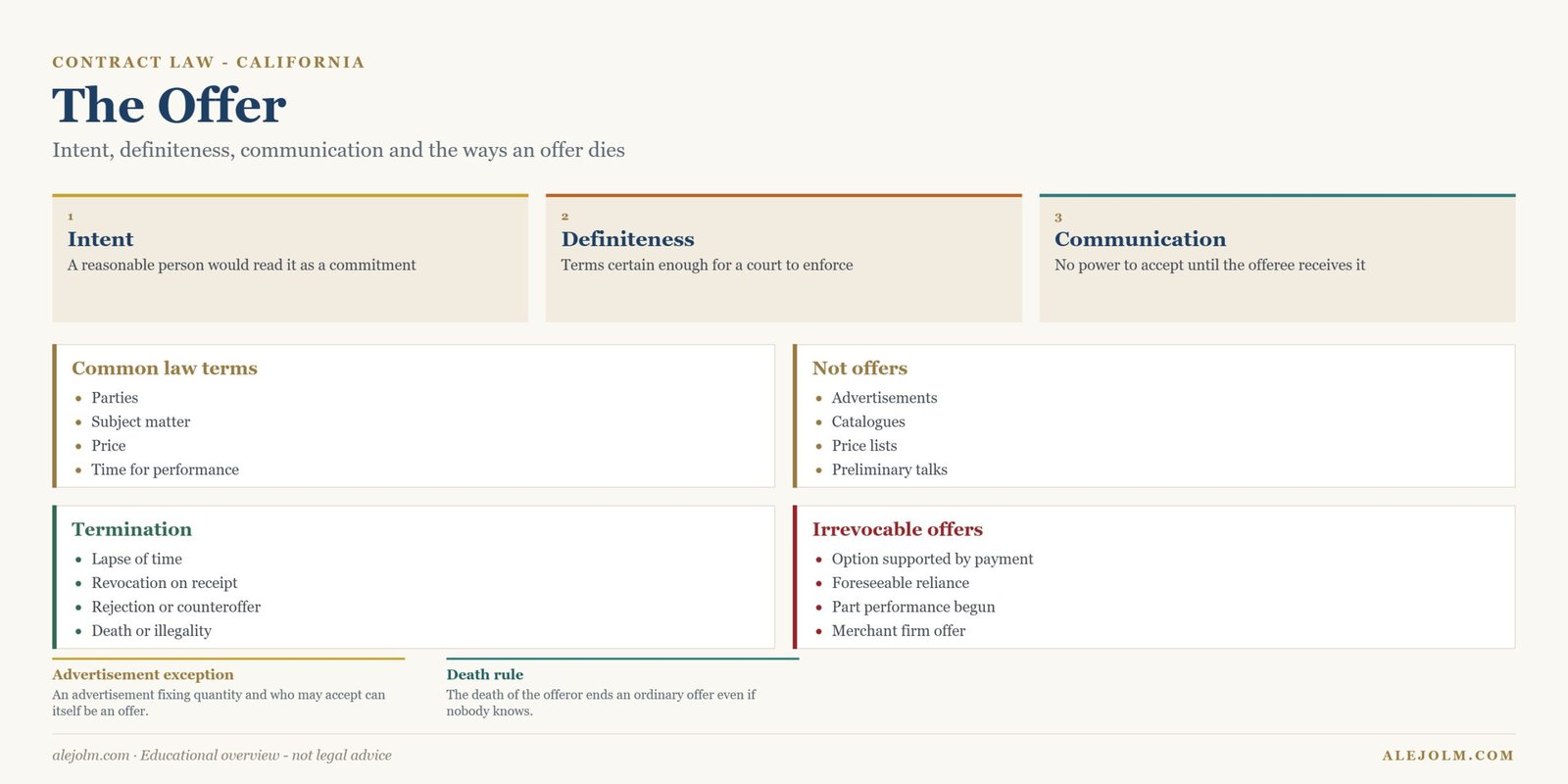
The three requirements
Present intent to be bound
The test is objective. A court asks whether a reasonable person in the position of the offeree would have understood that assent would conclude the bargain. Words spoken in jest, in anger or in the course of exploratory negotiation usually fail, not because the speaker did not mean them but because no reasonable listener would treat them as a commitment. Conversely, a party who signs a document cannot later rely on a private reservation.
Definite and certain terms
At common law California expects the parties, the subject matter, the price and the time for performance to be identifiable. Language such as a fair price or an appropriate amount, standing alone, generally will not do. For a sale of goods the Commercial Code is far more forgiving, treating quantity as the term that must be fixed and supplying a reasonable price, time and place where the parties left gaps. Real property offers require the parcel to be identified precisely, and an employment offer without a stated term leaves the relationship terminable at will.
Communication to the offeree
An offer is inert until it reaches the person who is to accept it. A person who performs the requested act without ever learning of the offer has not accepted anything, which is why reward cases so often turn on whether the claimant had read the notice before acting.
Advertisements and price quotations
The default rule is that advertising invites offers rather than making one. A shop that publishes a price list is not promising to sell to every reader, and a supplier who circulates a quotation is usually inviting a purchase order. Two exceptions matter. Reward notices are genuine offers, accepted by performing the act. And a promotion that fixes both the quantity available and precisely who may accept can cross the line into a binding offer, because at that point it no longer risks unlimited exposure.
- Quantity stated. A specific number of units signals commitment rather than invitation.
- Acceptors identified. Language limiting the deal to the first named number of customers narrows the exposure.
- Clear price and time. A stated price and a stated window support an offer reading.
- Words of commitment. Phrases promising to sell carry more weight than promotional adjectives.
- No reservation. Wording that reserves the right to refuse points back to invitation.
- Context. A trade circular sent to one buyer reads differently from a mass mailing.
| Communication | Effective when | Effect on the offer |
|---|---|---|
| Offer | Received | Creates power to accept |
| Revocation | Received | Ends the power to accept |
| Rejection | Received | Ends the power to accept |
| Counteroffer | Received | Rejects and proposes anew |
| Acceptance | Dispatched | Forms the contract |
A worked example
A gallery owner in Culver City writes to a collector offering a named painting for a stated sum, the offer to remain open until the end of the month. Before the collector replies the owner telephones to say the painting has been sold elsewhere. The offer is revoked from the moment the collector hears it, and a purported acceptance the next day is merely a new offer the gallery may ignore.
Change the consideration. Suppose the collector had paid one hundred dollars for the promise to keep the offer open. That payment creates an option, the offer is irrevocable for the stated period, and the mid month telephone call has no effect at all. The same words produce opposite outcomes because one version was bought and the other was not.
Offers in California and Los Angeles County in 2026
Los Angeles County disputes about offers cluster in real estate and construction. Residential purchase offers are made on standard forms with express expiry times, and the timing of delivery of a revocation regularly decides whether a deal exists. In construction, subcontractor bids submitted to general contractors are the classic reliance scenario: once the general has used the number in its own bid, the subcontractor faces a strong argument that the quotation cannot be withdrawn.
California also recognises indirect revocation. If the offeree learns from a reliable source that the subject matter has been sold, the offer is gone even though the offeror never sent a formal withdrawal. Rumour is not enough; the information must give reasonable grounds for belief.
- Put an expiry on every offer. A stated deadline avoids arguments about a reasonable time.
- Deliver revocations provably. Effectiveness depends on receipt, so use a method that records it.
- Price your options. Consideration converts a promise to hold open into an enforceable one.
- Treat bids with care. Reliance by a general contractor can freeze a subcontractor quotation.
- Identify real property precisely. A vague description defeats definiteness.
- State employment duration. Silence leaves the relationship terminable at will.
For 2026, confirm the current California authority on offer definiteness, revocation and reliance on bids directly with current authority, since these continue to develop.
Common mistakes to avoid
- Treating every advertisement as an offer. Most are invitations to deal.
- Reading negotiation as commitment. Exploratory language does not create a power of acceptance.
- Applying common law definiteness to goods. The Commercial Code fills most gaps.
- Assuming a promise not to revoke binds. Without consideration or a statutory basis it usually does not.
- Overlooking the death rule. An ordinary offer ends when the offeror dies, known or not.
- Ignoring receipt. An unsent or undelivered revocation changes nothing.
Frequently asked questions
Is a price quotation an offer?
Usually not. A quotation ordinarily invites a purchase order, although wording that commits to supply a stated quantity at a stated price for a stated period can amount to an offer.
How long does an offer last?
For any period the offer states, and otherwise for a reasonable time judged by the subject matter, the market and the parties dealings.
Can an offer be withdrawn after it has been posted?
Yes, provided the withdrawal reaches the offeree before acceptance is dispatched and no ground of irrevocability applies.
Does an offeree have to reply?
No. Silence is generally not acceptance, and an offeror cannot impose a duty to respond by declaring that silence will bind.
What makes an offer irrevocable?
A paid option, foreseeable and detrimental reliance, the beginning of performance under a unilateral offer, or a signed merchant assurance in a sale of goods.
Related guides
- Acceptance in contract law
- Revocation and rejection
- The firm offer rule
- The mirror image rule
- The mailbox rule
- Contract formation in California
- Unilateral and bilateral contracts
- Promissory estoppel
Next steps
If you are trying to work out whether a deal closed, start by isolating the offer and dating every communication. Our guides to acceptance and revocation and rejection complete the timeline.
For primary sources, read California Civil Code section 1580 and the civil jury instructions published by the Judicial Council of California.