
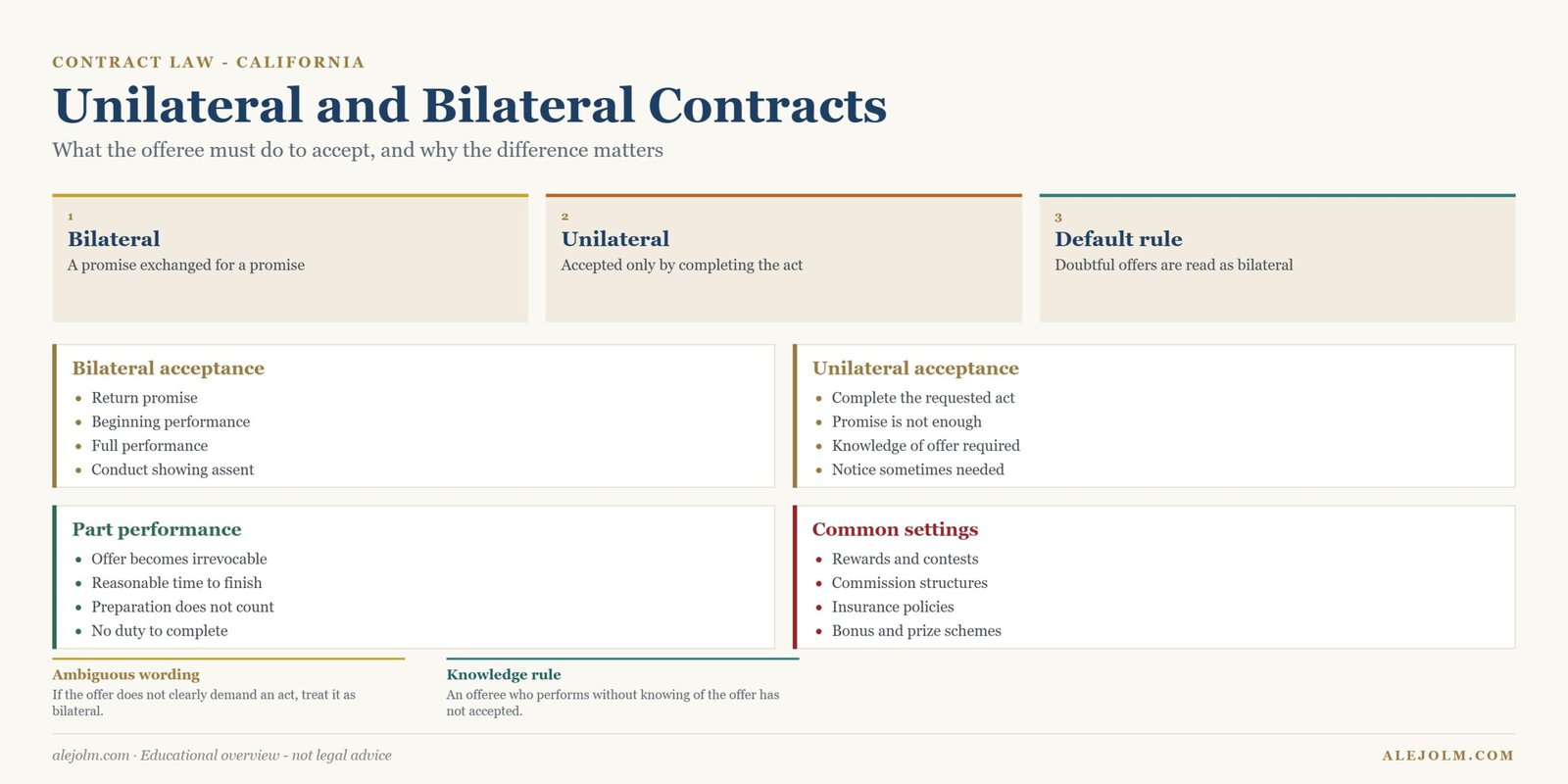
A unilateral contract can be accepted only by completing the act the offeror requested, while a bilateral contract is formed the moment promises are exchanged. The distinction sounds academic until an offeror tries to withdraw a reward halfway through the search, or a salesperson is dismissed the day before a commission would have vested. Then it decides who owes what.
California treats the bilateral form as the default and reads doubtful offers as inviting acceptance either by promise or by performance. This guide sets out how each type is formed, what happens when performance has begun but not finished, how the Civil Code treats acceptance by performance, and how California and Los Angeles County courts approach rewards, commissions and bonus schemes.
Bilateral contracts: promise for promise
In a bilateral contract each side commits to future performance. A supplier promises to deliver, a buyer promises to pay, and both obligations exist from the moment of acceptance. Nearly every commercial agreement in California is bilateral, which is why the default reading of an ambiguous offer is that a return promise will do.
Because the offer invites either mode of acceptance, an offeree can also accept a bilateral offer by starting to perform. Beginning work implies a promise to complete it, and the contract forms at that point rather than at completion.
Unilateral contracts: act for promise
A unilateral offer asks for something narrower. It says, in effect, that only the doing of the specified act will count. Reward notices, prize competitions and some commission and bonus arrangements fit this pattern. A promise to look for the lost dog is worthless; producing the dog is everything.
Part performance and the revocation problem
The obvious unfairness of a unilateral offer is that the offeror could withdraw it when the offeree is nearly finished. Modern doctrine solves this by making the offer irrevocable once the offeree has begun the invited performance, giving a reasonable time to complete. The offeree is not obliged to finish, but the offeror can no longer walk away.
- Preparation is not performance. Buying equipment or clearing a diary does not lock the offer open.
- Commencement does lock it. Once the requested act is genuinely under way, revocation is ineffective.
- No duty to complete. The offeree may abandon the effort without liability.
- Acceptance occurs at completion. The contract forms when the act is finished, not when it starts.
- Knowledge of the offer is essential. Someone who performs in ignorance of a reward cannot claim it afterwards.
- Notice may be required. If the offeror would not naturally learn of completion, the offeree should say so promptly.
| Question | Bilateral | Unilateral |
|---|---|---|
| How is it accepted | Promise, or performance | Complete performance only |
| When does it form | On the return promise | On completion of the act |
| Effect of starting work | Contract already formed | Offer becomes irrevocable |
| Can the offeree be sued | Yes, for non-performance | No, until the act is done |
| Typical example | Supply agreement | Reward notice |
A worked example
A property owner in Pasadena posts a notice offering two thousand dollars to anyone who locates and returns a missing sculpture. A neighbour who has read the notice spends a weekend searching, traces the piece to a dealer and delivers it. That is a classic unilateral acceptance: the act was requested, the act was performed, and the reward is owed.
Change the knowledge. A second neighbour who has never seen the notice happens to recover the sculpture and hands it back out of goodwill, only learning of the reward afterwards. Because acceptance requires that the offeree be responding to the offer, no contract formed and the reward is not owed. The act was identical; only awareness differed.
Unilateral and bilateral contracts in California and Los Angeles County in 2026
The practical battleground in California is employment. Commission plans, retention bonuses and incentive schemes are frequently drafted in unilateral terms, and disputes turn on whether the employee had begun the qualifying performance before the plan was withdrawn or the employment ended. Los Angeles County courts see a steady flow of these claims from sales, entertainment and technology employers.
The Civil Code expressly recognises that performing the conditions of a proposal is an acceptance of the proposal, which supplies the statutory anchor for unilateral analysis in California. Employers who wish to retain flexibility must say so clearly and prospectively rather than after performance has begun.
- Read the operative verb. Offers that say if you do rather than if you agree point towards a unilateral reading.
- Fix the qualifying event. Well drafted plans state exactly when a commission is earned.
- Reserve amendment rights in advance. Changes announced mid-performance are vulnerable.
- Record awareness. Acknowledgement forms defeat later claims that the scheme was unknown.
- Mind wage protections. Earned commissions are wages and carry statutory consequences.
- Keep reward notices precise. State the act, the deadline and the amount without ambiguity.
For 2026, confirm the current California authority on acceptance by performance and commission forfeiture directly with current authority, since these continue to develop.
Common mistakes to avoid
- Treating commencement as acceptance. Starting a unilateral performance makes the offer irrevocable but does not form the contract.
- Assuming bilateral offers cannot be accepted by conduct. They usually can, and often are.
- Forgetting the knowledge requirement. Performance in ignorance of the offer is a gift, not an acceptance.
- Confusing preparation with performance. Only the invited act triggers irrevocability.
- Applying illusory promise analysis to a unilateral offer. The offeree makes no promise, so the doctrine has nothing to bite on.
- Reading ambiguity as unilateral. The default runs the other way.
Frequently asked questions
Is a job offer unilateral or bilateral?
Usually bilateral, because the employer invites the candidate to accept by agreeing. Wording that conditions the deal on actually starting work can push it towards a unilateral reading.
Can an offeror revoke a reward once someone starts searching?
Not effectively once the invited performance has genuinely begun. The offer stays open for a reasonable time so the offeree can finish.
Does the offeree have to tell the offeror they are performing?
Only where the offeror would not otherwise learn of completion with reasonable promptness. Returning lost property in person supplies its own notice.
What if two people complete the act?
The first to complete performance accepts the offer. A well drafted notice states this expressly to avoid competing claims.
Are commission plans unilateral contracts?
Many are drafted that way, conditioning payment on completing a sale. Whether a commission has been earned depends on the plan wording and on California wage protections.
Related guides
- What counts as an offer
- Acceptance in contract law
- The firm offer rule
- Revocation and rejection
- Illusory promises
- The mailbox rule
- Contract formation in California
- Employment at will and fixed terms
Next steps
If you are drafting an incentive scheme or evaluating a withdrawn reward, start by identifying the mode of acceptance the offer actually invites. Our guides to offers and acceptance work through the wording that decides the point.
For primary sources, read California Civil Code section 1584 and the civil jury instructions published by the Judicial Council of California.