
Defense of property allows a possessor of land or goods to use reasonable force to protect them rather than waiting to sue. It is a genuine privilege, but a tightly drawn one, and the boundary is the point where force becomes capable of killing.
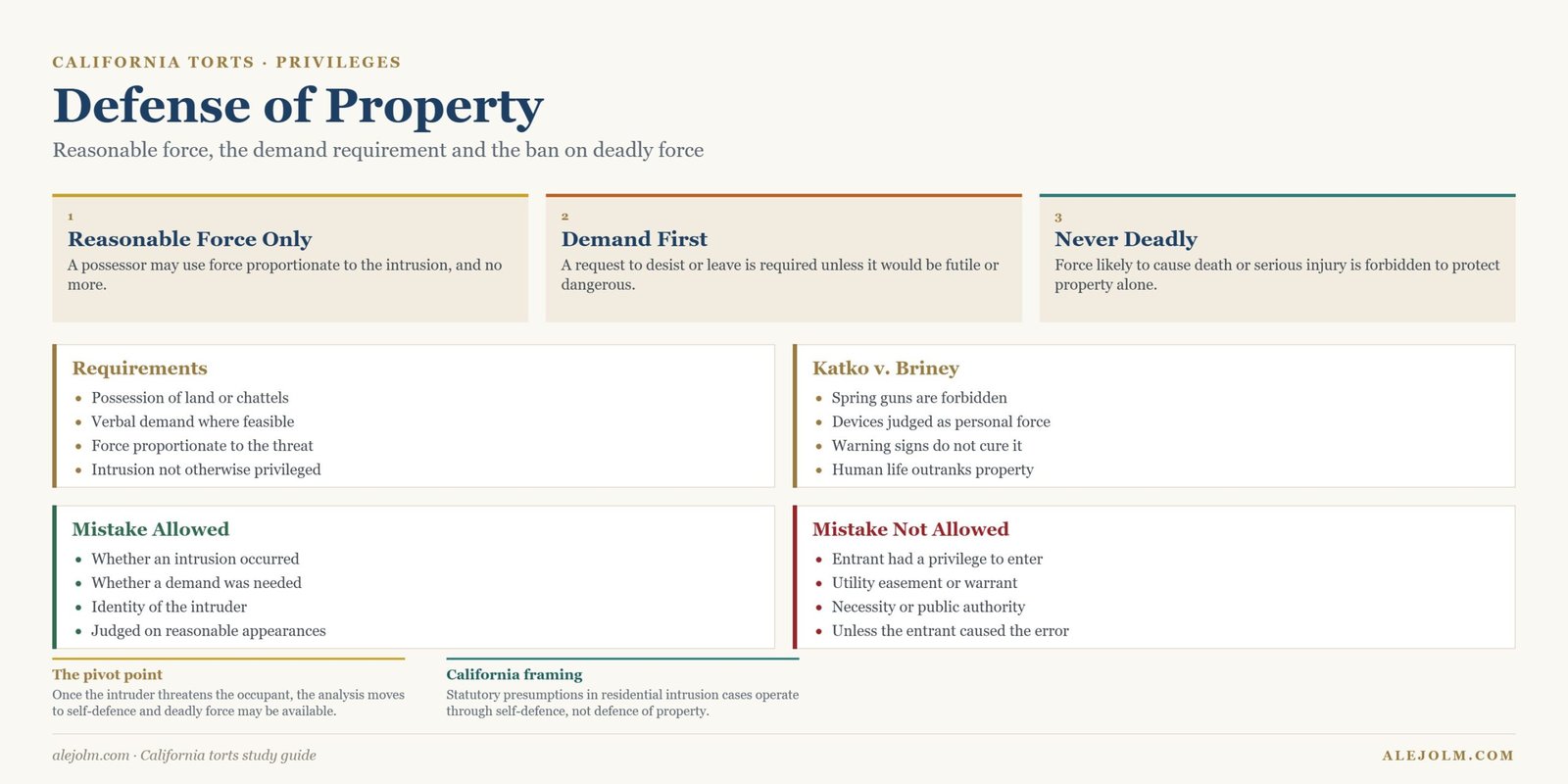
Three rules do nearly all the work. A demand to desist must ordinarily come first, the force must be proportionate, and deadly force is never available to protect property alone. The last of those is absolute, and the reason is a value judgement the law makes openly: a human life, including a wrongdoer life, is worth more than a building.
The demand requirement
Before using force, the possessor must generally ask the intruder to stop or to leave. It is the property equivalent of exhausting the milder option first. The requirement is excused where a demand would be futile, as where a thief is already running off with the goods, or where making it would itself invite violence, as where the intruder is armed and unaware of the occupant presence.
Proportionality
Force must match the intrusion. Removing a persistent trespasser by taking hold of an arm is proportionate. Breaking a jaw is not. The privilege authorises the amount of force reasonably necessary to prevent or terminate the interference, and anything beyond that converts the defender into a defendant in battery.
The prohibition on deadly force
No amount of property value justifies force likely to cause death or serious bodily harm when only property is at stake. The rule is best known from Katko v. Briney, in which a homeowner rigged a shotgun to fire at anyone opening a door in an unoccupied farmhouse. The intruder was a trespassing thief, and the homeowner was still liable. The reasoning is straightforward: the law will not permit a person to protect empty property at the cost of a life.
Mechanical devices
Spring guns, booby traps, electrified fences calibrated to injure and similar devices are treated as though the possessor had personally applied that level of force. Because the possessor could not lawfully shoot a trespasser in person, the device cannot do it either. A posted warning does not cure the problem. A device can only ever be used where the force it applies would have been lawful if delivered by hand.
The pivot to self-defence
Everything changes when the intruder threatens the occupant. At that moment the case leaves defence of property altogether and becomes self-defence, where deadly force is available under the ordinary imminence and proportionality rules. Problems in this area are usually built around the exact instant of that transition, and identifying it correctly is the whole exercise.
Mistake: an asymmetric rule
Reasonable mistake helps the possessor on some questions and not on others, and the asymmetry is worth learning precisely.
| Mistaken about | Privilege preserved? |
|---|---|
| Whether an intrusion or tort was occurring | Yes, if the belief was reasonable |
| Whether a demand was necessary | Yes, if the belief was reasonable |
| Whether the entrant had a privilege to enter | No, the possessor loses |
| Privilege caused by the entrant own conduct | Yes, the possessor is protected |
The reason for the exception is that privileges to enter exist to be exercised. A meter reader with an easement, a process server, an officer with a warrant, and a person acting under necessity are all entitled to be there, and the possessor good faith does not override that entitlement. If the entrant caused the confusion, by concealing their authority for instance, the possessor is protected.
A worked example
A shopkeeper sees a customer walking out with an unpaid item and grabs the bag. The demand requirement is satisfied because a demand would have been futile with the customer already through the door, and taking hold of a bag is proportionate. Suppose instead the shopkeeper tackles the customer to the ground and holds them there for twenty minutes awaiting police. Force has become disproportionate and the detention raises false imprisonment, mitigated only by the separate shopkeeper privilege.
Defense of Property in California and Los Angeles County in 2026
California follows the general framework and enforces the prohibition on deadly force in defence of property. The state also prohibits deadly mechanical devices, so the spring gun analysis is the same. What California adds is a statutory structure around residential intrusion that operates through self-defence rather than property, creating a presumption that a resident who uses force against someone unlawfully and forcibly entering a residence held a reasonable fear of imminent peril. That presumption is about protecting people in the home, not about protecting the home itself.
The practical Los Angeles County disputes involve retail loss prevention, private security at licensed premises and events, landlord self-help against tenants, and vehicle repossession. In each of them the possessor privilege is narrower than the client expects. Self-help eviction is prohibited outright, and repossession that breaches the peace loses its statutory protection.
- No deadly force. Property alone never justifies force likely to cause death or serious bodily injury.
- No deadly devices. Traps are judged as if the possessor had used that force personally, warning sign or not.
- Residential presumption. Penal Code section 198.5 operates through self-defence where a person forcibly and unlawfully enters a residence.
- No self-help eviction. A landlord must use judicial process; locking out or removing a tenant is unlawful.
- Repossession. Retaking secured property is permitted only without a breach of the peace.
- Shopkeeper privilege. Merchants have a separate statutory privilege to detain briefly on reasonable cause, which is not the same as defending property.
For 2026, confirm the current California authority on the residential intrusion presumption, merchant detention practice and repossession standards directly with current authority, since these continue to develop.
Common mistakes to avoid
- Allowing deadly force for valuable property. The prohibition does not scale with value.
- Approving traps with warning signs. A notice does not legitimise a device the owner could not use in person.
- Skipping the demand. Force before any request to desist exceeds the privilege unless a demand was futile or dangerous.
- Missing the pivot to self-defence. A threat to the person changes the applicable rules entirely.
- Assuming mistake always helps. Being wrong about an entrant privilege destroys the defence.
- Confusing it with recapture. Retaking a chattel already lost is a separate privilege with its own requirements.
Frequently asked questions
Can you use force to remove a trespasser?
Yes, reasonable force, and generally only after asking the person to leave. The amount permitted is what is reasonably necessary to end the intrusion and no more.
Can deadly force ever protect property?
No. Force likely to cause death or serious bodily harm is never privileged to protect property alone. It becomes available only if the situation turns into a threat to a person.
Are spring guns and booby traps legal?
No. Mechanical devices are treated as if the possessor personally applied the force, so a device that could kill or seriously injure is unlawful even against a burglar and even where warnings are posted.
What if the intruder had a right to be there?
The privilege fails. A mistaken belief about an entrant legal privilege, however reasonable, does not preserve the defence unless the entrant caused the mistake.
Do you have to warn before using force?
Generally yes. A demand to desist or leave is required unless it would plainly be futile or would expose the possessor to danger.
Related guides
- Self-Defense in Tort Law: Reasonable and Deadly Force
- Defense of Others: Reasonable Belief and Force Limits
- Trespass to Land in California: Elements and Remedies
- Trespass to Chattels: Elements, Damages and Conversion
- False Imprisonment in California: Elements and Defenses
- Battery in Tort Law: Elements, Defenses and Damages
- Conversion in Tort Law: California Elements and Remedies
- Premises Liability in California and Los Angeles County
Next steps
Read our guide to self-defence for the framework that takes over the moment a person is threatened, then trespass to land, the tort this privilege answers.
For primary sources, read California Penal Code section 198.5 and the justification instructions published by the Judicial Council of California.