
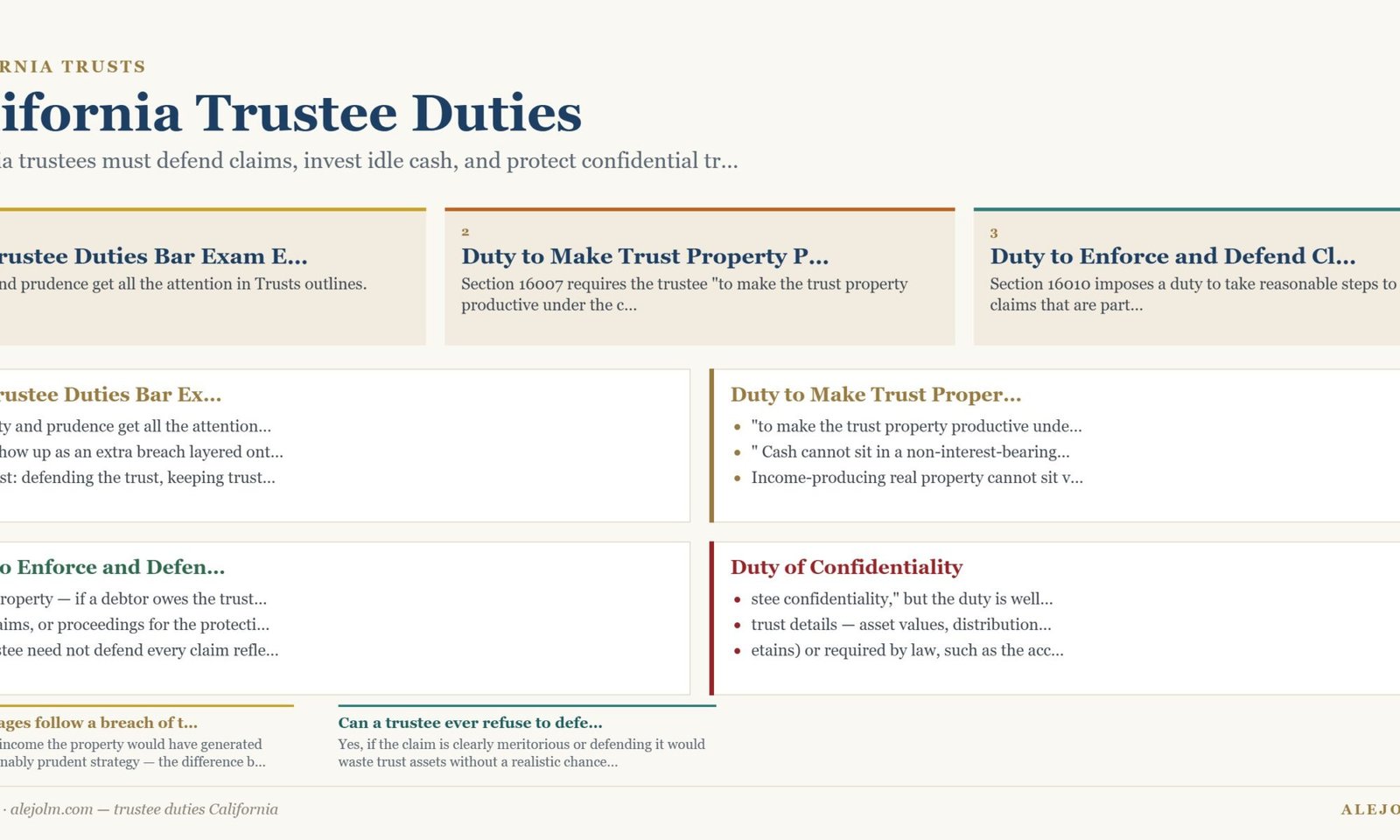
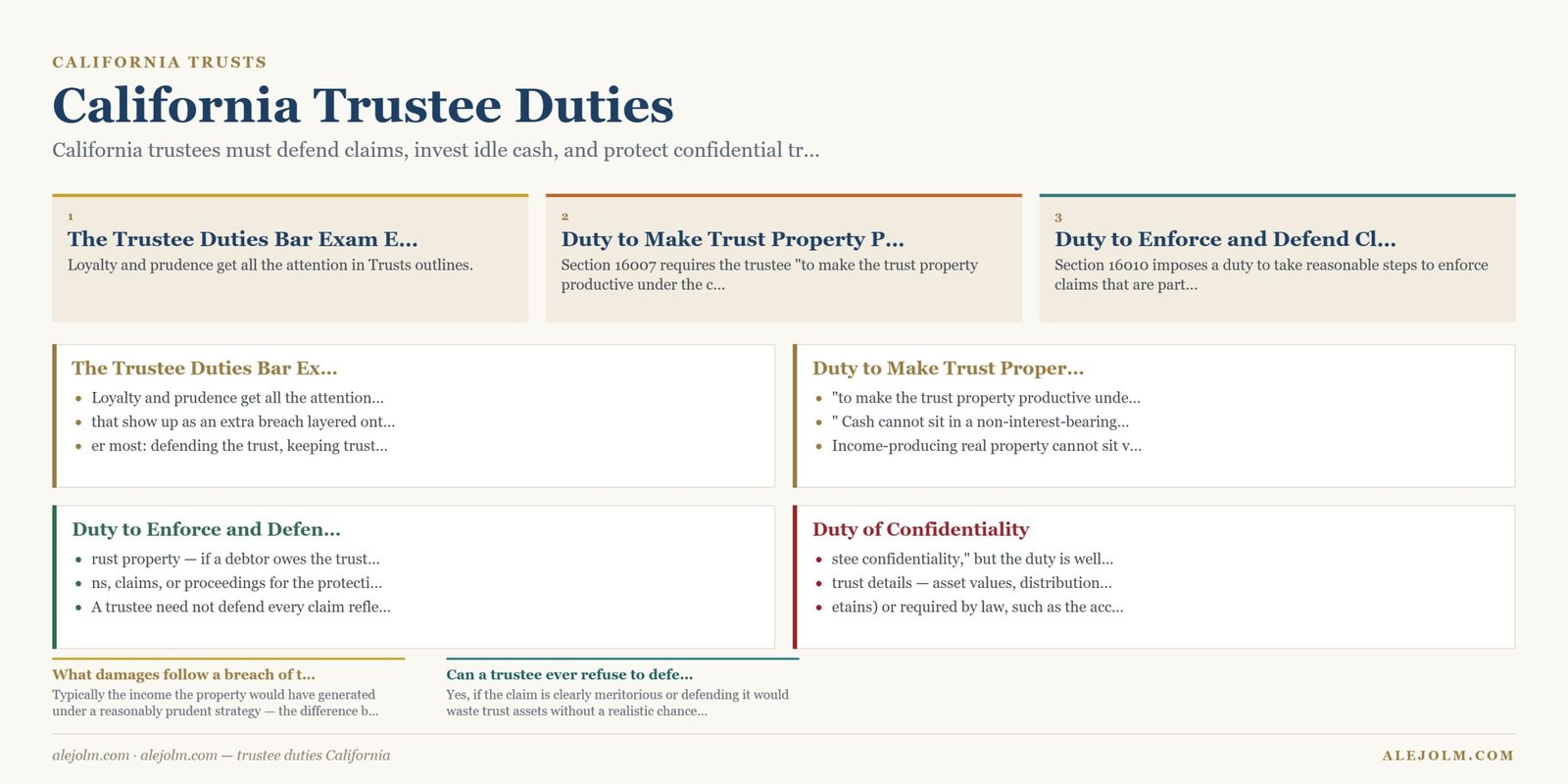
The Trustee Duties Bar Exam Essays Love to Bury
Loyalty and prudence get all the attention in Trusts outlines. But California’s Probate Code imposes several smaller, easy-to-miss duties that show up as an extra breach layered onto a bigger fact pattern — and graders reward students who spot them. Three matter most: defending the trust, keeping trust property productive, and protecting confidential trust information.
A California trustee must defend the trust against adverse claims, keep trust property productive rather than idle, and keep trust information confidential except where disclosure is necessary for administration or required by law — obligations rooted in Probate Code §§ 16006, 16007, 16010, and 16249.
Duty to Make Trust Property Productive (Prob. Code § 16007)
Section 16007 requires the trustee “to make the trust property productive under the circumstances and in furtherance of the purposes of the trust.” Cash cannot sit in a non-interest-bearing account indefinitely. Income-producing real property cannot sit vacant or unmanaged. Related is § 16006, which requires the trustee to take reasonable steps to take, keep control of, and preserve trust property in the first place — you cannot make property productive that you have not even secured.
The standard is reasonableness, not maximization. A trustee is not liable for earning a modest, prudent return instead of chasing the highest possible yield. The breach is leaving property entirely idle or unmanaged — not investing conservatively. Damages for breach are typically measured by the income a prudently invested portfolio would have generated.
Duty to Enforce and Defend Claims (Prob. Code §§ 16010, 16249)
Section 16010 imposes a duty to take reasonable steps to enforce claims that are part of trust property — if a debtor owes the trust money, the trustee cannot simply let the statute of limitations run. On the flip side, § 16249 empowers the trustee to prosecute or defend actions, claims, or proceedings for the protection of the trust and the trustee’s own performance of trustee duties.
A trustee need not defend every claim reflexively. If a claim is clearly meritorious, or defending it would waste trust assets on a losing fight, declining to defend can be reasonable. But ignoring a plainly defensible claim — letting a default judgment enter because no one bothered to respond — is a breach that can lead to surcharge for the resulting loss.
Duty of Confidentiality
California’s Probate Code does not contain one single statute labeled “trustee confidentiality,” but the duty is well established as part of the trustee’s general fiduciary obligations. The trustee cannot broadcast sensitive trust details — asset values, distribution amounts, a beneficiary’s financial troubles — to the world at large. Disclosure is permitted only where necessary for administration (to accountants, attorneys, and advisors the trustee properly retains) or required by law, such as the accounting and notice obligations found in Probate Code §§ 16060–16069.
That last point is worth remembering: California does require a trustee to keep beneficiaries reasonably informed under § 16060, and that duty of disclosure to beneficiaries is the mirror image of — not an exception to — the trustee’s duty to keep information confidential from everyone else.
| Duty | Statutory anchor | What triggers a breach |
|---|---|---|
| Make property productive | Prob. Code § 16007 (see also § 16006) | Idle cash, unmanaged income property |
| Enforce/defend claims | Prob. Code §§ 16010, 16249 | Letting a defensible claim default; failing to collect trust debts |
| Confidentiality | General fiduciary duty; contrast Prob. Code § 16060 (duty to inform beneficiaries) | Disclosing sensitive trust details without necessity or legal requirement |
Worked Example
Trustee David administers a California trust holding $250,000 in cash and a rental duplex. David leaves the cash in a checking account earning no interest for three years and lets the duplex sit vacant rather than finding a tenant. Separately, an ex-spouse of one of the beneficiaries files a facially meritless lawsuit against the trust, and David ignores it, resulting in a default judgment. Finally, David mentions a beneficiary’s ongoing bankruptcy at a neighborhood dinner party.
Each fact is a separate breach: the idle cash and vacant duplex breach § 16007’s duty to make trust property productive; the ignored lawsuit breaches the duty to defend under § 16249; and the dinner-party disclosure breaches the duty of confidentiality, since it was neither necessary for administration nor legally required. On an essay, David is exposed to surcharge for the lost income, the default judgment amount, and potentially removal as trustee.
Common Mistakes to Avoid
- Overlooking these duties entirely. They rarely anchor a whole essay question but often ride along with a bigger self-dealing or imprudent-investment fact pattern. Scan every fact pattern for idle cash, an undefended claim, or loose talk about trust affairs.
- Thinking “productive” means “maximized.” The duty requires reasonable investment, not the highest possible return.
- Assuming every claim must be defended. A meritorious claim, or one not worth the cost of defense, need not be fought.
- Believing confidentiality is absolute. Disclosure to professionals assisting with administration, or disclosure required by law (including § 16060 notices to beneficiaries), is not a breach.
Frequently Asked Questions
What damages follow a breach of the duty to make trust property productive?
Typically the income the property would have generated under a reasonably prudent strategy — the difference between actual returns and what a prudent trustee would have earned.
Can a trustee ever refuse to defend a lawsuit against the trust?
Yes, if the claim is clearly meritorious or defending it would waste trust assets without a realistic chance of success; the duty under § 16249 is to defend defensible, economically justified claims, not every claim filed.
Does the duty of confidentiality apply to the settlor as well as the beneficiaries?
Yes — the duty generally runs to both the settlor and the beneficiaries, meaning the trustee should not disclose sensitive trust information to unrelated third parties outside the recognized exceptions.
Key Takeaways
- Prob. Code § 16007 (with § 16006) requires trustees to keep trust property productive, not maximized — idle cash and vacant income property are breaches.
- Prob. Code §§ 16010 and 16249 impose duties to enforce trust claims and to defend the trust against defensible adverse claims.
- Confidentiality is a core fiduciary obligation, limited by the trustee’s disclosure duties to beneficiaries under § 16060 and by legal requirements.
- These ancillary duties frequently appear as additional, easy-to-miss breaches layered onto a bigger fact pattern.
- Always ask whether cash is sitting idle, a claim went undefended, or trust information leaked without necessity — three quick extra points on a California bar essay.
This article is educational and is not legal advice. Consult a licensed California attorney about your situation.
Related guides
- trustee duties
- rule against perpetuities
- trustee’s tort liability to third parties
- trustee’s contract liability to third parties