
Specific Intent vs. General Intent Crimes in California
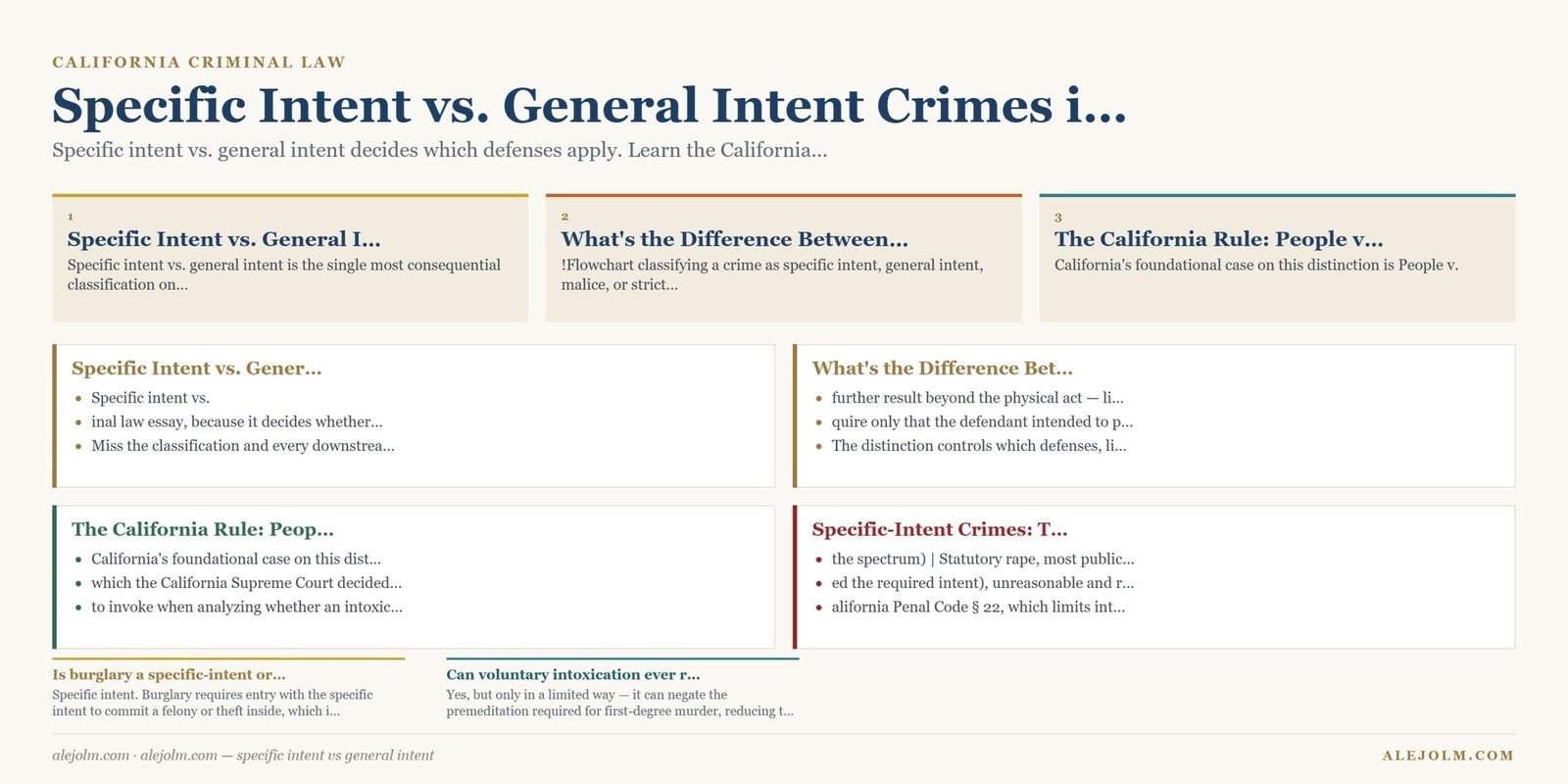
Specific intent vs. general intent is the single most consequential classification on a California criminal law essay, because it decides whether voluntary intoxication or mistake of fact even gets you in the door. Miss the classification and every downstream defense argument collapses, no matter how well-reasoned.
The good news: the test is mechanical once you memorize it. Specific-intent crimes require proof of a further mental purpose beyond the act itself; general-intent crimes require only that the defendant meant to do the act, or was aware of acting recklessly with respect to it.
What’s the Difference Between Specific and General Intent?
Specific intent crimes require the defendant to intend a particular further result beyond the physical act — like intending to permanently deprive someone of property in larceny. General intent crimes require only that the defendant intended to perform the prohibited act itself, with no additional purpose needed. The distinction controls which defenses, like voluntary intoxication, are legally available.
The California Rule: People v. Hood
California’s foundational case on this distinction is People v. Hood (Cal. 1969), which the California Supreme Court decided specifically to guide when voluntary intoxication can negate intent. Hood remains the doctrinal anchor bar examiners expect you to invoke when analyzing whether an intoxicated defendant’s specific-intent crime should be reduced or excused.
Specific-Intent Crimes: The Non-Exhaustive List
| Category | Examples |
|---|---|
| Specific intent | Solicitation, attempt, conspiracy, first-degree murder, larceny, embezzlement, false pretenses, robbery, receiving stolen property, burglary, forgery, extortion |
| General intent | Battery, rape, kidnapping, false imprisonment, mayhem (where still recognized) |
| Malice (separate lane) | Common-law murder, common-law arson |
| Strict liability (outside the spectrum) | Statutory rape, most public welfare offenses |
Available defenses track the category directly. Specific-intent crimes admit voluntary intoxication (if it actually negated the required intent), unreasonable and reasonable mistake of fact, and diminished capacity where recognized. General-intent crimes admit only a reasonable mistake of fact — voluntary intoxication is never a defense to a general-intent crime under California Penal Code § 22, which limits intoxication evidence to negating a specifically required mental state.
The Conditional-Intent Trap
A defendant cannot negate a prohibited intent by conditioning it on the victim’s compliance with a demand he has no right to make. “Your money or your life” still satisfies specific intent for robbery — the defendant’s threat is conditioned on compliance, but he has no legal right to impose that condition, so the intent element is fully satisfied regardless.
Malice Crimes Sit in a Separate Lane
Malice crimes — murder and arson at common law — form a related but distinct category from specific intent. Malice requires reckless or extreme indifference to an obvious risk, and critically, specific-intent defenses like voluntary intoxication do not reduce the severity of a malice crime. Intoxication evidence that reduces first-degree (premeditated, specific-intent) murder to second degree cannot further reduce a malice-based second-degree murder down to manslaughter — malice crimes resist that kind of mitigation entirely.
Why the Classification Drives Jury Instructions
The specific/general intent divide isn’t just an essay-organizing tool — it controls actual trial procedure. A defendant charged with a specific-intent crime may request a voluntary-intoxication jury instruction only where evidence of actual intoxication exists; courts have no duty to give the instruction sua sponte. For general-intent crimes, a defendant has no right to intoxication evidence at all, so the instruction issue rarely even reaches the jury. Giving an intoxication instruction for a general-intent crime, or failing to give one for a properly supported specific-intent crime, can be reversible error on appeal.
Worked Example
Dan, heavily intoxicated after a night of drinking, breaks into a house he genuinely (if drunkenly) believes is his own and takes a television set. Later that night, while still intoxicated, he strikes a bystander during a bar brawl, injuring him.
Analysis: Burglary and larceny are specific-intent crimes, so Dan’s voluntary intoxication is relevant to whether he actually formed the specific intent to steal from another’s dwelling — if it genuinely prevented him from realizing the property belonged to someone else, that can negate the required mental state, though juries are often skeptical of such claims. The bar-fight battery is different: battery is a general-intent crime, so Dan’s intoxication provides no defense whatsoever. He need only have intended to strike out or acted recklessly, and his intoxicated state does not excuse that.
Common Mistakes to Avoid
- Arguing intoxication for a general-intent or malice crime. It never works — state the crime’s category first, then explain why intoxication is categorically unavailable.
- Believing conditional threats negate intent. “Give me your money or I’ll shoot” still satisfies specific intent; the defendant’s motive doesn’t erase it.
- Confusing voluntary and involuntary intoxication. Involuntary intoxication (being secretly drugged) can negate even general-intent crimes; voluntary intoxication cannot.
- Skipping the classification step entirely. Essays that jump straight to defense analysis without classifying the crime first routinely lose points, even when the substantive analysis that follows is correct.
FAQ
Is burglary a specific-intent or general-intent crime in California?
Specific intent. Burglary requires entry with the specific intent to commit a felony or theft inside, which is why voluntary intoxication and unreasonable mistake of fact are both potentially available defenses.
Can voluntary intoxication ever reduce a murder charge in California?
Yes, but only in a limited way — it can negate the premeditation required for first-degree murder, reducing the charge to second degree. It cannot reduce a malice-based murder down to manslaughter.
Does mistake of fact work the same way for both categories?
No. Specific-intent crimes accept both reasonable and unreasonable mistakes of fact; general-intent crimes accept only a reasonable mistake.
Key Takeaways
- Specific-intent crimes require a further mental purpose beyond the act; general-intent crimes require only intent (or awareness) as to the act itself.
- California’s controlling case, People v. Hood, governs when voluntary intoxication can negate specific intent.
- Voluntary intoxication is categorically unavailable for general-intent and malice crimes.
- Conditional threats (“your money or your life”) do not negate specific intent.
- Always classify the crime before analyzing any defense — it’s the threshold move bar graders check first.
This article is educational and is not legal advice. Consult a licensed California attorney about your situation.
Related guides
- Mens Rea Explained: Criminal Intent Under CA Penal Code
- Strict Liability Crimes: California Penal Code Rules
- First-Degree Murder: California Penal Code § 189 Guide
- Murder and Manslaughter in California