
What Is an Executory Interest?
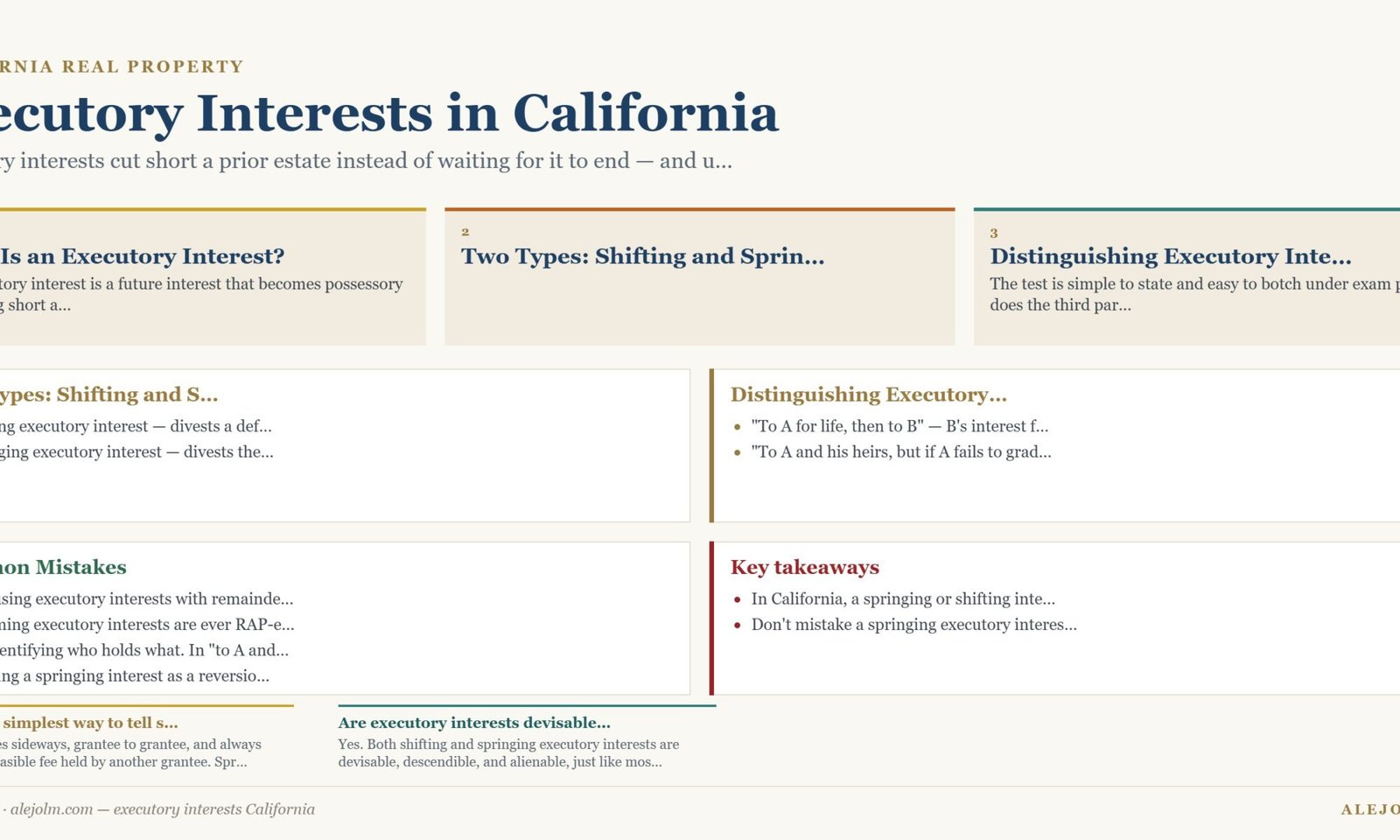
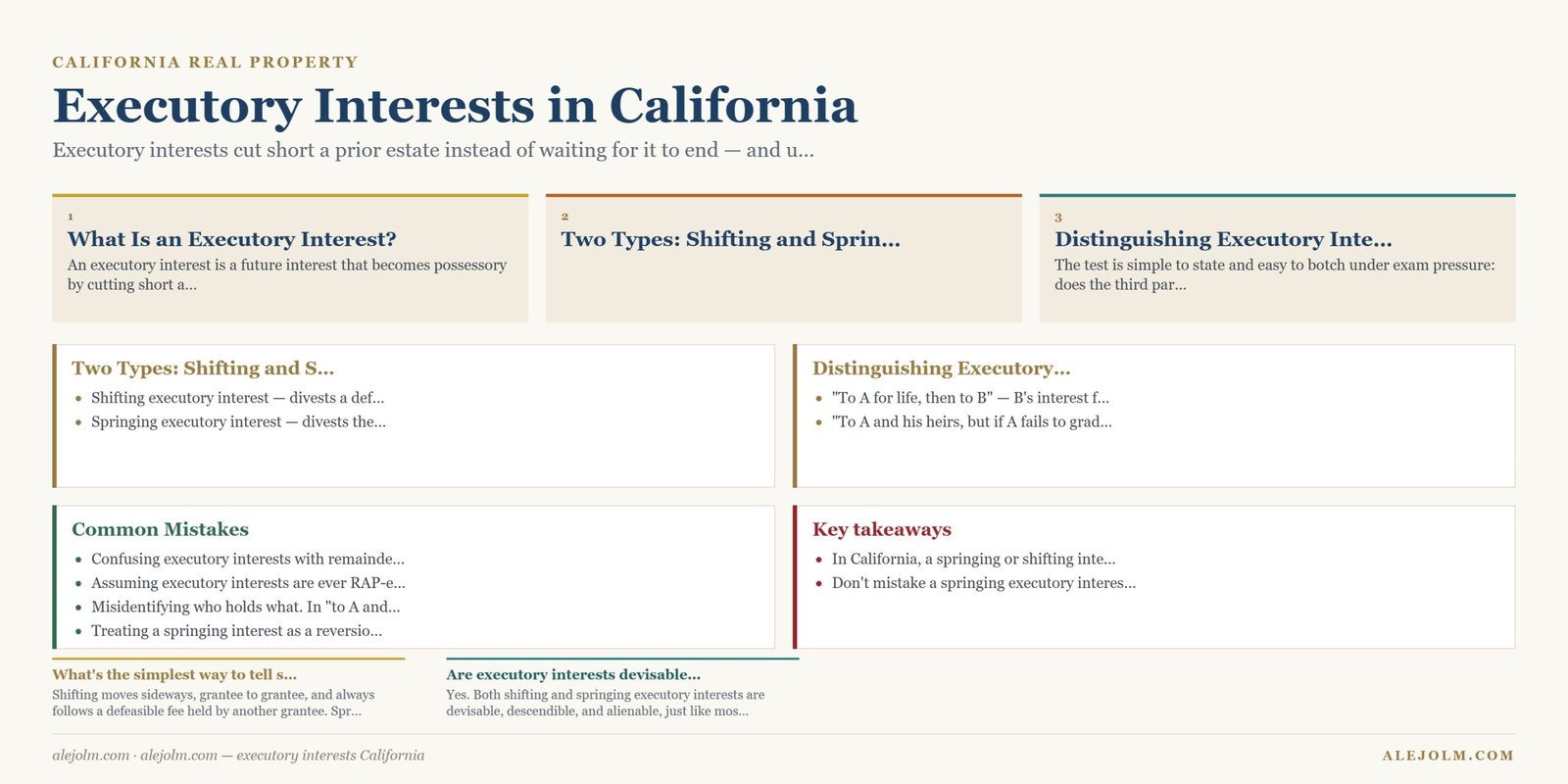
An executory interest is a future interest that becomes possessory by cutting short a prior estate, rather than patiently waiting for it to expire. That divesting feature is the entire difference between an executory interest and a remainder — a remainder always waits its turn; an executory interest jumps the line.
For California Bar Exam purposes, and for anyone drafting a deed with conditional language, this distinction controls which future interest a grantee holds, and — critically — whether the Rule Against Perpetuities applies to it at all.
Executory interest, in one sentence: it’s a future interest held by a third-party grantee that divests either a prior grantee’s estate or the grantor’s own estate before that estate would otherwise naturally end, and it is always subject to the Rule Against Perpetuities.
Two Types: Shifting and Springing
- Shifting executory interest — divests a defeasible fee held by another grantee. Possession shifts sideways, from one grantee to another. It always follows a defeasible fee.
- Springing executory interest — divests the grantor (or the grantor’s heirs). Possession springs out of the grantor’s retained estate at a future date or upon a future condition.
Shifting example: “To Aiden and his heirs, but if Bianca returns from Rome, to Bianca and her heirs.” Aiden holds a fee simple subject to executory limitation; Bianca holds a shifting executory interest that cuts Aiden’s estate short if she returns.
Springing example: “O conveys to Camila and her heirs when Camila marries.” The estate sits with O until the marriage condition is met. O retains a fee simple in the meantime, and Camila holds a springing executory interest that springs out of O’s estate once she marries.
Distinguishing Executory Interests From Remainders
The test is simple to state and easy to botch under exam pressure: does the third party’s interest divest a prior grantee’s estate, or does it merely take over after a prior estate ends naturally?
- “To A for life, then to B” — B’s interest follows naturally at A’s death. B holds a remainder.
- “To A and his heirs, but if A fails to graduate college by age 25, to B” — B’s interest cuts A’s fee simple short mid-stream, before it would otherwise continue indefinitely. B holds an executory interest.
Look for “but if,” “provided that,” or any conditional-divestment language pointing to a third party — that’s your signal to think executory interest, not remainder.
Executory Interests Are Always Subject to RAP
Grantor-side future interests — reversions, possibilities of reverter, and rights of entry — are never subject to the Rule Against Perpetuities, because the grantor already owns the fee and RAP only polices interests held by third parties. Executory interests get no such exemption. Whether shifting or springing, they belong to a grantee, not the grantor, so RAP always applies.
Under the traditional common-law test, if there’s any conceivable scenario — however remote — in which the condition triggering the executory interest might not occur within a life in being plus 21 years, the interest is void from the moment of creation. A springing interest conditioned on “if and when the property is used for commercial purposes,” with no time limit at all, is a textbook RAP failure at common law, because that condition could theoretically remain unresolved centuries into the future.
California softens this outcome somewhat through the Uniform Statutory Rule Against Perpetuities. Under Cal. Prob. Code § 21205, an interest that would fail the traditional test can still be saved if it actually vests within 90 years of its creation — a separate, independent savings period layered on top of the common-law analysis.
Worked Example
O executes a deed: “To Golden State University, so long as the parcel is used for educational purposes, and if that use ceases, to the Diaz Family Trust.” The University takes a fee simple subject to executory limitation. The Diaz Family Trust holds a shifting executory interest — the moment the University stops using the land for education, title shifts automatically to the Trust, cutting the University’s estate short.
Because the Trust’s interest divests a grantee (the University), not the grantor, it is subject to RAP. If there’s no measuring life or time limit tied to the condition, the shifting interest risks being void at common law — though California’s 90-year USRAP window, and cy pres reformation as a backstop, may still save it if the condition is likely to resolve well within that period.
Executory Interests vs. Remainders at a Glance
| Feature | Remainder | Executory Interest |
|---|---|---|
| Divests a prior estate? | No — waits for it to end naturally | Yes — cuts it short |
| Can follow a fee simple? | No | Yes (shifting, following a defeasible fee) |
| Can divest the grantor? | No | Yes (springing) |
| Always subject to RAP? | No — vested remainders are typically exempt | Yes, always |
Common Mistakes
- Confusing executory interests with remainders. Any conditional “but if” divestment language pointing to a third party signals an executory interest, not a remainder.
- Assuming executory interests are ever RAP-exempt. They never are — unlike reversions, possibilities of reverter, and rights of entry, which sit with the grantor and skip RAP entirely.
- Misidentifying who holds what. In “to A and his heirs, but if A fails to graduate, to B,” A holds a defeasible fee, not a remainder, and B — not A — holds the executory interest.
- Treating a springing interest as a reversion. A springing executory interest looks similar because it comes out of the grantor’s estate, but it’s contingent and RAP-sensitive; a reversion is automatic and RAP-exempt.
FAQ
What’s the simplest way to tell shifting from springing?
Shifting moves sideways, grantee to grantee, and always follows a defeasible fee held by another grantee. Springing moves out of the grantor, cutting the grantor’s own retained estate short at a future point.
Are executory interests devisable and transferable?
Yes. Both shifting and springing executory interests are devisable, descendible, and alienable, just like most other property interests — they simply remain contingent until the divesting condition occurs.
Does California’s 90-year rule replace the traditional RAP test for executory interests?
No. It’s an additional, independent savings period. An executory interest is valid in California if it satisfies the traditional common-law test or actually vests within 90 years under Cal. Prob. Code § 21205; only if it fails both may a court apply cy pres to reform it.
Key Takeaways
- An executory interest divests a prior estate — a grantee’s defeasible fee (shifting) or the grantor’s own estate (springing) — rather than waiting for it to end naturally.
- The “but if … then to [third party]” pattern signals a shifting executory interest, not a remainder.
- Executory interests are always subject to RAP, unlike grantor-held reversions, possibilities of reverter, and rights of entry.
- In California, a springing or shifting interest that would fail the traditional RAP test may still be saved under the 90-year USRAP window (Cal. Prob. Code § 21205) or reformed under cy pres.
- Don’t mistake a springing executory interest for a reversion — one is automatic and RAP-exempt, the other is conditional and RAP-sensitive.
This article is educational and is not legal advice. Consult a licensed California attorney about your situation.
Related guides
- the rule against perpetuities in California
- fee tail is abolished in California
- destructibility of contingent remainders
- modern rule against perpetuities reforms in California