
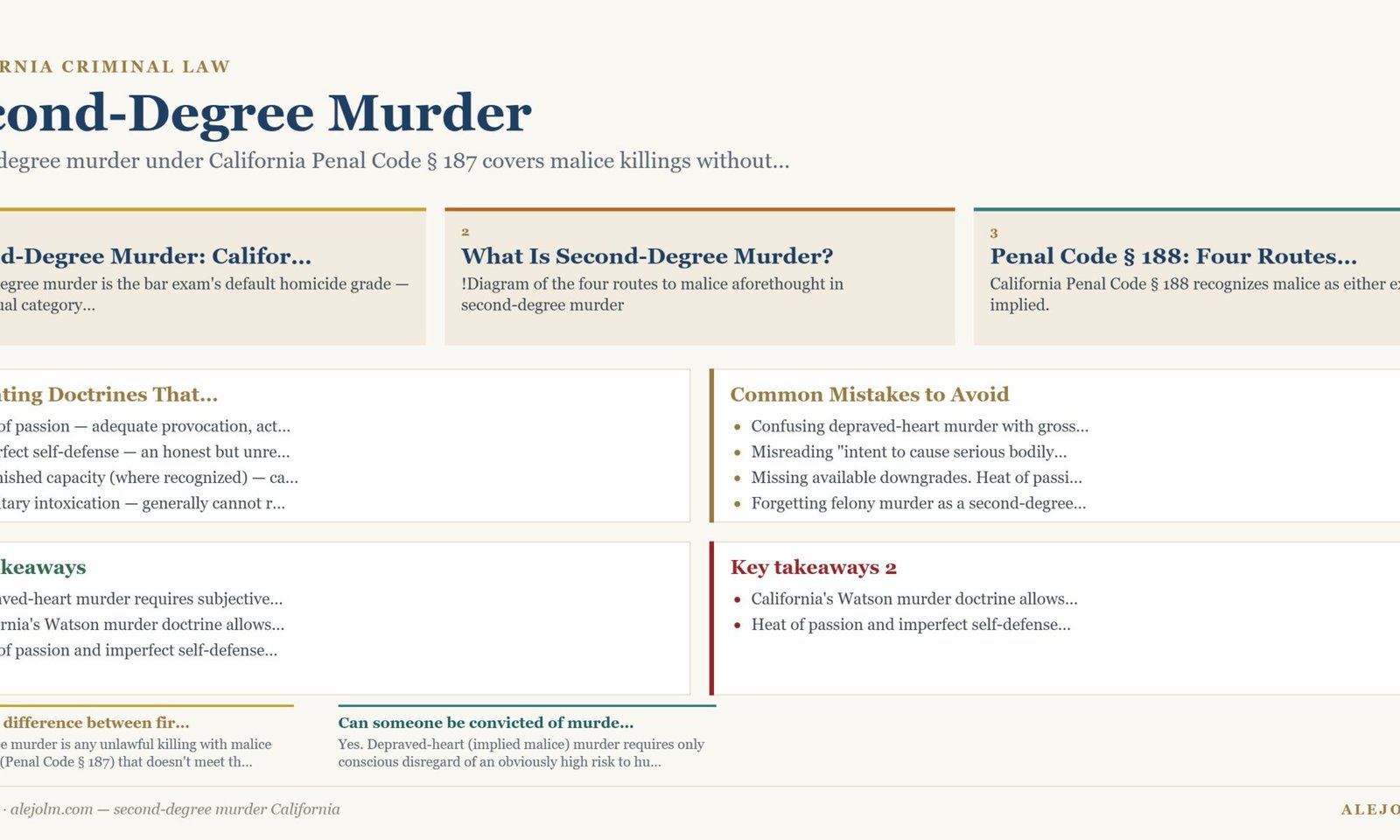
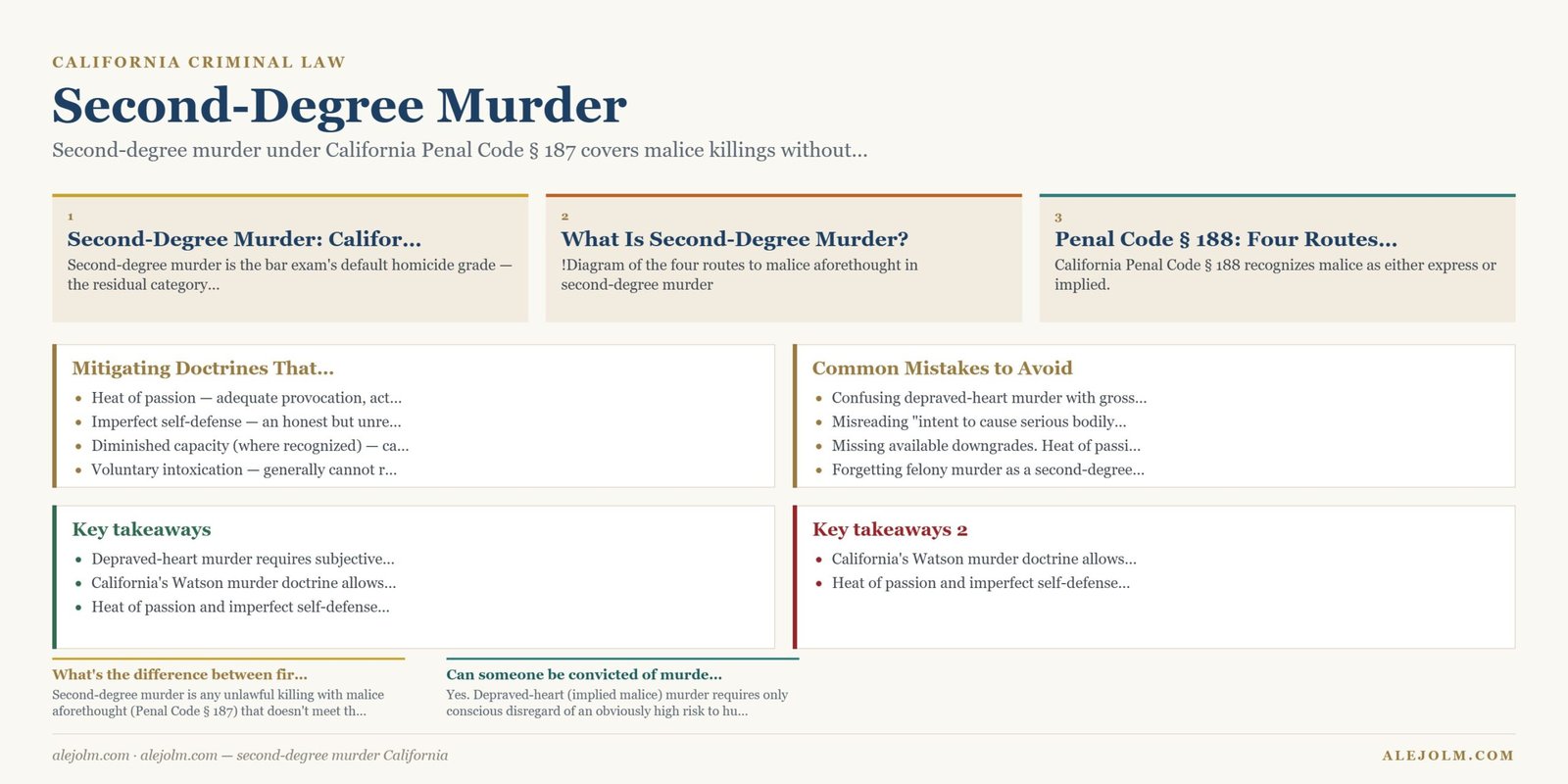
Second-Degree Murder: California Penal Code § 187 Rules
Second-degree murder is the bar exam’s default homicide grade — the residual category every unlawful killing with malice aforethought falls into unless the facts affirmatively earn an upgrade to first degree. Under California Penal Code § 187, murder is simply “the unlawful killing of a human being, or a fetus, with malice aforethought.” The real analytical work happens at Penal Code § 188, which defines what malice actually means.
Most homicide essays should start here, walk through all four routes to malice, and only then ask whether a first-degree elevator or a manslaughter downgrade applies. Landing anywhere else without doing that work first is the most common scoring mistake on this topic.
What Is Second-Degree Murder?
Second-degree murder is the residual category of murder — any unlawful killing with malice aforethought that does not qualify as first degree. It covers intent-to-kill killings without premeditation, intent to cause serious bodily injury resulting in death, depraved-heart (extreme recklessness) killings, and felony murder arising from a non-enumerated felony.
Penal Code § 188: Four Routes to Malice
California Penal Code § 188 recognizes malice as either express or implied. Malice aforethought can be shown four distinct ways:
| Route to Malice | Standard |
|---|---|
| Intent to kill | Express malice — a deliberate purpose to kill |
| Intent to cause serious bodily injury | Implied malice — serious harm intended, death results |
| Depraved-heart recklessness | Conscious disregard of an obviously high risk to human life |
| Felony murder (non-enumerated felony) | Death during commission of an inherently dangerous felony not on the § 189 enumerated list |
Depraved-heart murder — sometimes called an “abandoned and malignant heart” killing — requires conscious disregard of an obviously high risk, which is more than gross negligence (which supports only involuntary manslaughter) but does not require actual intent to kill.
The Bar’s Default Rule
All murder is second degree unless the facts establish a first-degree trigger: premeditation and deliberation, an enumerated (BARRK-style) felony under Penal Code § 189, or a special statutory method like poisoning or lying in wait. Bar essays reward students who state this default explicitly before analyzing whether any upgrade applies — don’t search for reasons to escalate the charge; make the facts earn it.
Depraved-Heart Murder: The Most Commonly Tested Theory
Depraved-heart fact patterns — firing a gun into a crowd, driving recklessly at high speed through a school zone, igniting a fire in an occupied building with apparent indifference — are the workhorse of second-degree murder essays. The key distinction from involuntary manslaughter is subjective awareness: depraved-heart murder requires the defendant actually realized the risk and consciously disregarded it. If the defendant merely should have known (“a reasonable person would have known”), that falls short of depraved-heart murder and supports only involuntary manslaughter instead.
California’s Watson Murder Doctrine
California has a well-developed line of implied-malice cases for grossly intoxicated driving. In People v. Watson (Cal. 1981), the California Supreme Court held that a defendant who drives while grossly intoxicated, with conscious disregard for the obvious danger to human life, can be convicted of second-degree murder — not merely vehicular manslaughter. This “Watson murder” theory is now standard in California DUI-fatality prosecutions where the defendant has a documented history of prior DUIs or explicit warnings about the dangers of intoxicated driving, since that history helps prove the required subjective awareness.
Mitigating Doctrines That Can Downgrade the Charge
Before finalizing a second-degree murder verdict, check whether a mitigating doctrine applies:
- Heat of passion — adequate provocation, actual passion, no reasonable cooling-off period, and no actual cooling off can reduce the charge to voluntary manslaughter.
- Imperfect self-defense — an honest but unreasonable belief in the necessity of self-defense can reduce murder to manslaughter.
- Diminished capacity (where recognized) — can negate the malice element by negating the required mental state.
- Voluntary intoxication — generally cannot reduce second-degree murder any further to manslaughter, unlike its ability to negate premeditation and prevent an escalation to first degree.
Worked Example
Dan, in a fit of anger after a bar fight (not legally adequate provocation), fires a gun several times into a crowded room to “scare everyone,” without aiming at anyone in particular, and kills a bystander.
Analysis: Dan is guilty of second-degree murder under the depraved-heart theory. Firing a gun multiple times into a crowded room shows conscious disregard of an obviously high risk to human life, satisfying malice aforethought even without specific intent to kill the bystander. This is not first-degree murder — there’s no premeditation or deliberation, since the shooting was impulsive, and no enumerated felony is involved. A bar-fight argument doesn’t count as legally adequate provocation for voluntary manslaughter, so the charge stays at second-degree murder rather than getting reduced.
Common Mistakes to Avoid
- Confusing depraved-heart murder with gross-negligence manslaughter. Depraved-heart murder requires subjective awareness of the risk; gross negligence uses an objective “reasonable person” standard.
- Misreading “intent to cause serious bodily harm.” It requires intent to cause serious injury, not any intent to harm at all.
- Missing available downgrades. Heat of passion and imperfect self-defense can reduce second-degree murder to voluntary manslaughter — don’t stop the analysis once malice is established.
- Forgetting felony murder as a second-degree theory. A death during a non-enumerated (non-BARRK) dangerous felony is still second-degree felony murder, even without depraved-heart recklessness.
FAQ
What’s the difference between first-degree and second-degree murder in California?
Second-degree murder is any unlawful killing with malice aforethought (Penal Code § 187) that doesn’t meet the elevated requirements of Penal Code § 189 — premeditation, an enumerated felony, or a special method like poisoning.
Can someone be convicted of murder without intending to kill anyone?
Yes. Depraved-heart (implied malice) murder requires only conscious disregard of an obviously high risk to human life, not actual intent to kill.
Is a DUI death always charged as vehicular manslaughter in California?
Not necessarily. Under the Watson murder doctrine, a grossly intoxicated driver who consciously disregarded the known risk to human life can be charged with second-degree murder instead.
Key Takeaways
- California Penal Code § 187 defines murder; Penal Code § 188 defines the malice aforethought that separates murder from manslaughter.
- Second-degree murder is the default homicide grade — first degree requires an affirmative statutory trigger under Penal Code § 189.
- Depraved-heart murder requires subjective, conscious disregard of a high risk — not mere negligence.
- California’s Watson murder doctrine allows a second-degree murder charge for grossly intoxicated, conscious-disregard driving deaths.
- Heat of passion and imperfect self-defense can downgrade second-degree murder to voluntary manslaughter; voluntary intoxication generally cannot.
Related guides
- First-Degree Murder: California Penal Code § 189 Guide
- Murder and Manslaughter in California
- Causation in Criminal Law: California’s Rules Explained
- Mens Rea Explained: Criminal Intent Under CA Penal Code
Sources and further reading
This article is educational and is not legal advice. Consult a licensed California attorney about your situation.