
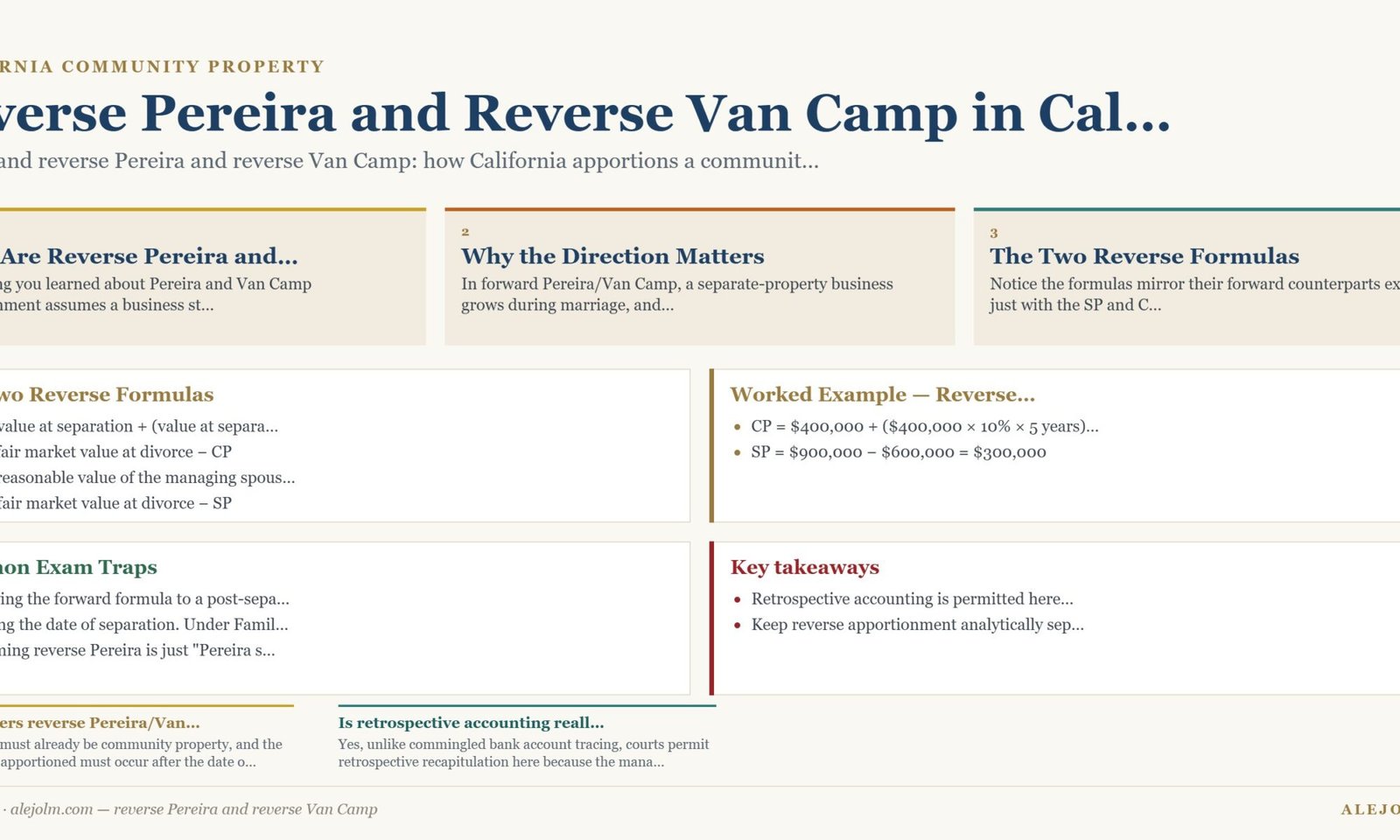
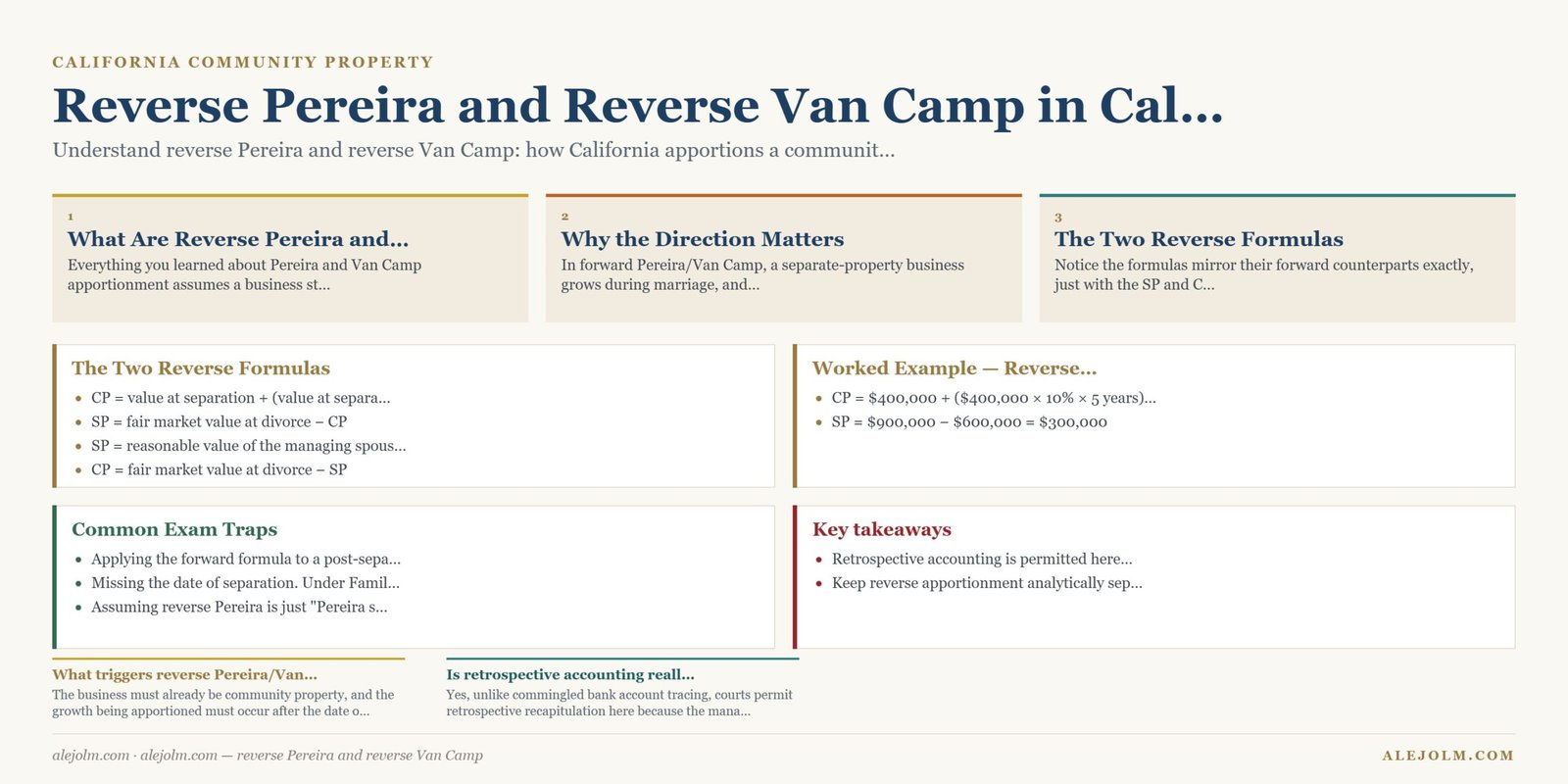
What Are Reverse Pereira and Reverse Van Camp?
Everything you learned about Pereira and Van Camp apportionment assumes a business started as separate property before marriage and grew during it. Now flip the timeline: a community property business keeps operating and growing after the spouses separate but before their divorce is final. California courts use the same logic, run in reverse.
Reverse Pereira and reverse Van Camp are California apportionment methods used when a community-property business continues operating and appreciating between the date of separation and the divorce judgment; they allocate the post-separation growth between the community (which owned the business at separation) and the managing spouse’s post-separation separate labor.
Getting the direction right — forward versus reverse — is the single biggest thing at stake here, because mixing up the timeline flips which estate carries the burden of proof.
Why the Direction Matters
In forward Pereira/Van Camp, a separate-property business grows during marriage, and the question is how much of that growth the community should get credit for. In reverse Pereira/Van Camp, a community-property business keeps growing after separation, and the question is how much of that growth the managing spouse’s post-separation separate labor should get credit for.
| Forward Pereira/Van Camp | Reverse Pereira/Van Camp | |
|---|---|---|
| Business starts as | Separate property | Community property |
| Growth period tested | During marriage | After date of separation, before divorce |
| Question | How much growth goes to the community? | How much growth goes to the managing spouse’s separate estate? |
The trigger is simple: identify which estate (SP or CP) existed first, and whether the growth you’re apportioning happened before or after the date of separation under Family Code § 70.
The Two Reverse Formulas
Reverse Pereira (used when the managing spouse’s post-separation labor and skill are the primary driver of continued growth):
- CP = value at separation + (value at separation × fair rate of return × years since separation)
- SP = fair market value at divorce − CP
Reverse Van Camp (used when the community’s existing capital — not post-separation labor — is the primary driver of continued growth):
- SP = reasonable value of the managing spouse’s post-separation services − salary already paid
- CP = fair market value at divorce − SP
Notice the formulas mirror their forward counterparts exactly, just with the SP and CP roles swapped, because the business you’re valuing is CP at the starting point instead of SP.
Why Retrospective Accounting Is Allowed Here
One nuance the source material flags explicitly: this is one of the few areas of community property law where retrospective recapitulation is permitted. In ordinary commingled bank account tracing, courts generally forbid reconstructing a running balance after the fact. But reverse apportionment of a CP business necessarily uses retrospective accounting, because the managing spouse could not have practically avoided mixing labor and capital contributions as the business operated day to day. Courts accept after-the-fact reconstruction here out of necessity.
Worked Example — Reverse Pereira
Facts: Wendy and her husband separate in 2021. At that date, Wendy’s accounting practice — built up during the marriage and therefore community property — is worth $400,000. After separation, Wendy’s income triples because she personally works longer hours, takes on new clients, and remodels the office through her own post-separation effort. By the time the divorce is finalized in 2026 (5 years later), the practice is worth $900,000.
Analysis: Because Wendy’s own post-separation labor is clearly the primary driver of the continued growth, reverse Pereira applies:
- CP = $400,000 + ($400,000 × 10% × 5 years) = $400,000 + $200,000 = $600,000
- SP = $900,000 − $600,000 = $300,000
The $600,000 CP component remains community property, divided equally between Wendy and her husband at divorce. The $300,000 above that is Wendy’s separate property, reflecting her own post-separation labor.
Worked Example — Reverse Van Camp
Facts: Same separation date and same $400,000 value at separation, but this time the practice’s continued growth after separation comes mainly from an exclusive referral contract the practice already held at the date of separation — not from any extra effort by the managing spouse. The managing spouse draws a modest salary of $60,000 per year during the 5 post-separation years.
Analysis: Because the community’s existing capital (the referral contract) — not post-separation labor — drives the growth, reverse Van Camp applies. The managing spouse’s SP is limited to the reasonable value of services rendered, minus salary already paid; if the reasonable value of those services is deemed to be about the same as the salary actually paid, the SP component approaches zero, and nearly all of the post-separation appreciation remains CP, divided equally at divorce.
Don’t Confuse This With a Reimbursement Claim
Reverse Pereira/Van Camp apportions the post-separation growth of a CP business between the community and the operating spouse’s post-separation separate labor. That’s a distinct question from a spouse contributing separate funds to improve a CP business, which instead raises a Family Code § 2640-style reimbursement claim. Labor apportionment and funds reimbursement are different doctrines answering different questions — don’t merge them in your exam answer.
Common Exam Traps
- Applying the forward formula to a post-separation CP business. If the business was CP before growth occurred, and the growth happened after separation, you need the reverse formula, not the forward one.
- Missing the date of separation. Under Family Code § 70, the date of separation is the dividing line for this entire analysis — get that date wrong, and the whole apportionment shifts.
- Assuming reverse Pereira is just “Pereira spelled backward.” The formulas share structure but assign the fair-return credit and the labor credit to opposite estates. Write out the formula rather than relying on memory of the forward version alone.
FAQ
What triggers reverse Pereira/Van Camp instead of the forward version?
The business must already be community property, and the growth being apportioned must occur after the date of separation but before the divorce judgment. If the business started as separate property, you’re in forward Pereira/Van Camp territory instead.
Is retrospective accounting really allowed for reverse apportionment?
Yes, unlike commingled bank account tracing, courts permit retrospective recapitulation here because the managing spouse could not have separated labor from capital contributions in real time while running the business.
Can a spouse claim both a reimbursement under FC § 2640 and a reverse Pereira/Van Camp apportionment?
Potentially, but they answer different questions — reimbursement addresses separate funds contributed to the business, while reverse apportionment addresses the managing spouse’s post-separation labor. Analyze each separately based on what the facts show was actually contributed.
Key Takeaways
- Reverse Pereira and reverse Van Camp apportion a community-property business’s growth between the date of separation and the divorce judgment.
- Reverse Pereira applies when post-separation labor drives growth; reverse Van Camp applies when existing CP capital drives it.
- The formulas mirror the forward versions but assign the fair-return credit and labor credit to opposite estates.
- Retrospective accounting is permitted here, unlike in ordinary commingled-account tracing.
- Keep reverse apportionment analytically separate from an FC § 2640 reimbursement claim for separate-fund contributions.
Related guides
Sources and further reading
This article is educational and is not legal advice. Consult a licensed California attorney about your situation.