
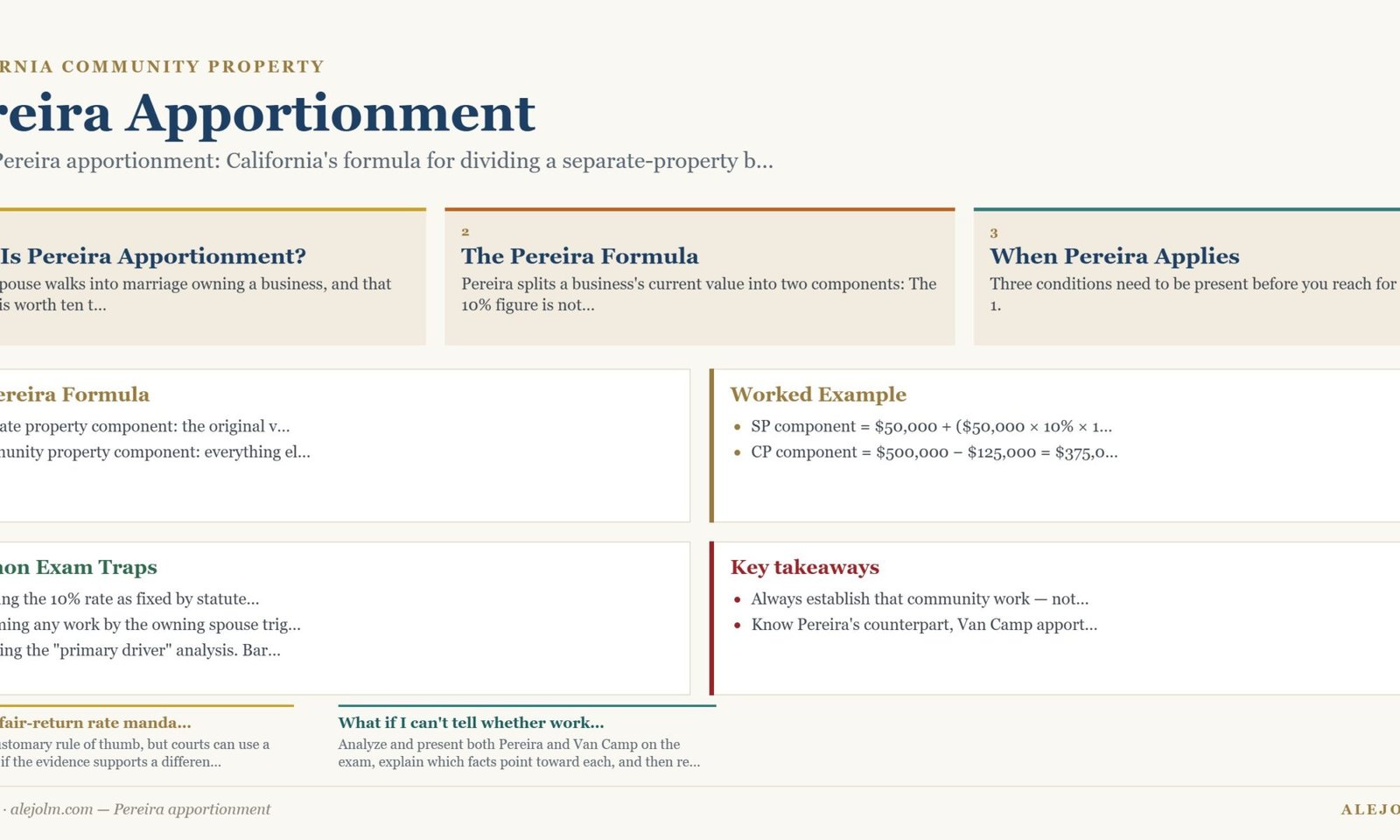
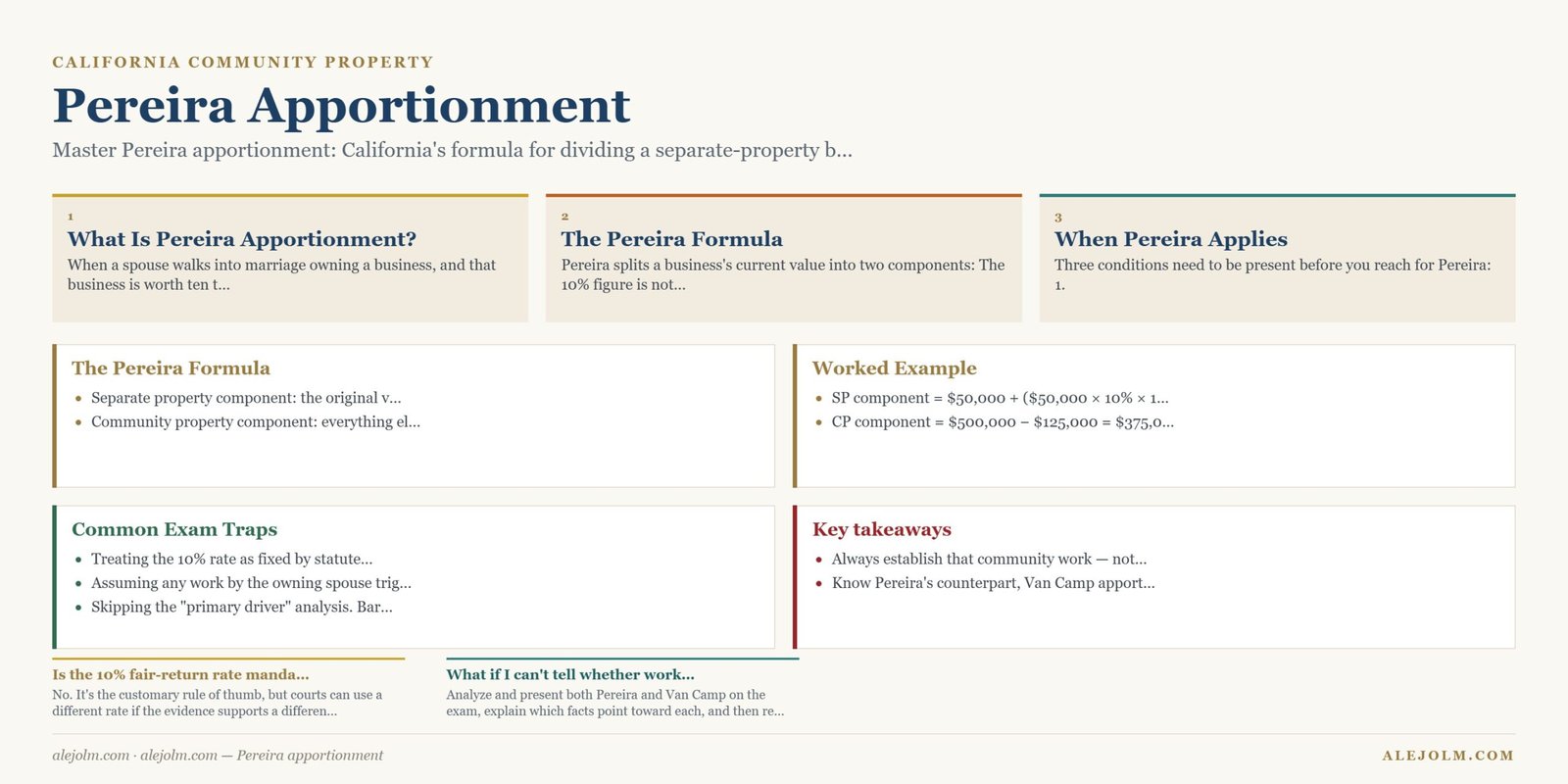
What Is Pereira Apportionment?
When a spouse walks into marriage owning a business, and that business is worth ten times more by the time of divorce, California law has to decide how much of that growth belongs to the community. Pereira apportionment is one of two competing answers — and it’s the one that favors the community.
Pereira apportionment is a California formula that allocates the growth of a spouse’s premarital separate-property business between the separate estate and the community when the community’s work, skill, or effort — not market forces or existing capital — is the primary driver of the business’s appreciation during marriage.
The doctrine comes from Pereira v. Pereira (1909), a foundational California Supreme Court case, and it remains one of the most frequently tested topics in the community property portion of the bar exam.
The Pereira Formula
Pereira splits a business’s current value into two components:
- Separate property component: the original value of the business at marriage, plus a fair return on that capital (a rule-of-thumb 10% simple interest per year).
- Community property component: everything else — the appreciation beyond that fair return.
| Component | Formula |
|---|---|
| SP component | Original value + (Original value × 10% × years of marriage) |
| CP component | Current value − SP component |
The 10% figure is not a statute — it’s a judicially developed rule of thumb. A court can adjust it if the facts suggest a different reasonable return, such as a lower rate if the capital would otherwise have earned a modest return in bonds.
When Pereira Applies
Three conditions need to be present before you reach for Pereira:
- A separate-property business existed before the marriage.
- The business appreciated substantially during the marriage.
- Community work, skill, or effort — not market conditions or passive capital growth — was the primary driver of that appreciation.
If the third element is missing — if the business grew because of market conditions, a hot location, or a pre-existing reputation the owner brought into the marriage — Pereira is the wrong tool. That’s when its counterpart, Van Camp apportionment, usually applies instead.
Worked Example
Facts: Ten years before marrying Isabel, Marcus opens an accounting firm. At the time he marries Isabel, the firm is worth $50,000. During their 15-year marriage, Marcus works full-time growing the firm — building client relationships, expanding services, and developing its reputation. By the time of divorce, the firm is worth $500,000. The growth is clearly driven by Marcus’s ongoing labor, not market conditions.
Analysis:
- SP component = $50,000 + ($50,000 × 10% × 15 years) = $50,000 + $75,000 = $125,000
- CP component = $500,000 − $125,000 = $375,000
At divorce, the community estate (the $375,000 CP component) is divided equally: Isabel receives $187,500, and Marcus keeps that same $187,500 plus his $125,000 separate property component, for a total of $312,500.
When Pereira Does NOT Apply
Change one fact and the analysis flips. Suppose instead that Marcus’s firm’s growth came almost entirely from a merger wave that consolidated the accounting industry in his region, with Marcus doing essentially the same modest amount of work he’d always done. That’s market-driven growth, not labor-driven growth — Pereira is inappropriate, and Van Camp (or no apportionment at all, if the spouse did no relevant work) is the better fit.
Similarly, if a spouse owned and actively managed a business before marriage and continued the same active management style afterward with only modest growth, courts look at whether the post-marriage work — not the pre-marital reputation the spouse already built — is what’s driving the increase. Value attributable to pre-marital reputation stays in the SP component.
Pereira and Van Camp Are Not Interchangeable
Attorneys often argue for whichever method benefits their client — a spouse without a business interest generally wants Pereira (it delivers more to the community); the business-owning spouse generally wants Van Camp (it delivers more to the separate estate). But the method isn’t a matter of preference — it’s a matter of what actually drove the growth, and courts choose the formula that fits the facts, not the one either party prefers.
| Feature | Pereira | Van Camp |
|---|---|---|
| Primary growth driver | Community labor/skill | Capital/market conditions |
| Favors | Community | Separate property owner |
| Formula base | Fair return on capital (~10%) | Market-rate value of community’s labor |
Common Exam Traps
- Treating the 10% rate as fixed by statute. It’s a rule of thumb from case law, adjustable to the facts.
- Assuming any work by the owning spouse triggers full CP treatment of appreciation. Pereira apportions only — it doesn’t convert the whole business to CP; the SP owner keeps the capital-return component.
- Skipping the “primary driver” analysis. Bar answers that jump straight to a calculation without first establishing that community work was the primary driver of growth lose points. Always analyze causation before you calculate.
FAQ
Is the 10% fair-return rate mandatory in every Pereira calculation?
No. It’s the customary rule of thumb, but courts can use a different rate if the evidence supports a different reasonable return on the original capital.
What if I can’t tell whether work or capital drove the growth?
Analyze and present both Pereira and Van Camp on the exam, explain which facts point toward each, and then reach a reasoned conclusion. Bar graders reward this dual analysis when the facts are genuinely ambiguous.
Does Pereira apply to businesses started during the marriage?
No. Pereira apportionment is specifically for a business that existed as separate property before the marriage. A business started during marriage with community funds or effort is typically community property from the outset.
Key Takeaways
- Pereira apportionment applies when community labor is the primary driver of growth in a premarital separate-property business.
- The formula gives the separate estate the original value plus a fair return (commonly 10% simple interest), with the remainder going to the community.
- The 10% rate is a rule of thumb, not a statute, and can be adjusted to the facts.
- Always establish that community work — not market forces — drove the growth before applying the formula.
- Know Pereira’s counterpart, Van Camp apportionment, and be ready to argue both when facts are ambiguous.
This article is educational and is not legal advice. Consult a licensed California attorney about your situation.
Related guides
- Van Camp apportionment
- reverse Pereira and reverse Van Camp
- community property presumptions
- business judgment rule