
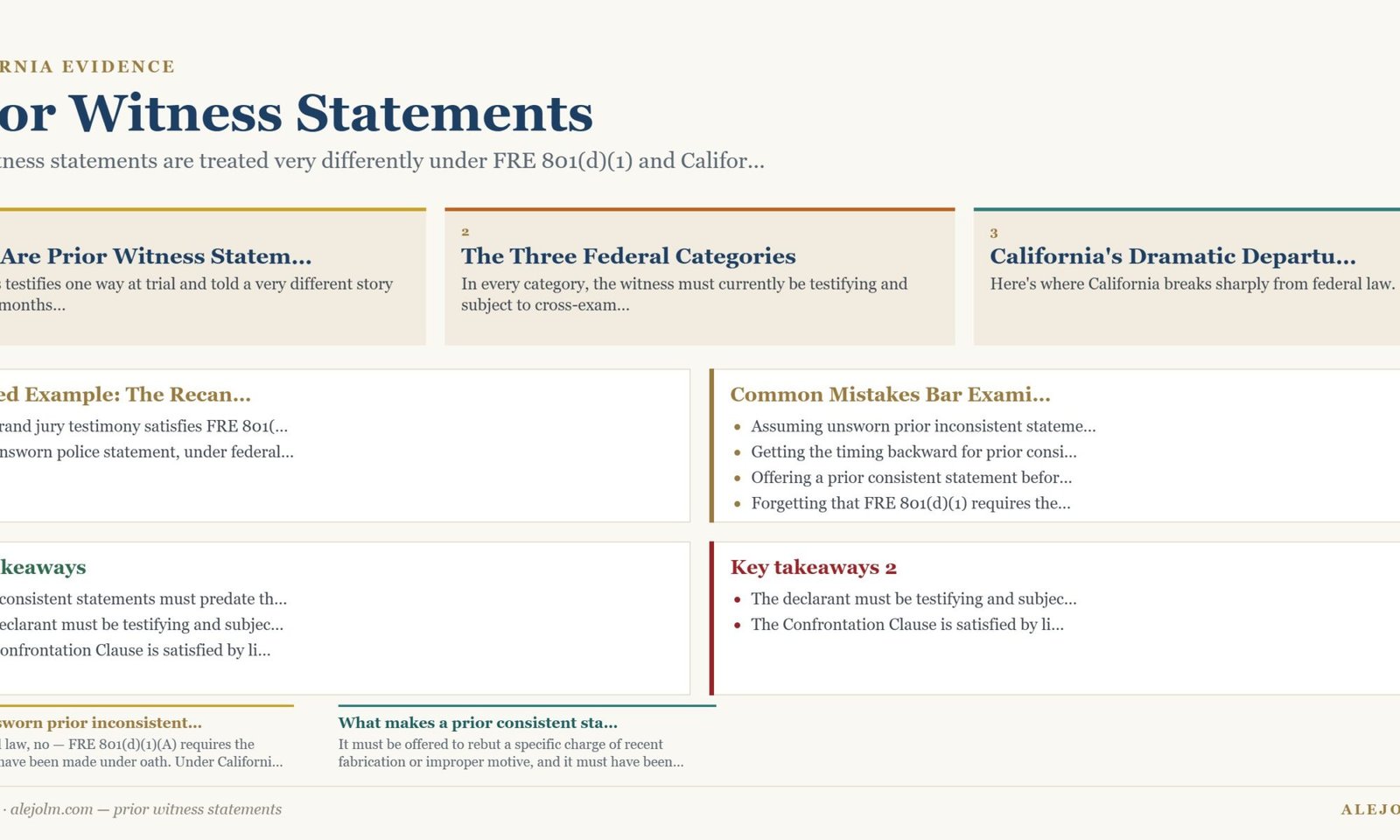

What Are Prior Witness Statements?
A witness testifies one way at trial and told a very different story to police months earlier. Can the earlier version come in as actual proof, or only to make the jury doubt her? The answer depends entirely on whether you’re in federal court or California state court — and this is one of the most consequential CEC-versus-FRE splits on the whole exam.
Prior witness statements, defined: under FRE 801(d)(1), three categories of a testifying witness’s own earlier statements are classified as “not hearsay” and admissible as substantive evidence, provided the witness testifies and is subject to cross-examination about the statement.
The Three Federal Categories
(A) Prior inconsistent statement. Admissible for its truth only if it was made under oath at a trial, hearing, or deposition. An unsworn prior inconsistent statement — like a casual comment to police at the scene — can only be used to impeach under FRE 613, never as substantive proof.
(B) Prior consistent statement. Admissible for all purposes to rebut a charge of recent fabrication or improper motive, but only if the consistent statement was made before the alleged motive to fabricate arose. A statement made after the bias emerged doesn’t rebut the charge.
(C) Prior identification. A witness’s earlier identification of a person — from a lineup or photo array — is admissible substantively, valued because it was made close in time to the actual perception.
In every category, the witness must currently be testifying and subject to cross-examination. If the declarant doesn’t testify, FRE 801(d)(1) doesn’t apply at all.
California’s Dramatic Departure: CEC § 1235
Here’s where California breaks sharply from federal law. Under CEC § 1235, a prior inconsistent statement is admissible for all purposes — including substantive truth — whether or not it was made under oath.
| Issue | FRE 801(d)(1)(A) (Federal) | CEC § 1235 (California) |
|---|---|---|
| Oath requirement for substantive use | Required — must be made under oath in a prior proceeding | Not required — any prior inconsistent statement qualifies |
| Unsworn statement to police, contradicting trial testimony | Impeachment only (FRE 613) | Admissible for its truth |
| Classification | “Not hearsay” (exemption) | Hearsay exception |
| Prior consistent statements (timing rule) | Must predate the motive to fabricate | Same general rule (CEC § 1236), though under Proposition 8 some post-motive statements may be offered, subject to CEC § 352 |
| Prior identification | Admissible substantively | Admissible substantively (CEC § 1238) — parallels federal law |
This is not a minor technical difference. A witness’s casual, unsworn statement to a police officer at the scene — the kind of statement made every day in real investigations — can be used as substantive proof of guilt or liability in a California courtroom, while a federal court would allow the very same statement only to impeach.
Confrontation Clause Interaction
Because the witness testifies and submits to cross-examination in the current proceeding, the Confrontation Clause is satisfied even if the witness now recants or evades the truth. That’s true whether the prior statement comes in under the sworn-statement federal rule or California’s broader unsworn-statement rule — the constitutional safeguard is live cross-examination, not the oath status of the earlier statement.
Worked Example: The Recanting Eyewitness
A prosecution eyewitness testifies at trial that the defendant was at the crime scene. On cross-examination, the defense reveals she was paid $10,000 by the prosecution. On redirect, the prosecutor offers: (1) her sworn grand jury testimony, given before the payment, consistent with her trial testimony; and (2) her unsworn statement to police at the scene, also given before the payment and also consistent.
- The grand jury testimony satisfies FRE 801(d)(1)(A) — sworn, in a prior proceeding — and comes in substantively to rebut the bias charge.
- The unsworn police statement, under federal law, only impeaches; it isn’t substantive evidence because it wasn’t under oath. Under California’s CEC § 1235, that same statement is admissible for its truth, oath or not — a result the FRE would never permit.
Common Mistakes Bar Examiners Test
- Assuming unsworn prior inconsistent statements are never substantively admissible — true federally, false in California.
- Getting the timing backward for prior consistent statements — the statement must predate the motive to fabricate, not follow it.
- Offering a prior consistent statement before the witness has actually been attacked on credibility — that’s improper “bolstering.”
- Forgetting that FRE 801(d)(1) requires the declarant to be currently testifying and subject to cross-examination about the statement.
Frequently Asked Questions
Can an unsworn prior inconsistent statement ever be used as substantive evidence?
Under federal law, no — FRE 801(d)(1)(A) requires the statement to have been made under oath. Under California’s CEC § 1235, yes — the oath requirement doesn’t apply.
What makes a prior consistent statement admissible?
It must be offered to rebut a specific charge of recent fabrication or improper motive, and it must have been made before that alleged motive arose.
Does the witness need to actually remember making the prior statement?
The witness must testify and be subject to cross-examination about the statement, but doesn’t necessarily need to remember every detail — inconsistency or fading memory is often exactly why the prior statement matters.
Key Takeaways
- FRE 801(d)(1) covers prior inconsistent statements (sworn only), prior consistent statements (pre-motive only), and prior identifications.
- California’s CEC § 1235 is dramatically broader, admitting unsworn prior inconsistent statements for their truth — a major, high-frequency CEC-versus-FRE split.
- Prior consistent statements must predate the alleged motive to fabricate in both systems.
- The declarant must be testifying and subject to cross-examination for FRE 801(d)(1) to apply at all.
- The Confrontation Clause is satisfied by live cross-examination in the current proceeding, regardless of the prior statement’s oath status.
This article is educational and is not legal advice. Consult a licensed California attorney about your situation.
Related guides
- party-opponent statements and admissions
- lay opinion testimony in California
- character evidence rules