
How California Classifies Personal Injury Recoveries
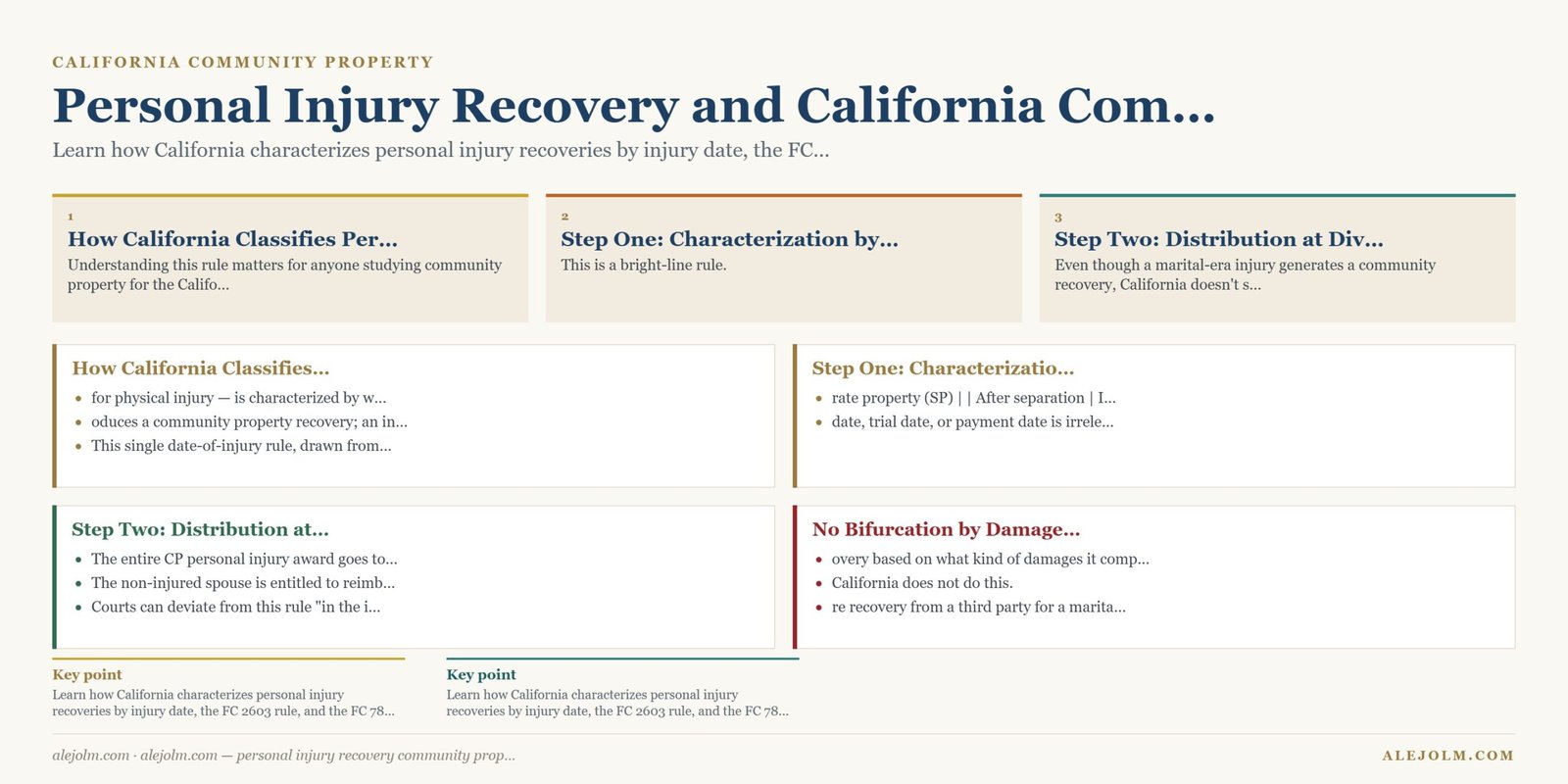
Personal injury recovery — damages, awards, or settlements for physical injury — is characterized by when the injury occurred, not when the money is actually received. An injury during marriage produces a community property recovery; an injury before marriage or after separation produces separate property. This single date-of-injury rule, drawn from Family Code §§ 780–784, controls the entire analysis.
Understanding this rule matters for anyone studying community property for the California Bar Exam, because the characterization step and the divorce-division step are governed by two different statutes that are easy to conflate.
Step One: Characterization by Injury Date
| When the Injury Occurred | Characterization |
|---|---|
| During marriage | Community property (CP) |
| Before marriage | Injured spouse’s separate property (SP) |
| After separation | Injured spouse’s separate property (SP) |
This is a bright-line rule. The settlement date, trial date, or payment date is irrelevant to characterization — only the date the injury happened counts.
Step Two: Distribution at Divorce Under FC § 2603
Even though a marital-era injury generates a community recovery, California doesn’t split it 50-50 like ordinary CP at divorce. Instead:
- The entire CP personal injury award goes to the injured spouse, not split evenly.
- The non-injured spouse is entitled to reimbursement for medical expenses the community paid out of CP funds.
- Courts can deviate from this rule “in the interests of justice,” but this exception is rarely applied — nearly all awards still go to the injured spouse.
This is a two-step analysis: first classify the recovery (CP or SP) by injury date, then apply the special division rule if it turns out to be CP.
No Bifurcation by Damage Type
A common misconception is that courts split a personal injury recovery based on what kind of damages it compensates — pain and suffering versus lost wages versus medical bills. California does not do this. Under FC § 780, the entire recovery from a third party for a marital-era injury is CP, regardless of the mix of damages it represents.
Lost-wage damages would independently be CP anyway, since they replace marital earnings. But the pain-and-suffering component is not carved out as a separate SP category — the whole recovery is characterized as one asset by the single date-of-injury test.
The Interspousal Tort Exception: FC § 781
The date-of-injury rule has one major exception. If the tortfeasor is the injured spouse’s own spouse, the recovery is the injured spouse’s separate property from the moment it is received — it never becomes CP at all, even if the injury happened during marriage.
This is a meaningfully different mechanism than the ordinary rule. An ordinary third-party recovery during marriage is CP first, then gets awarded 100% to the injured spouse at divorce under § 2603. An interspousal-tort recovery skips that two-step process entirely: it’s SP immediately under § 781, so § 2603 never even comes into play.
Worked Example 1: Injury During Marriage, Third-Party Tortfeasor
Marcus is injured in a car accident caused by another driver in 2012, while married to Elena. The case settles in 2014, after Marcus and Elena have already separated. Because the injury occurred during marriage, the $100,000 award is CP.
At divorce, the entire $100,000 goes to Marcus under FC § 2603 — Elena gets none of it directly. But if the community paid $10,000 in medical expenses for Marcus’s injury out of CP funds, that $10,000 is reimbursable to the community from the award.
Worked Example 2: Injury Before Marriage
Sofia is injured in an accident in 2010, two years before she marries Tom in 2012. Her case settles in 2014 for $200,000. Because the injury predates the marriage, the award is Sofia’s SP by the date-of-injury rule — regardless of when the settlement check arrives. At divorce, Tom receives no part of the award, and there’s no reimbursement claim unless community funds paid post-marriage medical expenses tied to that earlier injury.
Worked Example 3: Interspousal Tort
Elena is injured in a car accident caused by her husband Marcus’s negligent driving during the marriage. The award is $150,
- Because the tortfeasor is her own spouse, FC § 781 makes the recovery Elena’s separate property from the moment she receives it — it is never CP, and Marcus cannot claim any interest in it, at divorce or otherwise.
Structured Settlements Don’t Change the Rule
If a personal injury recovery is paid out over time as a structured settlement rather than a lump sum, the characterization is still fixed by the date of injury, not the date each individual payment arrives — as long as the tortfeasor is a third party and the § 781 interspousal-tort exception doesn’t apply.
Common Mistakes to Avoid
- “Recoveries split by damage type.” Wrong. California doesn’t bifurcate a third-party PI recovery into CP and SP slices based on pain-and-suffering versus lost wages. The whole recovery is characterized as one asset by injury date.
- Confusing characterization with division. A marital-era injury produces a CP recovery (characterization step), but that CP recovery still goes 100% to the injured spouse at divorce (division step under § 2603) — these are two separate rules.
- Treating interspousal-tort recoveries like ordinary CP. They’re never CP in the first place under § 781, so § 2603’s injured-spouse allocation rule is irrelevant to them.
Exam Strategy
Always ask “when did the injury occur?” first — that single fact drives characterization. Then check whether the tortfeasor was the other spouse (triggering § 781) before applying the § 2603 divorce-division rule. If community funds paid medical expenses, flag the reimbursement issue separately.
FAQ
Is a personal injury settlement community property in California?
It depends on when the injury occurred. An injury during marriage produces a community property recovery; an injury before marriage or after separation produces the injured spouse’s separate property, regardless of when the settlement money is paid.
Does the non-injured spouse get half of a personal injury award?
Generally no. Under FC § 2603, even a community property personal injury award is awarded entirely to the injured spouse at divorce, not split 50-50, though the community can seek reimbursement for medical expenses it paid.
What happens if one spouse injures the other spouse?
Under FC § 781, a recovery for an injury caused by one spouse against the other is the injured spouse’s separate property from the moment it’s received — it never becomes community property, even if the injury happened during the marriage.
Key Takeaways
- Character follows the date of injury, not the date of settlement or payment.
- Injuries during marriage produce CP; injuries before marriage or after separation produce SP.
- FC § 2603 sends the entire CP recovery to the injured spouse at divorce, subject to medical-expense reimbursement.
- California does not bifurcate recoveries by damage type — the whole award is one asset.
- FC § 781 makes interspousal-tort recoveries SP immediately, bypassing the CP/§ 2603 analysis entirely.
This article is educational and is not legal advice. Consult a licensed California attorney about your situation.
Related guides
- community property presumptions
- wage replacement benefits
- life insurance and community property
- is a professional degree community property