
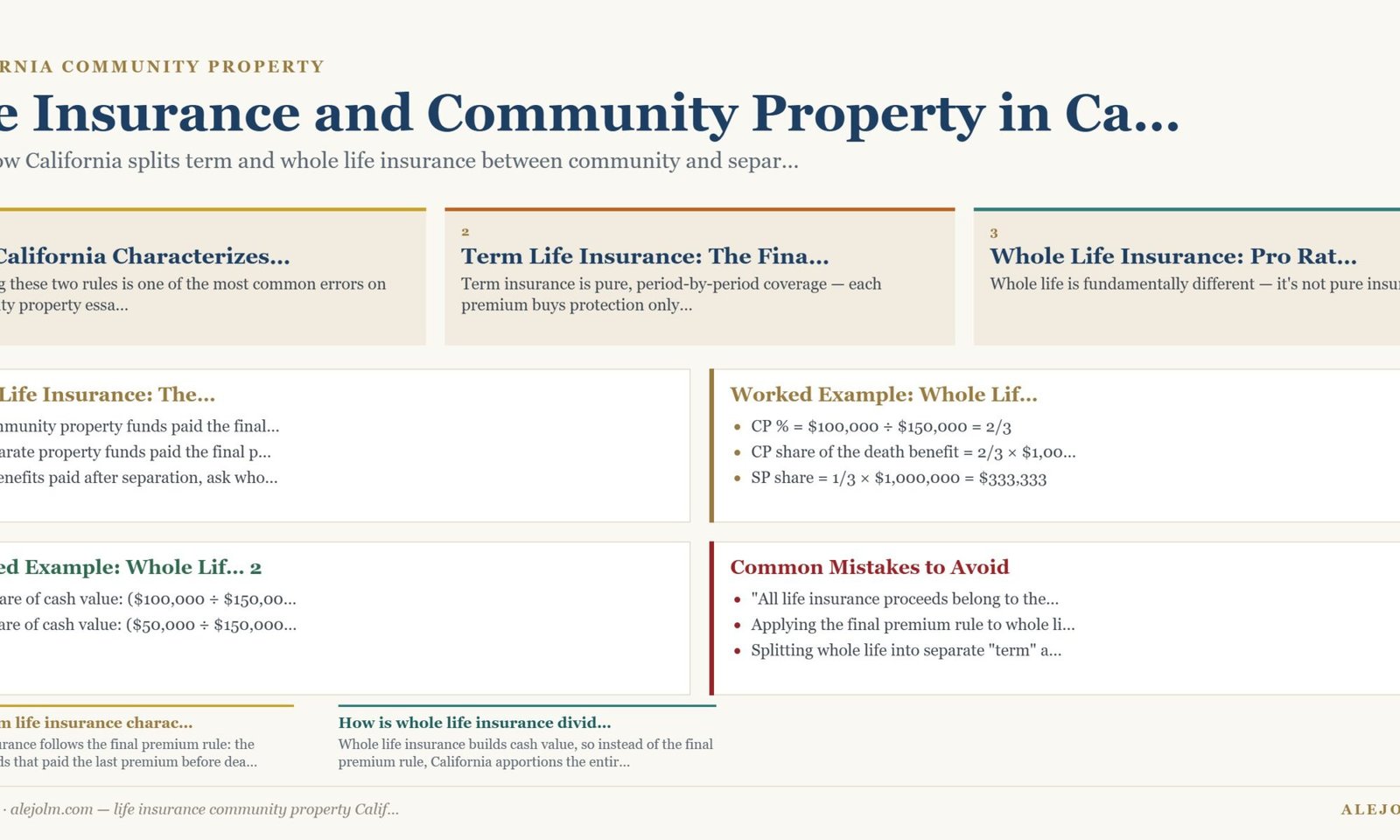
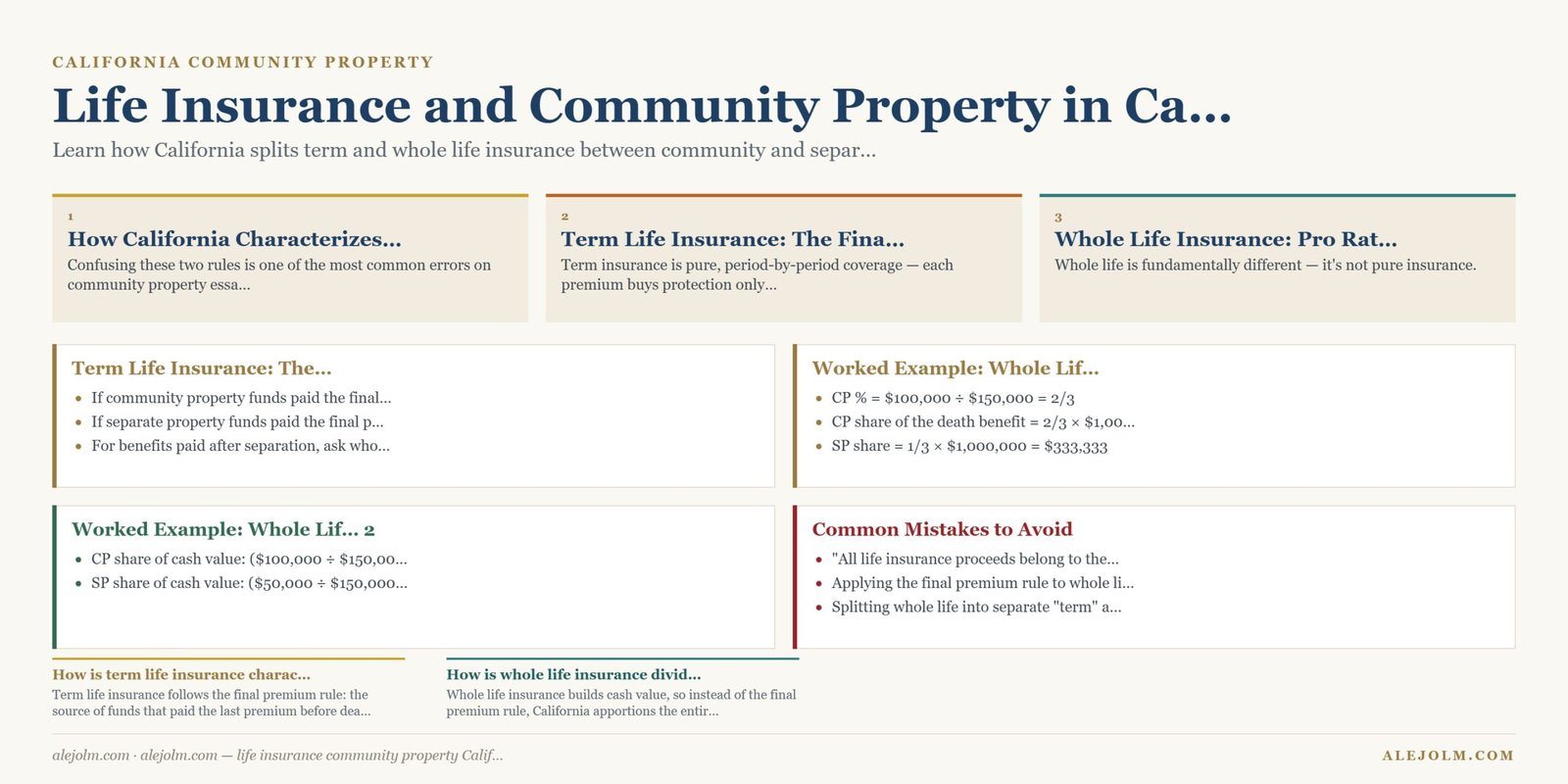
How California Characterizes Life Insurance
Life insurance is a contract paying a death benefit, and California characterizes it differently depending on the type of policy. Term life insurance — pure insurance with no savings component — follows the final premium rule: whoever’s funds paid the last premium owns the death benefit. Whole life insurance, which builds cash value, is instead apportioned pro rata across every premium ever paid, using a formula from Estate of Logan and In re Marriage of Lorenz.
Confusing these two rules is one of the most common errors on community property essay questions, because term and whole life look similar on the surface but are analyzed completely differently.
Term Life Insurance: The Final Premium Rule
Term insurance is pure, period-by-period coverage — each premium buys protection only for that specific period, with nothing carried forward. Because there’s no accumulated value, California applies a simple rule:
Final Premium Rule: the spouse whose funds paid the last premium before death owns the entire death benefit.
- If community property funds paid the final premium, the benefit is CP.
- If separate property funds paid the final premium, the benefit is SP.
- For benefits paid after separation, ask who paid the premium covering the period in which the insured died.
Worked example: A couple buys a $500,000 annual-premium term policy during marriage, paid with CP funds throughout the marriage. The policy stays CP through the end of the coverage period the last CP-paid premium purchased. After separation, if the insured continues paying premiums from post-separation (SP) earnings, the policy becomes the insured’s SP once SP-funded coverage takes over. So if the insured dies during the period covered by the last CP premium, the $500,000 is CP; if death occurs during a period covered by a later SP premium, the benefit is SP.
Whole Life Insurance: Pro Rata Apportionment
Whole life is fundamentally different — it’s not pure insurance. Every premium contributes to a permanent, cumulative cash value that doesn’t expire the way term coverage does. Because of that, the final premium rule doesn’t apply. Instead, California apportions the entire policy — cash value and the pure-insurance component together — using a single, unified formula:
CP % = Total premiums paid with CP funds ÷ Total premiums paid (CP + SP)
Apply that percentage to whichever value is being divided: the death benefit at death, or the cash value/policy value at divorce. There is no separate “term piece” carved out and governed by a different rule — the whole policy is apportioned as one asset.
Term vs. Whole Life at a Glance
| Feature | Term Life | Whole Life |
|---|---|---|
| Governing rule | Final premium rule | Pro rata apportionment (all premiums) |
| Cash value | None | Yes — builds over time |
| CP determined by | Who paid the last premium | Ratio of CP premiums to all premiums paid |
| Applies to | Death benefit only | Both cash value and death benefit |
| Leading authority | Standard CP timing principles | Estate of Logan; In re Marriage of Lorenz |
Worked Example: Whole Life at Death
A couple buys a whole life policy with a $1,000,000 death benefit. Over the life of the policy, $100,000 in premiums were paid with CP funds and $50,000 with SP funds — $150,000 total. The husband dies, and a named beneficiary (say, a child from a prior relationship) receives the payout.
- CP % = $100,000 ÷ $150,000 = 2/3
- CP share of the death benefit = 2/3 × $1,000,000 = $666,667
- SP share = 1/3 × $1,000,000 = $333,333
The community estate has a claim to its $666,667 share regardless of who is named as the policy’s beneficiary — naming a third party doesn’t defeat the community’s proportional interest.
Worked Example: Whole Life at Divorce
Same type of policy, but this time the couple is divorcing rather than dealing with a death. The policy’s cash value is $50,000; $100,000 of total premiums were CP and $50,000 were paid from the wife’s SP.
- CP share of cash value: ($100,000 ÷ $150,000) × $50,000 = $33,333, divided equally — each spouse takes $16,667.
- SP share of cash value: ($50,000 ÷ $150,000) × $50,000 = $16,667, belonging entirely to the wife, since her separate funds paid those premiums.
Beneficiary Designations Don’t Defeat the Community’s Interest
Naming a third party — or even the other spouse — as beneficiary does not eliminate the community’s proportional claim to the proceeds. If CP funds paid part of the premiums, the community estate has a pro rata claim to the death benefit even though the money passes to the named beneficiary outside of probate. The non-insured spouse’s community interest rides along with that claim.
Common Mistakes to Avoid
- “All life insurance proceeds belong to the named beneficiary as their SP.” Wrong. If CP funds paid any of the premiums, the community holds a proportional interest in the proceeds regardless of who’s named as beneficiary.
- Applying the final premium rule to whole life insurance. Whole life is never governed by the final premium rule — always use the pro rata formula across all premiums paid over the policy’s life.
- Splitting whole life into separate “term” and “cash value” pieces. California treats whole life as one unified asset apportioned by a single CP-premium ratio, not two assets governed by different rules.
Exam Strategy
First identify the policy type — term or whole life — because that single fact determines which formula applies. For term policies, find who paid the premium covering the period of death. For whole life, calculate the CP percentage by adding up every premium ever paid, then apply that ratio to whatever value is being divided (cash value at divorce, or death benefit at death).
FAQ
How is term life insurance characterized as community or separate property in California?
Term life insurance follows the final premium rule: the source of funds that paid the last premium before death determines the character of the entire death benefit — community funds mean a CP benefit, separate funds mean an SP benefit.
How is whole life insurance divided differently from term life insurance?
Whole life insurance builds cash value, so instead of the final premium rule, California apportions the entire policy value pro rata based on the ratio of community-paid premiums to all premiums ever paid over the life of the policy.
Does naming someone else as beneficiary eliminate the community’s interest in a life insurance policy?
No. If community funds paid part of the premiums, the community estate retains a proportional claim to the proceeds even if a third party is named as beneficiary and the money passes outside of probate.
Key Takeaways
- Term life insurance is governed by the final premium rule: whoever paid the last premium owns the death benefit.
- Whole life insurance is apportioned pro rata using the ratio of CP premiums to total premiums paid, applied to the whole policy value.
- The same pro rata formula applies both at death (to the death benefit) and at divorce (to the cash value).
- Naming a third-party beneficiary does not defeat the community’s proportional interest in the proceeds.
- Never apply the final premium rule to whole life insurance, and never split whole life into separate term and cash-value components.
Related guides
- community property presumptions
- wage replacement benefits
- pension time rule for community property
- personal injury recovery and community property
Sources and further reading
This article is educational and is not legal advice. Consult a licensed California attorney about your situation.