
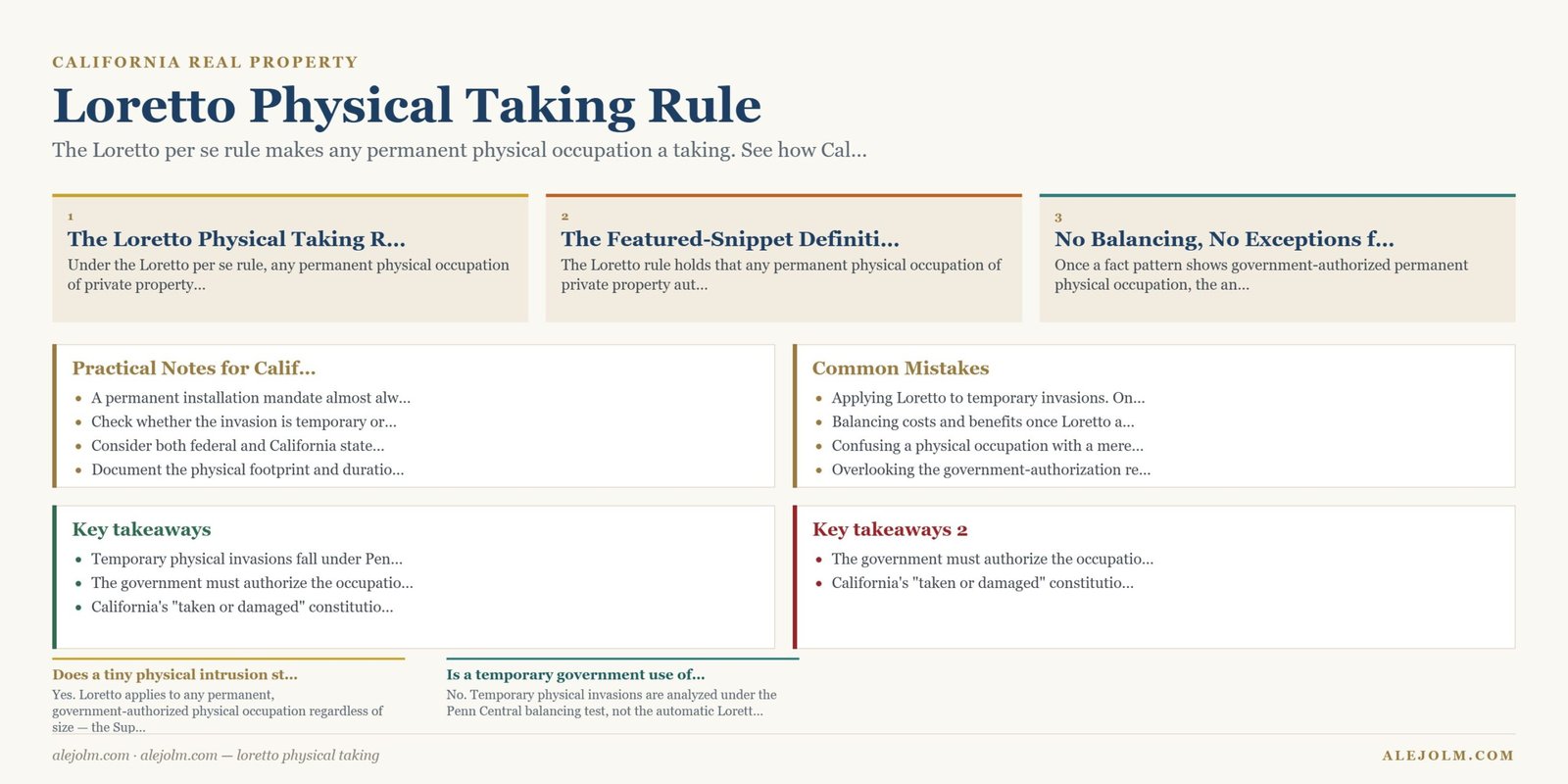
The Loretto Physical Taking Rule, Explained
Under the Loretto per se rule, any permanent physical occupation of private property authorized by the government is automatically a taking — no matter how small, and no matter how large the public benefit. The rule comes from Loretto v. Teleprompter Manhattan CATV Corp., 458 U.S. 419 (1982), where a state law forcing landlords to allow a tiny cable box on their buildings was still held to require just compensation.
This matters in California well beyond bar exam essays. The state’s constitution goes further than the federal Fifth Amendme nt takings clause: Article I, section 19 of the California Constitution compensates property that is “taken or damaged” for public use, a broader trigger than the federal “taken” standard alone. Anyone dealing with a utility easement, a required public-access strip, or a government-mandated installation on their land should understand this rule.
The Featured-Snippet Definition
The Loretto rule holds that any permanent physical occupation of private property authorized by the government is automatically a taking requiring just compensation, regardless of how minor the physical intrusion or how significant the public benefit — no balancing test applies once a permanent occupation is shown.
No Balancing, No Exceptions for Size
Once a fact pattern shows government-authorized permanent physical occupation, the analysis is over — compensation is owed as a matter of law. It does not matter that the footprint is a single cable box, that the public benefit is universal utility access, or that the property owner’s economic loss is minimal. Loretto is categorical, not case-by-case.
This is what separates Loretto from every other takings doctrine. Everywhere else in takings law, courts weigh costs against benefits. Under Loretto, the weighing never starts.
“Permanent” Is the Word That Controls Everything
The entire rule turns on one modifier. A temporary physical invasion — even an intrusive one — does not trigger Loretto’s automatic rule. It gets analyzed instead under the ad hoc Penn Central balancing test, which weighs the public benefit against the owner’s economic harm and reasonable investment-backed expectations.
| Fact Pattern | Loretto Applies? | Governing Test |
|---|---|---|
| Permanent cable box bolted to a building | Yes | Loretto per se rule |
| Permanent utility line or pipeline across land | Yes | Loretto per se rule |
| Six-week emergency flood-control diversion | No | Penn Central balancing |
| Permanent forced public-access easement | Usually yes, if it authorizes ongoing physical occupation | Loretto per se rule |
| Height restriction or use limitation (no physical entry) | No | Penn Central balancing |
Examiners test this line constantly: the moment “temporary” appears in a fact pattern, the automatic rule is off the table.
Government Authorization Is the Trigger, Not Just Any Trespass
Loretto only applies when the government authorizes, mandates, or enables the occupation. A private party’s unauthorized trespass — even a permanent one — is a tort claim, not a constitutional taking. The government has to be the one requiring or permitting the occupation for the per se rule to attach.
This distinction matters practically: if a neighbor’s fence permanently encroaches on your land, that’s a boundary dispute and potential trespass or adverse-possession issue, not a Loretto taking. If a city ordinance requires you to let a utility company install permanent equipment on your building, that is squarely within Loretto.
California’s Broader “Taken or Damaged” Standard
California property owners have an extra tool the federal Constitution doesn’t provide. California Constitution Article I, section 19 requires compensation when property is “taken or damaged” for public use — language broader than the federal Fifth Amendment’s “taken” alone. This matters for claims like consequential flooding or construction-related property damage from a public project that might not qualify as a “taking” under a strict federal physical-occupation analysis but can still support a state constitutional claim.
Anyone pursuing a California takings claim should evaluate both the federal Loretto/Penn Central framework and the state constitution’s damage-inclusive standard — they don’t always overlap, and the state claim can succeed where the federal one would not. Consequential property damage from a public project can also overlap conceptually with a private nuisance claim, though the constitutional and nuisance theories run on separate tracks with separate defendants and defenses.
Worked Example: The Rooftop Antenna Mandate
A California city passes an ordinance requiring landlords citywide to permit emergency-services antenna equipment — a roughly two-square-foot mounting bracket — to be permanently installed on rooftops at no cost to the landlord, to improve first-responder radio coverage. Landlord Priya challenges the ordinance, arguing it takes her property without compensation. The city responds that the public safety benefit vastly outweighs the trivial physical footprint.
Analysis: Under Loretto, the city’s benefit-outweighs-burden argument is irrelevant. The mounting bracket is a permanent, government-authorized physical occupation of Priya’s rooftop, however small. That is a categorical taking requiring just compensation as a matter of law — the ordinance’s importance to public safety does not change the outcome. The city can still require the installation; it simply has to pay for the physical occupation it is mandating.
Practical Notes for California Property Owners
- A permanent installation mandate almost always means compensation is owed — don’t accept “it’s for the public good” as the final word from a government agency or utility.
- Check whether the invasion is temporary or permanent before assuming Loretto applies; temporary disruptions (construction staging, emergency access) usually fall under Penn Central instead.
- Consider both federal and California state claims. California’s “taken or damaged” language can support a claim even where a purely federal Loretto/Penn Central analysis might fall short.
- Document the physical footprint and duration of any government-authorized occupation — these facts decide which test applies.
- A Loretto taking claim is separate from a vested rights claim — the first compensates a physical occupation, the second protects a project already under construction from a rezoning.
Common Mistakes
- Applying Loretto to temporary invasions. Only permanent occupation triggers the per se rule; temporary ones go to Penn Central.
- Balancing costs and benefits once Loretto applies. No balancing occurs — permanent occupation equals a taking, full stop.
- Confusing a physical occupation with a mere use restriction. A height limit or setback rule is not “physical” and is analyzed under Penn Central, even if severe.
- Overlooking the government-authorization requirement. A private trespass is not a Loretto taking; the government must authorize or mandate the occupation.
- Ignoring California’s broader state constitutional standard. The “taken or damaged” language in Article I, section 19 can support claims a federal-only analysis would miss.
FAQ
Does a tiny physical intrusion still count as a taking under Loretto?
Yes. Loretto applies to any permanent, government-authorized physical occupation regardless of size — the Supreme Court applied it to a cable box just a few inches across.
Is a temporary government use of my land automatically a taking?
No. Temporary physical invasions are analyzed under the Penn Central balancing test, not the automatic Loretto rule, which is reserved for permanent occupations.
How is California’s takings clause different from the federal one?
California Constitution Article I, section 19 compensates property “taken or damaged,” a broader standard than the federal Fifth Amendment’s “taken” language alone, which can support claims federal law would not reach.
Key Takeaways
- Any permanent, government-authorized physical occupation is automatically a taking under Loretto, regardless of size or public benefit.
- No balancing test applies once permanent physical occupation is established.
- Temporary physical invasions fall under Penn Central balancing instead of Loretto.
- The government must authorize the occupation — private trespass is not a Loretto taking.
- California’s “taken or damaged” constitutional language is broader than the federal Fifth Amendment.
Related guides
Sources and further reading
- Loretto v. Teleprompter Manhattan CATV Corp., 458 U.S. 419 (1982)
- Penn Central Transportation Co. v. New York City, 438 U.S. 104 (1978)
- California Constitution, Article I, Section 19
This article is educational and is not legal advice. Consult a licensed California attorney about your situation.