
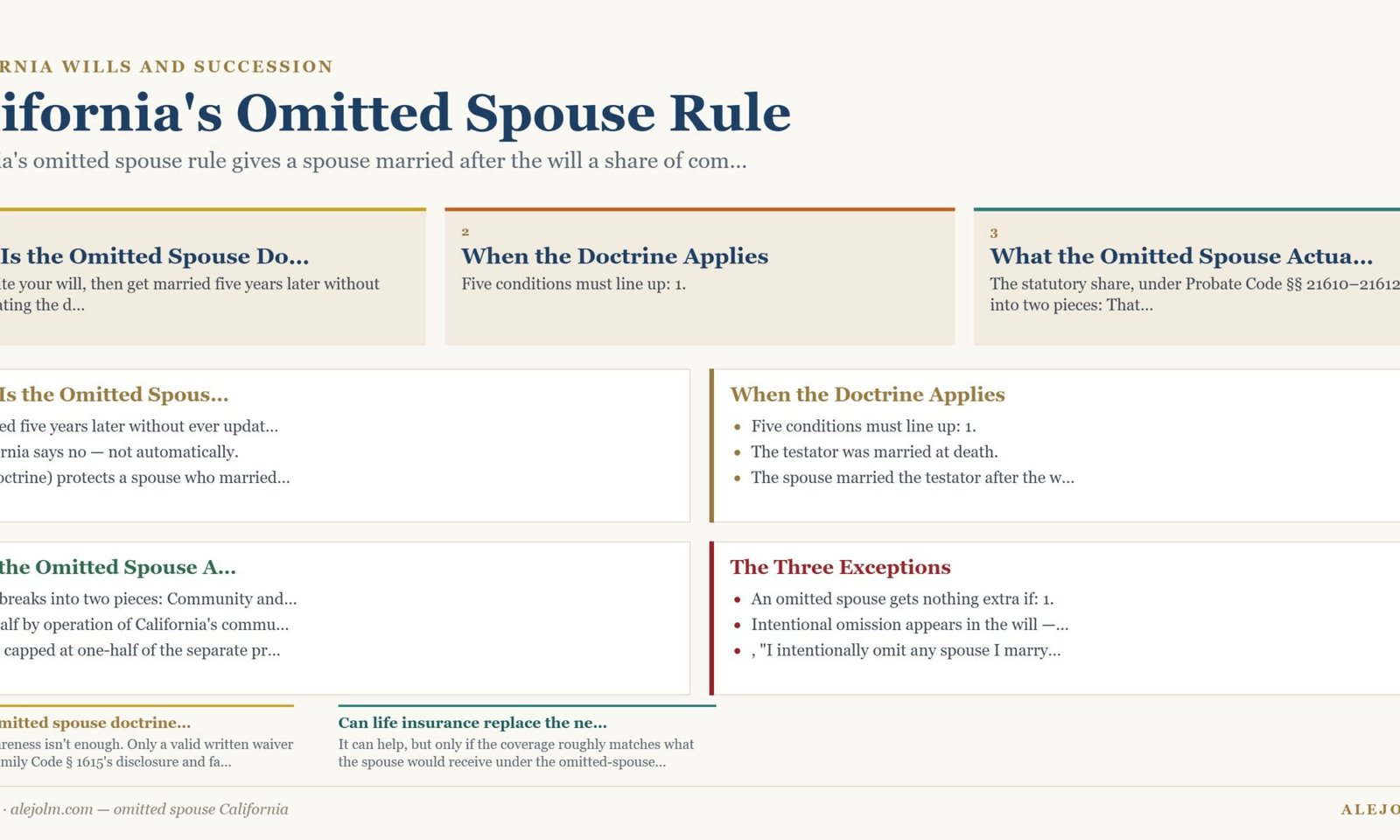
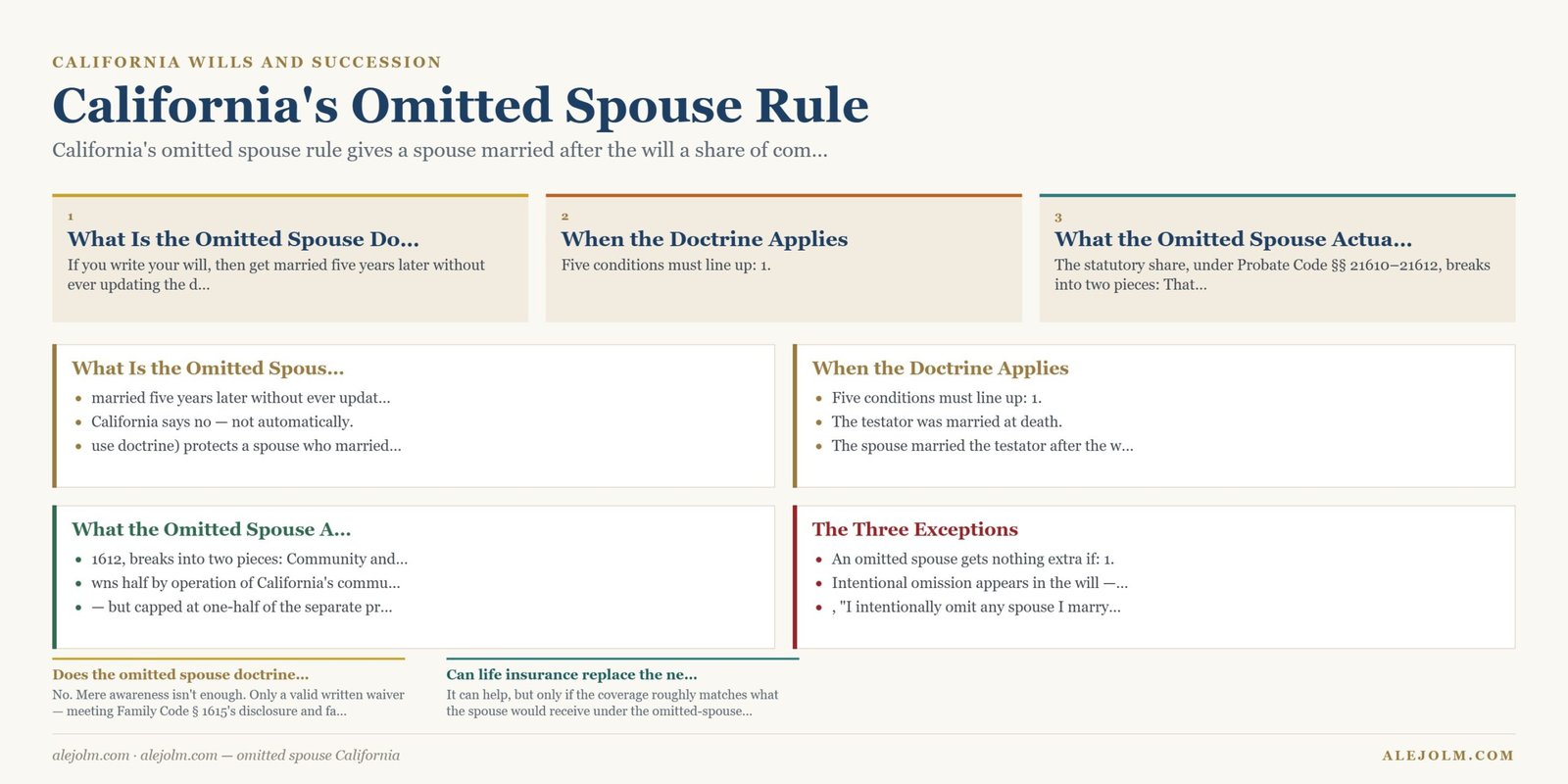
What Is the Omitted Spouse Doctrine?
If you write your will, then get married five years later without ever updating the document, does your new spouse get shut out of your estate? California says no — not automatically. The omitted spouse doctrine (also called the pretermitted spouse doctrine) protects a spouse who married the testator after the will was signed and was never added to it. It’s a heavily tested California Bar Exam topic because the math combines community property rules with intestate succession shares, and it’s also one of the most practically important protections in real-world estate planning.
Omitted spouse, in one breath: a spouse who married the testator after the will’s execution, and who was neither named nor intentionally excluded, is entitled by statute to a share of the estate — generally all community and quasi-community property, plus a capped share of separate property — unless a recognized exception applies.
When the Doctrine Applies
Five conditions must line up:
- The testator was married at death.
- The spouse married the testator after the will was executed.
- The spouse is not named or provided for in the will.
- The will doesn’t show intent to omit that spouse.
- The spouse never validly waived their rights in writing.
If a spouse is named in the will and later divorces the testator, that’s a completely different rule — revocation by divorce under Probate Code § 6122 — not the omitted spouse doctrine.
What the Omitted Spouse Actually Receives
The statutory share, under Probate Code §§ 21610–21612, breaks into two pieces:
Community and quasi-community property: The omitted spouse gets 100% of it. The spouse already owns half by operation of California’s community property law; the statute grants the decedent’s other half too.
Separate property: The omitted spouse gets the share they would have received under intestate succession — but capped at one-half of the separate property, no matter how large the intestate share would otherwise be.
| Surviving Family | Intestate Share of Separate Property | Omitted-Spouse Share (Capped) |
|---|---|---|
| Two or more children | 1/3 | 1/3 (below the cap, unaffected) |
| One child | 1/2 | 1/2 |
| No issue, but parents or siblings survive | 1/2 | 1/2 |
| No issue, no parents, no siblings | 100% | 1/2 (cap kicks in) |
That cap — trimming what would otherwise be a full intestate share down to one-half — is the single detail most students forget, and it’s a favorite bar-exam trap.
The Three Exceptions
An omitted spouse gets nothing extra if:
- Intentional omission appears in the will — e.g., “I intentionally omit any spouse I marry after this will’s execution.”
- The testator provided for the spouse outside the will — life insurance, joint tenancy, or a trust — but only if that provision is roughly equivalent to the statutory share. If it falls short, the spouse can claim the shortfall.
- A valid written waiver exists, meeting California Family Code § 1615: full financial disclosure (or a knowing waiver of disclosure), independent legal counsel or clearly fair circumstances, and a knowing, voluntary signature. Courts construe waivers strictly against the person trying to enforce them.
Worked Example: The Separate-Property Estate
Facts: Testator T’s 2019 will leaves his entire $2 million estate, all separate property, to his son. T marries his partner P in 2021 and never updates the will. T dies in 2023. P survives, and T’s only child is the son from before.
Analysis:
- Omitted spouse status: P married after the will was signed (2021 > 2019) and isn’t named in it.
- No exception: No intentional-omission language, no outside provision, no waiver.
- Share calculation: All property is separate property; T left exactly one child, so the intestate share of separate property is one-half — and the § 21610(c) cap doesn’t reduce it further because one-half is already the cap.
Result: P receives $1 million (half the separate-property estate). The son’s inheritance shrinks from $2 million to $1 million. If T had left two or more children instead of one, P’s share would drop to one-third ($666,667); if T had left no children, parents, or siblings at all, P’s intestate share would theoretically be 100%, but the statutory cap would still hold P to one-half.
Why Community Property Makes This Doctrine So Powerful
The community-property piece is what makes omitted-spouse claims so valuable in California. Say T executed a will in 2018, married S in 2021, and the couple earned $600,000 in salary together during the marriage before T’s death in 2023. S automatically keeps their own $300,000 half as community property, then receives the other $300,000 from T’s half under the omitted-spouse statute — a full $600,000, regardless of anything the will says. That doubling effect explains why anyone marrying after signing a will should update their estate plan promptly.
Burden of Proof
The omitted spouse must first show three things: the marriage happened after the will was executed, no express omission appears in the will, and no valid waiver or adequate outside provision exists. Once that’s shown, the burden shifts to whoever is defending the will to prove one of the exceptions. Courts lean toward protecting the spouse — vague will language like “everything to my children” doesn’t automatically show intent to exclude a later spouse; only clear, explicit language does.
Frequently Asked Questions
Does the omitted spouse doctrine apply if my spouse knew about my will and didn’t object?
No. Mere awareness isn’t enough. Only a valid written waiver — meeting Family Code § 1615’s disclosure and fairness requirements — defeats the claim. A spouse can know all about a will and still be legally “omitted” for statutory purposes.
Can life insurance replace the need to update my will after marriage?
It can help, but only if the coverage roughly matches what the spouse would receive under the omitted-spouse statute. If the insurance falls short of that statutory share, the spouse can still claim the difference from the estate.
What if I got married and then divorced before my spouse died?
That’s not an omitted-spouse situation at all. Divorce triggers a different rule — Probate Code § 6122 — which automatically revokes gifts to a former spouse in an existing will.
Key Takeaways
- The omitted spouse doctrine protects a spouse married after the will was executed and never added to it.
- Under Probate Code §§ 21610–21612, the omitted spouse gets 100% of community and quasi-community property, plus a capped share (never more than one-half) of separate property.
- Three exceptions defeat the claim: intentional omission in the will, adequate outside provision, or a valid written waiver under Family Code § 1615.
- The community-property share can be far larger than the separate-property share, since the spouse already owns half by law.
- The burden starts with the spouse but shifts to the will’s proponent once basic eligibility is shown.
- The safest fix is simple: update your will (or execute a valid waiver) whenever you marry.
This article is educational and is not legal advice. Consult a licensed California attorney about your situation.