
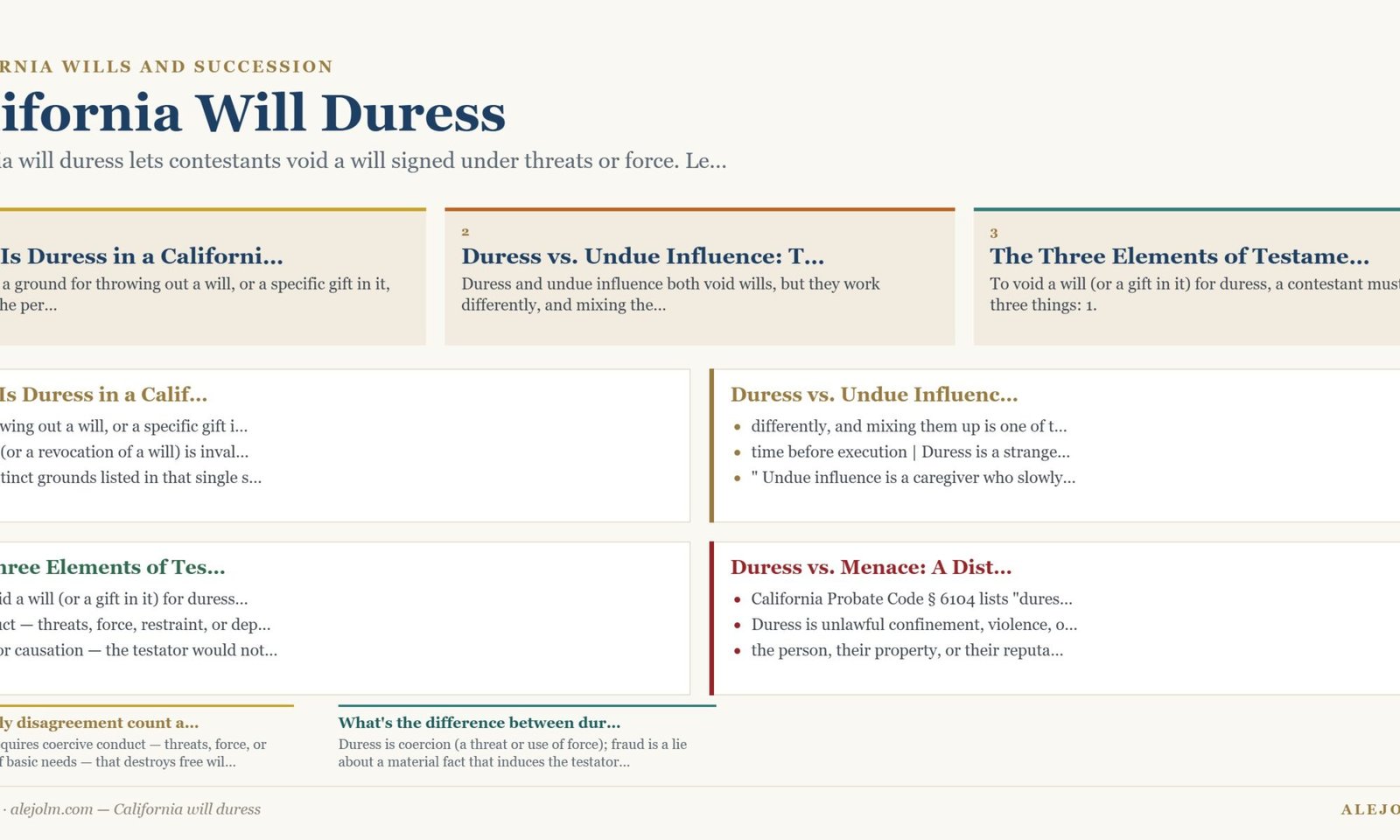
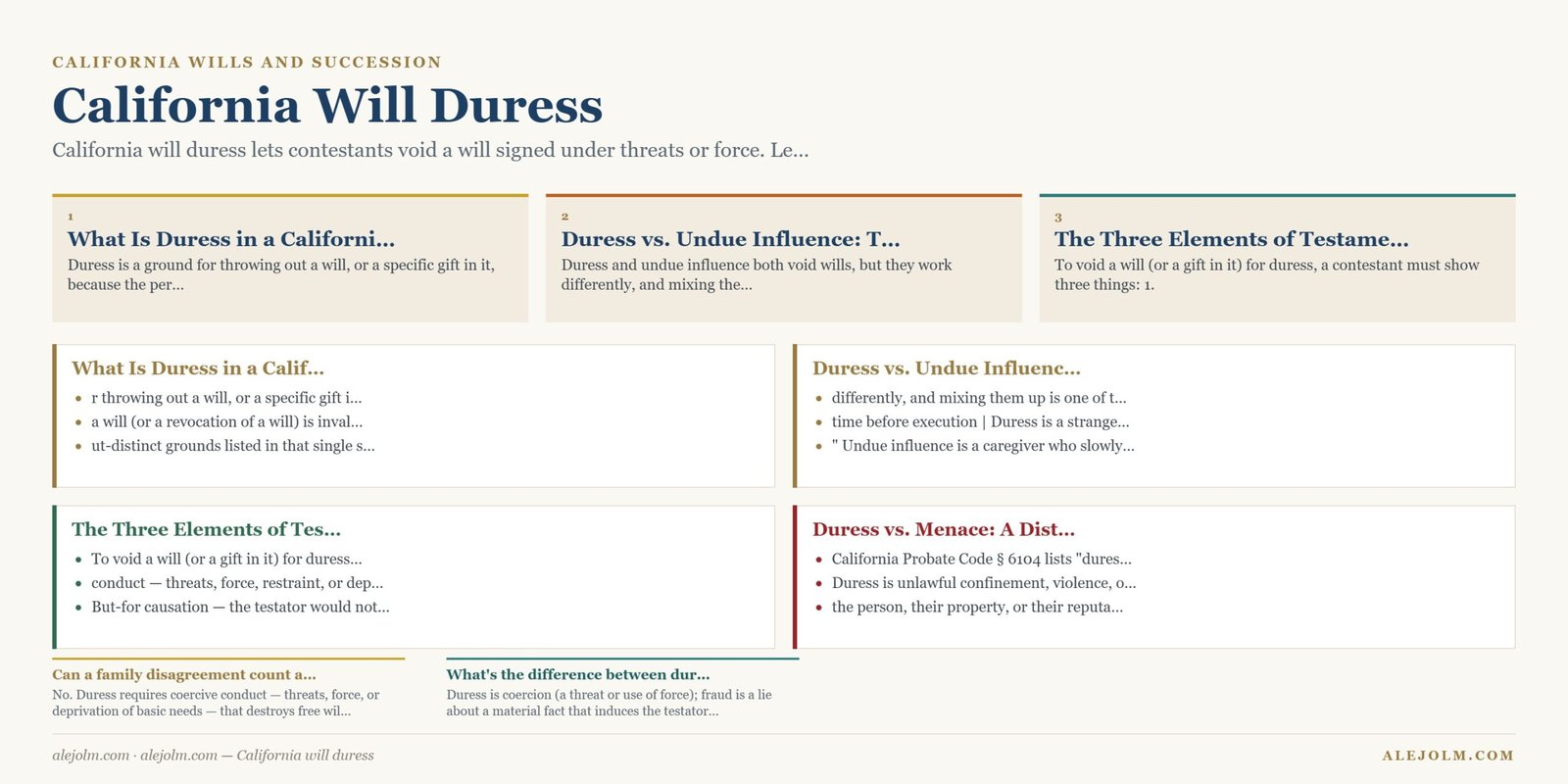
What Is Duress in a California Will Contest?
Duress is a ground for throwing out a will, or a specific gift in it, because the person who signed it wasn’t really free to say no. Under California Probate Code § 6104, a will (or a revocation of a will) is invalid if it was procured by “duress, menace, fraud, or undue influence.” If you’re studying for the California Bar Exam, duress is one of four related-but-distinct grounds listed in that single sentence, and examiners love to test whether you can tell them apart. If you’re a family member wondering whether Grandpa’s last-minute will can be challenged, duress is the doctrine that applies when someone forced his hand — literally.
Duress, in a single sentence: it’s overt coercion — threats, physical force, confinement, or denial of food, shelter, or medical care — that overrides a testator’s free will at the moment they sign or revoke a will, and it must be proven by clear and convincing evidence.
Duress vs. Undue Influence: The Distinction Everyone Misses
Duress and undue influence both void wills, but they work differently, and mixing them up is one of the most common errors on bar exam essays and in real will contests.
| Aspect | Duress | Undue Influence |
|---|---|---|
| Nature of pressure | Overt: threats, force, restraint | Subtle: psychological manipulation |
| Source | Often external or even adversarial | Usually someone in a position of trust |
| Evidence | Explicit threats, physical control | Isolation, dependency, access |
| Timing | Must be active at execution/revocation | Can build up over time before execution |
Duress is a stranger — or a family member acting like one — saying “sign this, or else.” Undue influence is a caregiver who slowly isolates a vulnerable person and steers their decisions. Both are will-contest grounds under § 6104, but courts analyze the proof very differently.
The Three Elements of Testamentary Duress
To void a will (or a gift in it) for duress, a contestant must show three things:
- Coercive conduct — threats, force, restraint, or deprivation of basic needs that destroys the testator’s free choice.
- But-for causation — the testator would not have signed (or revoked) as they did without the coercion.
- Operative timing — the pressure was actively constraining the testator at the moment of the testamentary act.
All three must be present. A testator who is merely disappointed by family criticism, or who changes a will after an argument, hasn’t been subjected to duress — hurt feelings aren’t coercion.
Duress vs. Menace: A Distinction Bar Examiners Love
California Probate Code § 6104 lists “duress, menace, fraud, or undue influence” as four separate grounds. Duress is unlawful confinement, violence, or the threat of immediate physical harm. Menace is broader: it’s a threat of future or indirect harm — to the person, their property, or their reputation — made by someone who doesn’t have to carry it out on the spot. “Sign this will or I’ll tell everyone in town your secret” is menace, not duress, because the harm is future and reputational rather than immediate and physical.
The good news for exam purposes: both are analyzed the same way (coercion + causation + timing) and produce the same remedy — invalidation of the affected disposition. You get partial credit for spotting the coercion; full credit comes from correctly labeling whether the facts describe immediate force (duress) or a threat of future harm (menace).
Worked Example: The Nursing-Home Threat
Facts: Testator T, a widow living alone, has a will splitting her estate equally between her son S and daughter D. S moves in “to help.” Over several months, S isolates T from D, tells T that D “stole from her,” and threatens to move T into a remote nursing facility unless T rewrites her will to leave everything to S. Frightened, T signs a new will leaving her entire estate to S. T dies shortly after.
Analysis:
- Coercive conduct: Isolation plus an explicit threat of institutional placement qualifies as coercion — it’s more than persuasion.
- But-for causation: T likely would not have disinherited D absent the threat; the new will is directly traceable to the coercion.
- Operative timing: The pressure was ongoing right up to and through execution.
Result: D has a strong duress claim. If she proves it by clear and convincing evidence, the new will is void, and the prior will (or intestacy, if no earlier will exists) controls — meaning D and S split the estate equally after all.
Revocation Under Duress Is Also Void
Here’s a wrinkle that trips up even careful students: duress doesn’t just void new wills — it also voids revocations. If a testator tears up or formally revokes a valid earlier will because someone coerced them into it, that revocation is treated as if it never happened, and the earlier will remains in force. Practically speaking, duress can “undo an undo.”
Partial vs. Total Invalidity
If duress affected only one clause of the will, only that clause falls; the rest of the document stands. If duress infected the entire instrument, the whole will is void, and the estate passes under a prior will or by intestate succession under the California Probate Code’s intestacy rules.
Burden of Proof
Because wills are presumed valid and duress accusations are serious, the contestant carries the burden of proving duress by clear and convincing evidence — a demanding standard above the ordinary “preponderance” bar used in most civil cases. Courts look for threats (witnessed, recorded, or credibly testified to), medical or psychological records documenting fear or distress, and circumstantial evidence like isolation of the testator or unusual last-minute changes favoring the alleged wrongdoer.
Frequently Asked Questions
Can a family disagreement count as duress?
No. Duress requires coercive conduct — threats, force, or deprivation of basic needs — that destroys free will. A testator who’s simply upset about a family conflict, or who disinherits a relative out of anger, has not been coerced in the legal sense.
What’s the difference between duress and fraud in a California will contest?
Duress is coercion (a threat or use of force); fraud is a lie about a material fact that induces the testator to act. A caregiver who falsely says “your family abandoned you” to win a bequest is committing fraud (or possibly undue influence); one who threatens to move the testator to an institution is committing duress or menace.
Does a threat have to be carried out to count as duress?
No. The threat itself is enough if it destroyed the testator’s free will and caused the disposition. Whether the wrongdoer could actually follow through matters more for classifying the conduct as duress versus menace than for the ultimate remedy.
Key Takeaways
- Duress requires overt coercion — threats, force, restraint, or denial of necessities — not mere persuasion or hurt feelings.
- Under Cal. Probate Code § 6104, duress, menace, fraud, and undue influence are four distinct grounds for contesting a will.
- Three elements must all be proven: coercive conduct, but-for causation, and operative timing at execution or revocation.
- A revocation made under duress is void, reviving the prior will.
- Duress can invalidate part of a will or the entire instrument, depending on scope.
- Contestants bear the burden of proof, and it’s a high one: clear and convincing evidence.
This article is educational and is not legal advice. Consult a licensed California attorney about your situation.
Related guides
- undue influence in California wills
- how to contest a will in California
- California will execution requirements