
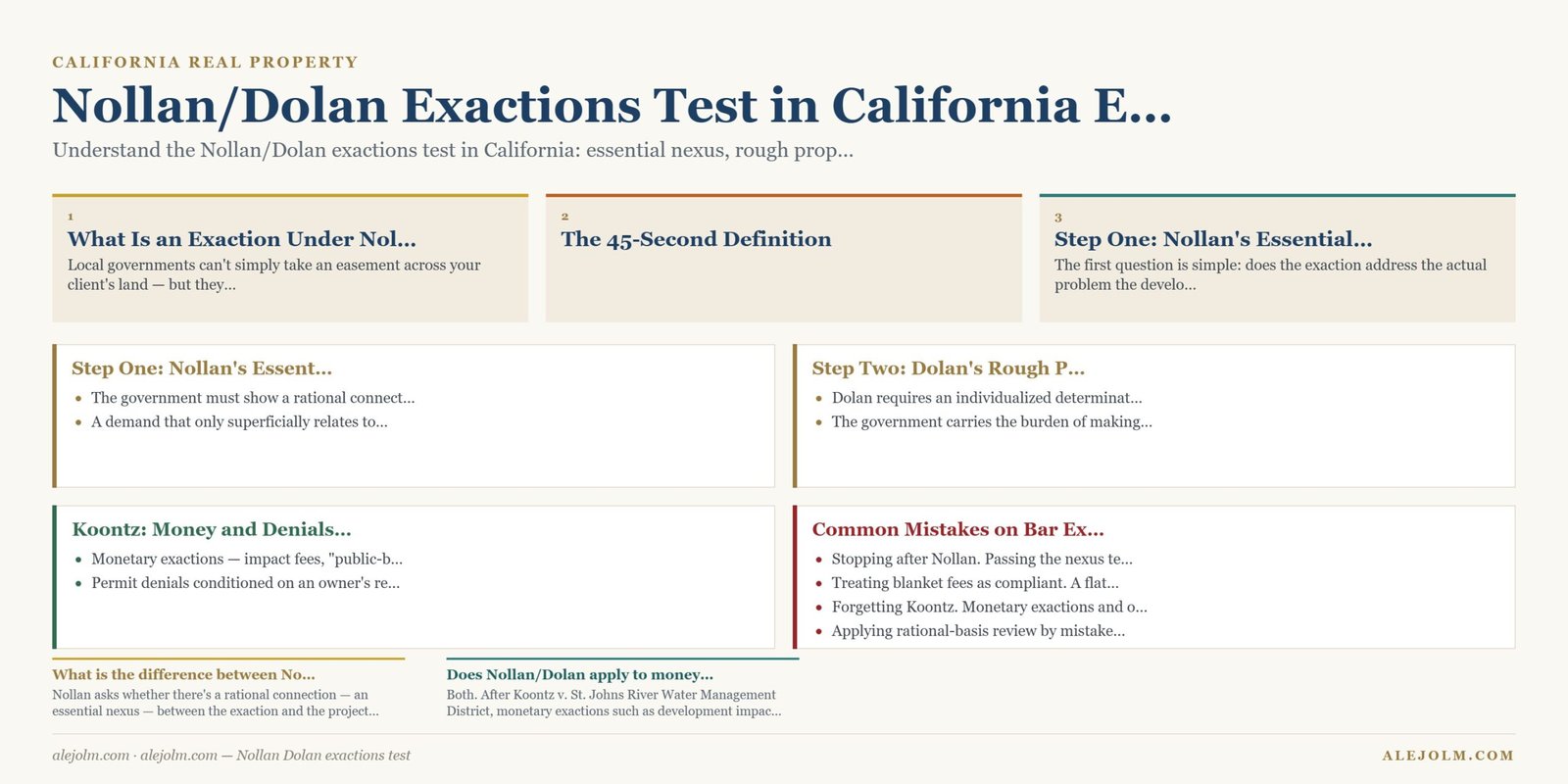
What Is an Exaction Under Nollan/Dolan?
Local governments can’t simply take an easement across your client’s land — but they can, in theory, ask for one as the price of a building permit. That’s an exaction, and it’s a favorite fact pattern on the California Bar Exam because it sits at the intersection of land-use law and the Takings Clause.
The government can’t get through the front door of outright condemnation without paying, so it sometimes tries the back door: conditioning permit approval on a “voluntary” dedication of property, an easement, or a fee. The Nollan/Dolan two-part test exists precisely to stop that kind of leverage.
The 45-Second Definition
Exaction: a condition — a physical dedication, an easement, or a monetary fee — that the government demands as a prerequisite to approving a development permit. To survive constitutional scrutiny, the exaction must satisfy both an essential nexus (Nollan) to the project’s impact and rough proportionality (Dolan) to that impact’s actual extent; failing either prong makes the exaction an uncompensated taking.
Step One: Nollan’s Essential Nexus
The first question is simple: does the exaction address the actual problem the development creates?
- The government must show a rational connection between the condition it’s demanding and the burden the specific project imposes on the public.
- A demand that only superficially relates to the project’s impact — or addresses an entirely different harm — fails Nollan outright, and the analysis never even reaches Dolan.
Worked example. Dawson wants to replace a small beach cottage with a larger two-story home. The California coastal agency conditions the permit on Dawson dedicating a public lateral easement across his beachfront, reasoning that the larger house will “block ocean views” from the road. Does this pass Nollan?
No. Blocking a view has nothing to do with public beach access. The agency needs a rational connection between the burden the project actually creates and the exaction demanded. A view obstruction doesn’t justify demanding a public-access easement — that’s exactly the kind of leverage Nollan was designed to stop.
Step Two: Dolan’s Rough Proportionality
Passing Nollan gets you only halfway. Even where a nexus exists, the government must also show the exaction is roughly proportional — in nature and extent — to the specific project’s impact.
- Dolan requires an individualized determination, not a blanket rule applied to every permit regardless of actual impact.
- The government carries the burden of making some sort of individualized showing that the exaction’s scope matches the development’s burden.
| Test | Question asked | Bar | Failure consequence |
|---|---|---|---|
| Nollan (nexus) | Is there a rational connection between the exaction and the project’s impact? | Low | Analysis stops; exaction is a taking |
| Dolan (proportionality) | Is the exaction’s extent roughly proportional to the project’s specific impact? | Higher | Individualized showing required; blanket rules fail |
Worked example. A city requires every retail permit applicant to dedicate a strip of land for a sidewalk, citing increased foot traffic — applied identically to a 2,000-square-foot boutique and a 50,000-square-foot big-box store. There’s a nexus (traffic causes a need for sidewalks), but the uniform rule ignores each project’s actual impact. That flat, undifferentiated approach fails Dolan’s proportionality requirement even though it clears Nollan.
Koontz: Money and Denials Count Too
For years, some courts treated cash exactions differently from land dedications, and treated outright permit denials as outside Nollan/Dolan entirely. Koontz v. St. Johns River Water Management District closed both gaps.
- Monetary exactions — impact fees, “public-benefit” charges, in-lieu payments — are subject to the same nexus-and-proportionality analysis as physical dedications.
- Permit denials conditioned on an owner’s refusal to accept an excessive exaction are also reviewable under Nollan/Dolan. The government cannot use denial as leverage to extract something it couldn’t lawfully demand as a condition.
Worked example. A county charges every new single-family home a flat $50,000 infrastructure fee, with no case-by-case assessment of each home’s actual burden on roads or utilities. Post-Koontz, that flat fee is subject to Nollan/Dolan scrutiny just like a land dedication would be — and the lack of an individualized assessment likely dooms it under Dolan.
Common Mistakes on Bar Exam Fact Patterns
- Stopping after Nollan. Passing the nexus test doesn’t end the inquiry — Dolan’s proportionality prong is a separate, independent hurdle.
- Treating blanket fees as compliant. A flat rule applied to every permit, without regard to that project’s actual impact, violates Dolan even when a nexus clearly exists.
- Forgetting Koontz. Monetary exactions and outright permit denials are both fair game for Nollan/Dolan review — this is a frequently missed expansion.
- Applying rational-basis review by mistake. Nollan/Dolan is heightened scrutiny, meaningfully tougher than the deferential review applied to ordinary, generally applicable zoning regulations.
FAQ
What is the difference between Nollan and Dolan?
Nollan asks whether there’s a rational connection — an essential nexus — between the exaction and the project’s impact. Dolan asks a separate, harder question: whether the exaction’s size is roughly proportional to that specific project’s actual impact. Both must be satisfied.
Does Nollan/Dolan apply to money, or just land dedications?
Both. After Koontz v. St. Johns River Water Management District, monetary exactions such as development impact fees are analyzed under the same nexus-and-proportionality framework as physical land dedications.
Can a city deny a permit outright to pressure a developer into an exaction?
No, not without consequence. Koontz makes clear that a permit denial used as leverage to extract an exaction that would otherwise fail Nollan/Dolan is itself subject to takings scrutiny.
Key Takeaways
- An exaction is any condition — land, easement, or money — imposed as a prerequisite to a development permit.
- Nollan requires an essential nexus between the exaction and the project’s impact.
- Dolan separately requires rough proportionality, based on an individualized assessment — not a blanket rule.
- Koontz extends both prongs to monetary exactions and to permit denials used as leverage.
- Nollan/Dolan is heightened scrutiny, not the rational-basis review used for ordinary zoning.
This article is educational and is not legal advice. Consult a licensed California attorney about your situation.
Related guides
- Lucas total regulatory taking
- Inverse condemnation in California
- Loretto’s per se physical-occupation rule
- California zoning law basics