
Alienage is one of the few areas of equal protection where the tier does not follow from the classification alone. It follows from who is doing the classifying and what they are classifying about. State a citizenship requirement and the answer is presumptively strict scrutiny; move the identical requirement to a federal statute and the answer becomes rational basis.
The structure is therefore easy to state and easy to get wrong: one default, and three pockets carved out of it. Almost every real restriction sits in a pocket, which is why an answer that stops at the default usually reaches the wrong conclusion.
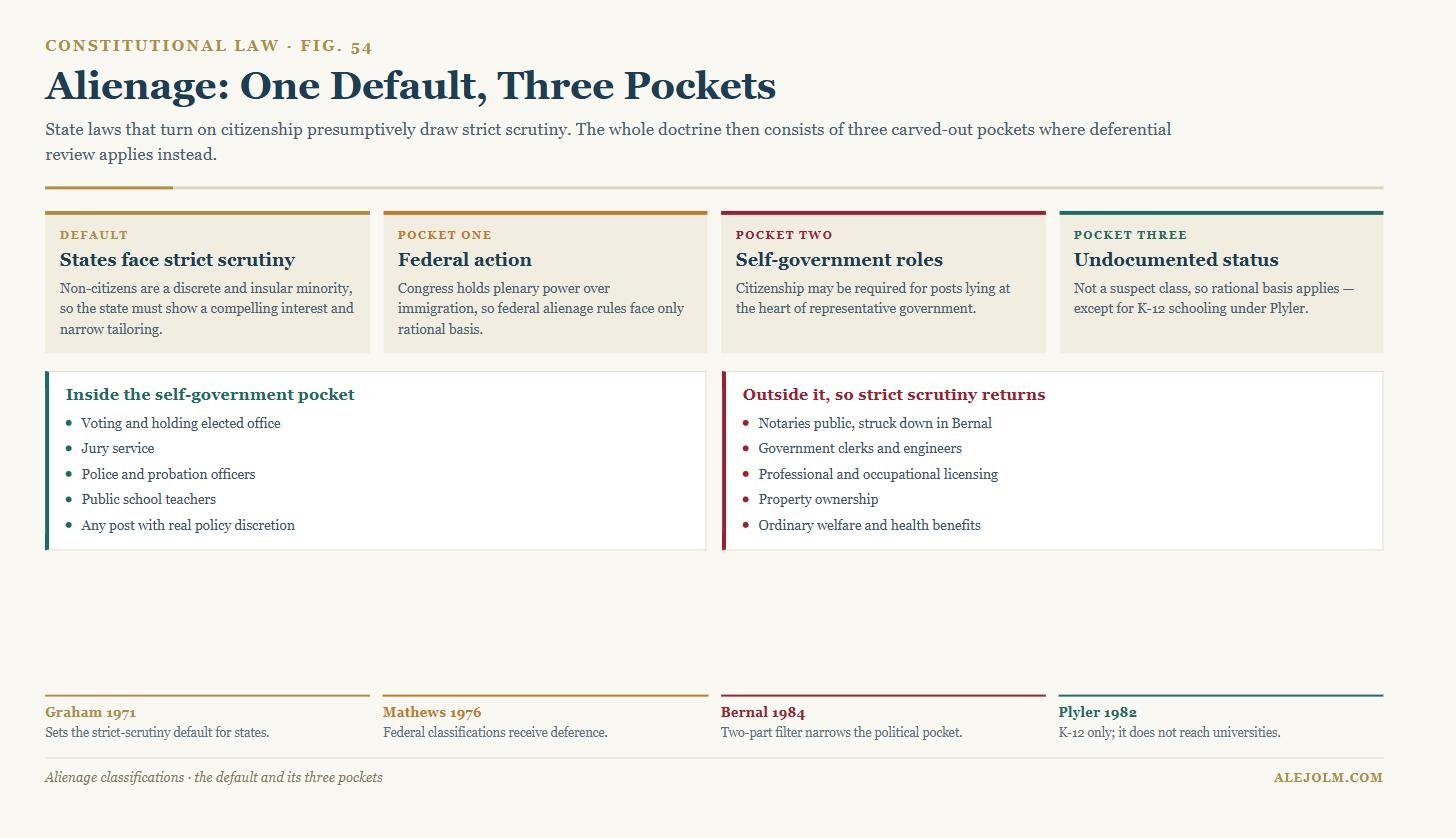
The default: strict scrutiny against the states
State laws distinguishing citizens from non-citizens presumptively receive strict scrutiny. The reasoning is the classic suspect-class rationale: non-citizens form a discrete and insular minority who cannot defend their interests through the ordinary political process, since the very characteristic being used against them excludes them from the franchise.
The consequence is that pure alienage discrimination in ordinary economic and welfare matters fails. A state cannot condition welfare eligibility on citizenship, and it cannot bar non-citizens from owning property or entering licensed professions. Because these restrictions almost never rest on a compelling interest, and because a residency or means test would achieve any fiscal aim more precisely, narrow tailoring collapses as well.
Pocket one: federal action
When the classifying authority is Congress rather than a state, deference replaces suspicion. The Constitution assigns naturalisation and, by extension, immigration policy to the national government, and courts have treated that allocation as incompatible with searching judicial review of federal line-drawing between citizens and non-citizens.
So a federal statute conditioning a benefit on years of lawful residence survives, upheld unless arbitrary and unreasonable, even though a state statute doing the same thing would not. The first question in any alienage problem is therefore not what the rule says but which sovereign enacted it.
Exam tip: identify the actor before the tier. State plus alienage means strict scrutiny unless a pocket applies; federal plus alienage means rational basis full stop. Candidates who reverse these two lose the question in its first line.
Pocket two: self-government functions
States may reserve certain roles to citizens. The justification is that a political community may define who exercises its sovereign authority, and the pocket is narrower than its name suggests. Two conditions must both be met: the classification must be specifically tailored to a genuine self-government interest, and the position must lie at the heart of representative government, meaning it carries discretionary power over the formulation or execution of public policy.
Voting, holding elected office and jury service clearly qualify. So do police officers, probation officers and public school teachers, on the reasoning that each exercises significant discretionary authority on the state’s behalf. What does not qualify is government employment as such. A citizenship requirement for notaries public was struck down precisely because notarial duties are essentially clerical, and the same logic exposes requirements aimed at clerks, engineers and other technical staff.
| Situation | Standard |
|---|---|
| State bars non-citizens from welfare or licensing | Strict scrutiny |
| Federal statute conditions benefits on residence | Rational basis |
| State reserves police or teaching posts to citizens | Rational basis |
| State reserves clerical posts to citizens | Strict scrutiny |
| State denies undocumented adults a public benefit | Rational basis |
| State denies undocumented children K-12 schooling | Heightened review |
Pocket three: undocumented status and the Plyler exception
Being unlawfully present is not a suspect classification. Because the status involves conduct rather than an immutable characteristic, courts apply rational basis, and states may generally exclude undocumented adults from discretionary benefits.
The exception is narrow and specific. Denying free public primary and secondary education to undocumented children draws heightened, intermediate-like review. Two features combine to produce that result: the children did not choose to enter unlawfully and so cannot fairly be charged with the conduct, and education, while not itself a fundamental right, occupies a distinctive position because exclusion from it imposes a lifelong disability. On the facts, asserted fiscal interests were insufficient.
Resist the temptation to generalise from that holding. It does not reach higher education, so states may withhold subsidised tuition from undocumented residents. It does not reach health care or social services. And it does not elevate undocumented persons to quasi-suspect status for any other purpose. The combination of K-12 schooling and children is doing all the work.
Worked example
State K denies state-funded health insurance to all non-citizens, permanent residents included. A lawful permanent resident who lives and pays tax in the state is refused cover and sues.
Work the sequence. The actor is a state, so the default is strict scrutiny, and the task is to check the pockets. This is not federal action. Health insurance is a public benefit, not an office or a role touching self-government, so the second pocket is unavailable. The claimant is lawfully present, so the third pocket and its exception are irrelevant. Strict scrutiny therefore governs. The state offers fiscal restraint and a preference for its own citizens; the latter is precisely the interest the suspect-class analysis treats as illegitimate, and the former is not compelling. Even granting the fiscal aim, a blanket citizenship bar is not narrowly tailored when means-testing or a durational residence requirement would serve it. The restriction fails.
Change one fact. Suppose the same eligibility restriction appeared in a federal health programme instead. The plenary immigration power now applies, review drops to rational basis, cost containment is a legitimate objective, and the line between citizens and recent arrivals is rationally related to it. Identical text, opposite result.
Common mistakes that cost points
- Applying strict scrutiny to a federal alienage classification, when plenary immigration power reduces review to rational basis.
- Applying rational basis to a state classification without first checking whether any pocket genuinely applies.
- Reading the self-government pocket as covering all public employment rather than roles with policy discretion.
- Forgetting the two-part filter, and so upholding citizenship requirements for clerical posts.
- Extending Plyler to universities, tuition subsidies, health care or adult education.
- Treating undocumented status as suspect because lawful alienage is; the two sit in different tiers.
- Overlooking that a benefit never offered at all raises no alienage problem, since there is no entitlement from which to exclude anyone.
Frequently asked questions
Why do states and the federal government face different standards?
Because the Constitution commits naturalisation and immigration policy to the national government. Judicial deference to federal line-drawing reflects that allocation of authority, while states enjoy no comparable competence and so face the ordinary suspect-class analysis.
Can a state require citizenship for public sector jobs?
Only for positions central to representative government, which means posts exercising discretionary authority over public policy. Police officers, probation officers and teachers qualify. Clerical and technical roles do not, and requirements aimed at them face strict scrutiny.
How far does Plyler actually extend?
To free public primary and secondary education for undocumented children, and no further. It does not create heightened review for higher education, tuition rates, health care or other public benefits, and it does not change the tier for undocumented adults.
Alienage classifications in California and Los Angeles County, 2026
Federal doctrine treats state alienage classifications as suspect while giving Congress wide latitude, and it carves out a political function exception allowing states to reserve certain sovereign roles for citizens. California sits at the permissive end of what states may choose to do, and the gap between what federal law allows and what California actually does is where most practical questions arise.
The state’s position was crystallised when the California Supreme Court admitted Sergio Garcia to the State Bar of California in 2014 despite his lack of lawful immigration status, relying on state legislation authorising professional licensure without regard to status. California has since extended driver’s licences, in-state tuition and state financial aid on similar terms, and completed an expansion of Medi-Cal eligibility to income-qualified residents regardless of immigration status.
In Los Angeles County specifically:
- County health services do not screen on status. Programmes for uninsured county residents are administered on residency and income criteria instead.
- Public benefits are largely state-funded where federal law restricts them. California substitutes its own money precisely to avoid federal eligibility limits.
- The political function exception still applies. Police officers, probation officers and certain policy roles may be limited to citizens, and that limit survives strict scrutiny.
- Federal classifications get rational basis review. A distinction drawn by Congress in an immigration or benefits statute is judged far more leniently than a state one.
- Employment verification is federal. State generosity in licensing does not displace federal work authorisation requirements, a distinction that trips up employers.
- Notario and unauthorised practice enforcement is active. The California Attorney General and district attorneys pursue immigration consultant fraud, which disproportionately affects county residents.
For 2026, separate three actors: Congress, the State of California and the county, because each is judged by a different standard. Read with equal protection, the naturalization power and the Citizenship Clause.
Next steps
This topic is a specialised branch of a larger framework, so read equal protection first for the three-step method and the tier table, then the levels of scrutiny for the mechanics of each standard. Because the federal pocket rests on an enumerated power rather than on rights analysis, it is also worth separating the two sides of alienage law by reviewing the incorporation doctrine and the state action doctrine.
The leading opinions are available at Justia, the Fourteenth Amendment is annotated by the Cornell Legal Information Institute, and current examination scope is published by the State Bar of California.
Related guides
 Personal Jurisdiction: The 3-Step Bar Exam Framework
 One Person, One Vote: Voting Rights Under Equal Protection
 No Federal Police Power: Enumerated Powers and Enclaves
 Congress’s Naturalization Power and Citizenship Limits
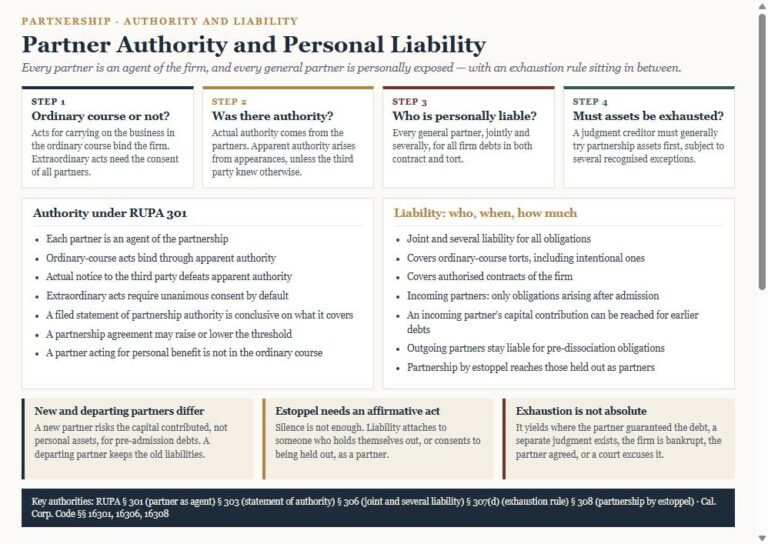 Partner Liability and Authority Under RUPA Explained
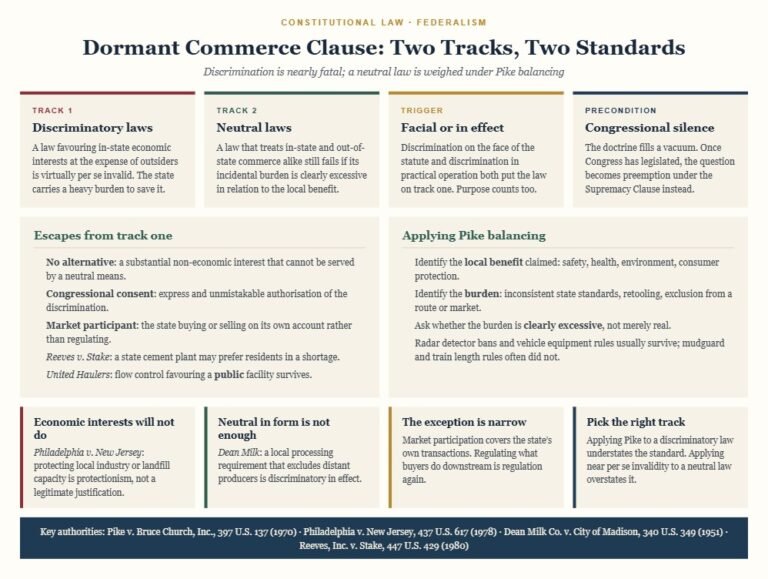 Dormant Commerce Clause: Discrimination vs Pike Balancing
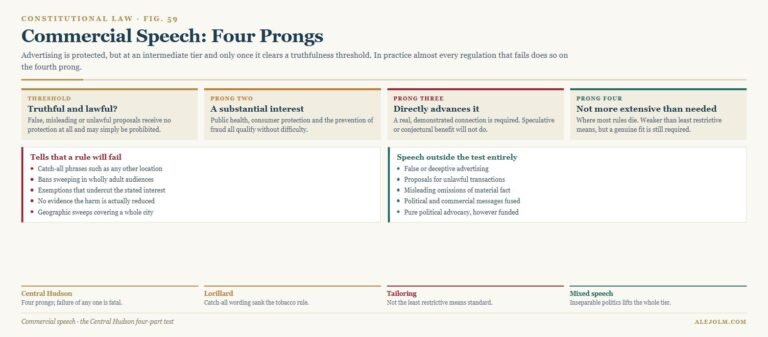 Commercial Speech and the Central Hudson Four-Part Test
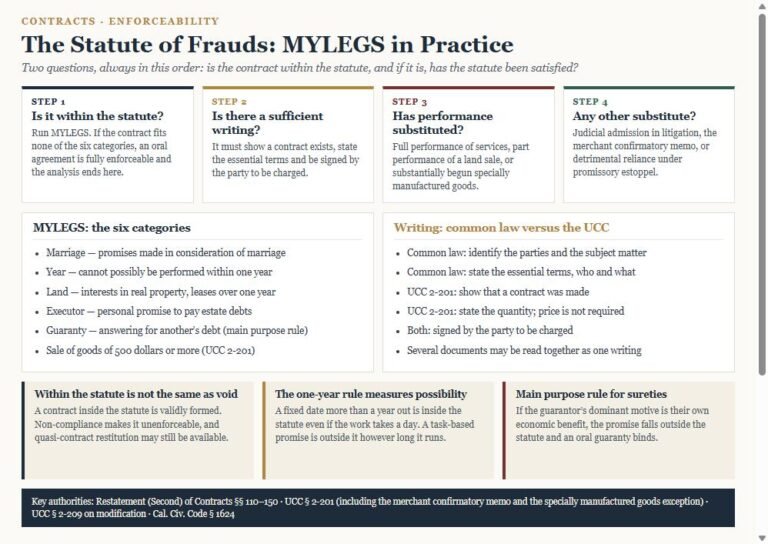 The Statute of Frauds: MYLEGS and How to Satisfy It
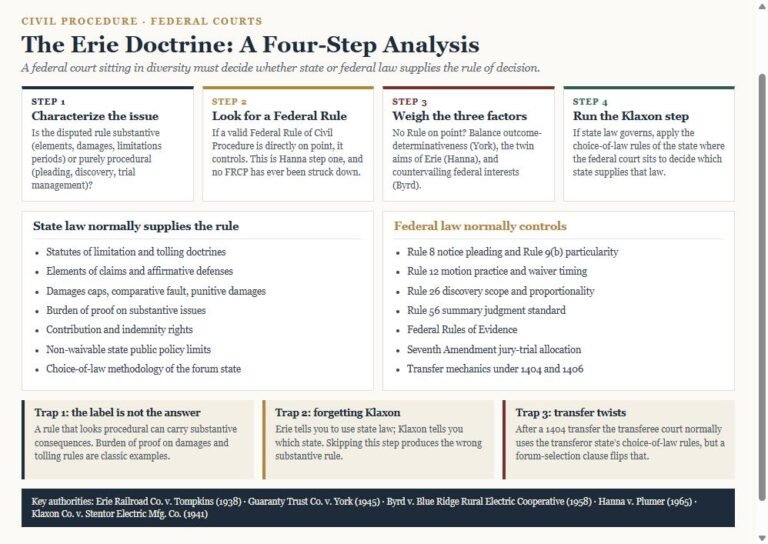 The Erie Doctrine Explained: A 4-Step Bar Exam Guide
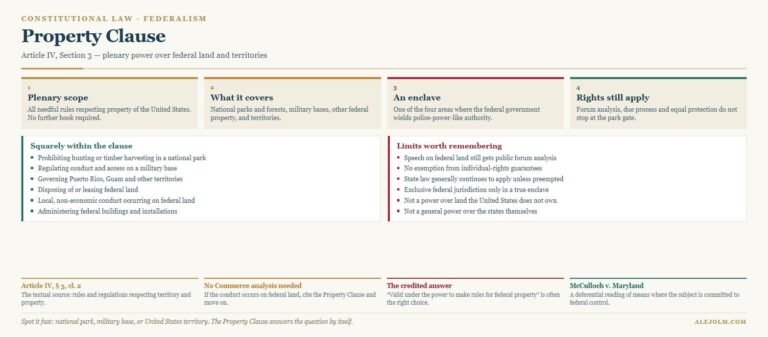 Property Clause: Congress and Federal Lands Explained
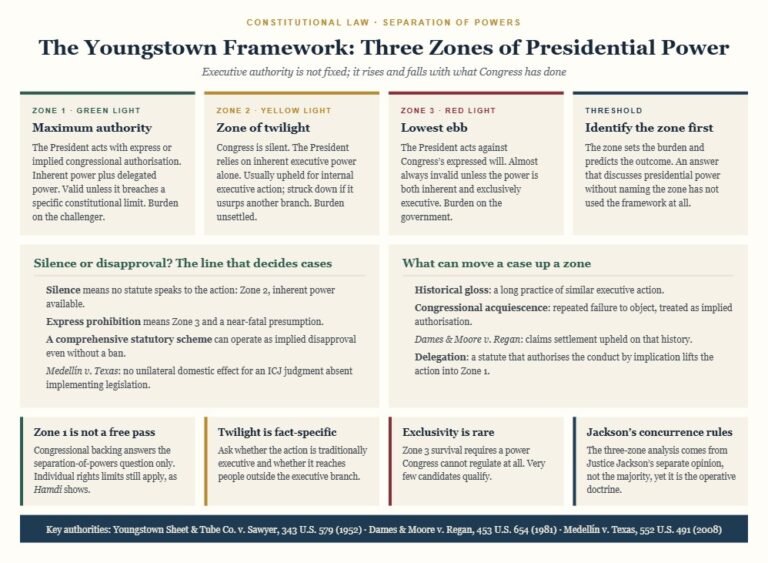 The Youngstown Framework: Presidential Power in 3 Zones
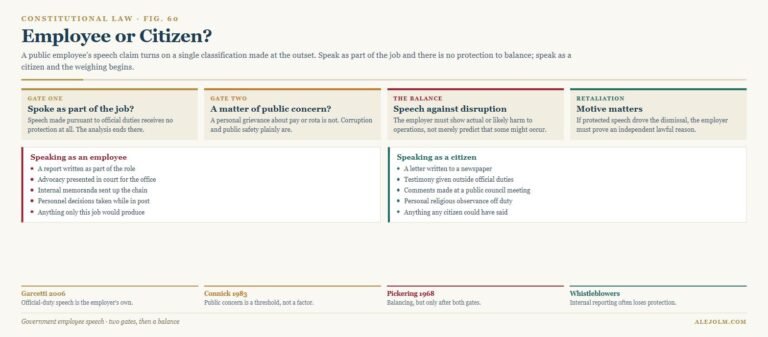 Government Employee Speech: Garcetti and Pickering Rules