

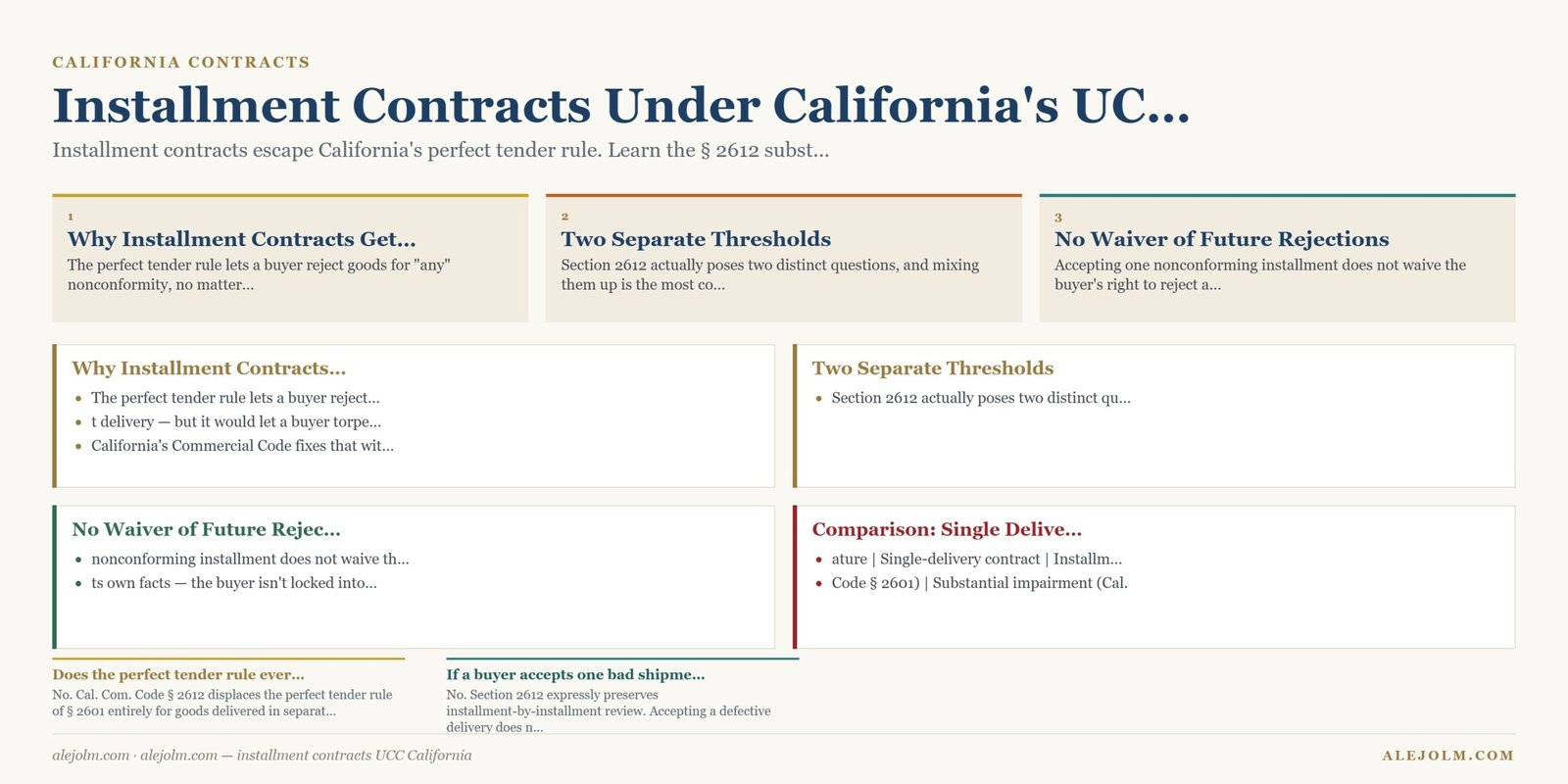
Why Installment Contracts Get Their Own Rule
The perfect tender rule lets a buyer reject goods for “any” nonconformity, no matter how trivial. That rule makes sense for a single, one-shot delivery — but it would let a buyer torpedo a year-long supply relationship over one cosmetically dented box. California’s Commercial Code fixes that with a separate, more forgiving standard.
An installment contract requires or authorizes delivery of goods in separate lots, separately accepted. Installment contracts are not governed by the perfect tender rule. Instead, under Cal. Com. Code § 2612, California’s enactment of UCC § 2-612, the buyer’s right to reject any single installment — or cancel the whole deal — is measured by the far more forgiving substantial impairment standard.
Two Separate Thresholds
Section 2612 actually poses two distinct questions, and mixing them up is the most common exam error.
1. Rejecting a Single Installment (Cal. Com. Code § 2612(2))
The buyer may reject one installment only if the nonconformity both:
- Substantially impairs the value of that installment, and
- Cannot be cured.
A minor, curable defect must be accepted, though the buyer keeps a damages claim. This incurability requirement is baked directly into the rejection standard — unlike ordinary § 2601 rejections, where cure operates as a separate, later defense.
2. Breaching the Whole Contract (Cal. Com. Code § 2612(3))
The buyer may treat the entire multi-delivery contract as breached only when a defect in one or more installments substantially impairs the value of the whole contract — a materially higher showing than impairing just one lot. A defective March shipment doesn’t automatically blow up a twelve-month supply agreement.
No Waiver of Future Rejections
Accepting one nonconforming installment does not waive the buyer’s right to reject a future nonconforming installment. Each delivery is evaluated independently on its own facts — the buyer isn’t locked into a pattern of tolerance just because it let one earlier defect slide.
Comparison: Single Delivery vs. Installment Contract
| Feature | Single-delivery contract | Installment contract |
|---|---|---|
| Governing rule | Perfect tender (Cal. Com. Code § 2601) | Substantial impairment (Cal. Com. Code § 2612) |
| Rejection trigger | Any nonconformity | Substantial impairment of that installment, plus incurability |
| Whole-contract cancellation | N/A (one delivery) | Requires substantial impairment of the whole contract |
| Effect of accepting a defective delivery | May waive certain rights | Does not waive rejection rights for future installments |
Common Law Parallel: Divisible Contracts
Common law has an analogous concept for non-goods contracts: a divisible contract, which splits performance into agreed-equivalent pairs so materiality of breach is judged unit by unit rather than against the whole deal. Section 2612 is the UCC’s statutorily defined version of that same idea, purpose-built for goods delivered in separate lots.
Also flag the cure interaction: because § 2612 already conditions rejection on incurability, the seller’s cure rights are built directly into the rejection standard, rather than functioning as a separate, after-the-fact defense the way cure operates under Cal. Com. Code § 2508 for ordinary, single-delivery sales. If the seller can plausibly cure the defect within the contract’s time frame, that possibility alone can defeat the buyer’s attempt to reject the installment, even before you reach the substantial-impairment question.
Worked Hypothetical
Facts: Bakery contracts with Miller for 12 monthly deliveries of 1,000 pounds of flour each. The March delivery arrives with torn packaging on 40 of the 100 sacks, though the flour inside is uncontaminated and usable, and Miller offers to replace the torn sacks within three days. Bakery rejects the entire March delivery and declares the whole 12-month contract cancelled.
Analysis: Bakery is wrong on both counts. This is an installment contract, so Cal. Com. Code § 2612 — not the perfect tender rule — controls. Bakery may reject the March installment only if the defect substantially impairs that installment’s value and cannot be cured; cosmetically torn packaging around otherwise usable flour, paired with a prompt replacement offer, fails both prongs. Bakery must accept the installment, retaining a damages claim for any actual loss. Cancelling the entire contract requires the still-higher showing that the defect substantially impairs the value of the whole 12-delivery deal — which one lot of torn sacks plainly does not. Bakery’s rejection and cancellation are themselves wrongful, exposing Bakery to a breach claim from Miller.
Frequently Asked Questions
Does the perfect tender rule ever apply to installment contracts in California?
No. Cal. Com. Code § 2612 displaces the perfect tender rule of § 2601 entirely for goods delivered in separate lots, replacing it with the substantial-impairment-plus-incurability standard.
If a buyer accepts one bad shipment, does it waive the right to reject the next one?
No. Section 2612 expressly preserves installment-by-installment review. Accepting a defective delivery does not waive the right to reject a later, separately nonconforming delivery.
What’s the difference between impairing one installment and impairing the whole contract?
Impairing one installment lets the buyer reject just that lot (if also incurable). Impairing the whole contract is a higher, separate showing required before the buyer can cancel the entire multi-delivery agreement.
Key Takeaways
- Installment contracts run on Cal. Com. Code § 2612, not the perfect tender rule of § 2601.
- Rejecting one installment requires substantial impairment of that lot plus incurability.
- Cancelling the whole contract requires substantial impairment of the whole deal — a separate, higher bar.
- Accepting a defective installment does not waive rejection rights for future installments.
- Common law’s divisible-contract doctrine is the conceptual ancestor of § 2612’s statutory test.
This article is educational and is not legal advice. Consult a licensed California attorney about your situation.
Mostrando SEO-07-contracts.md.