

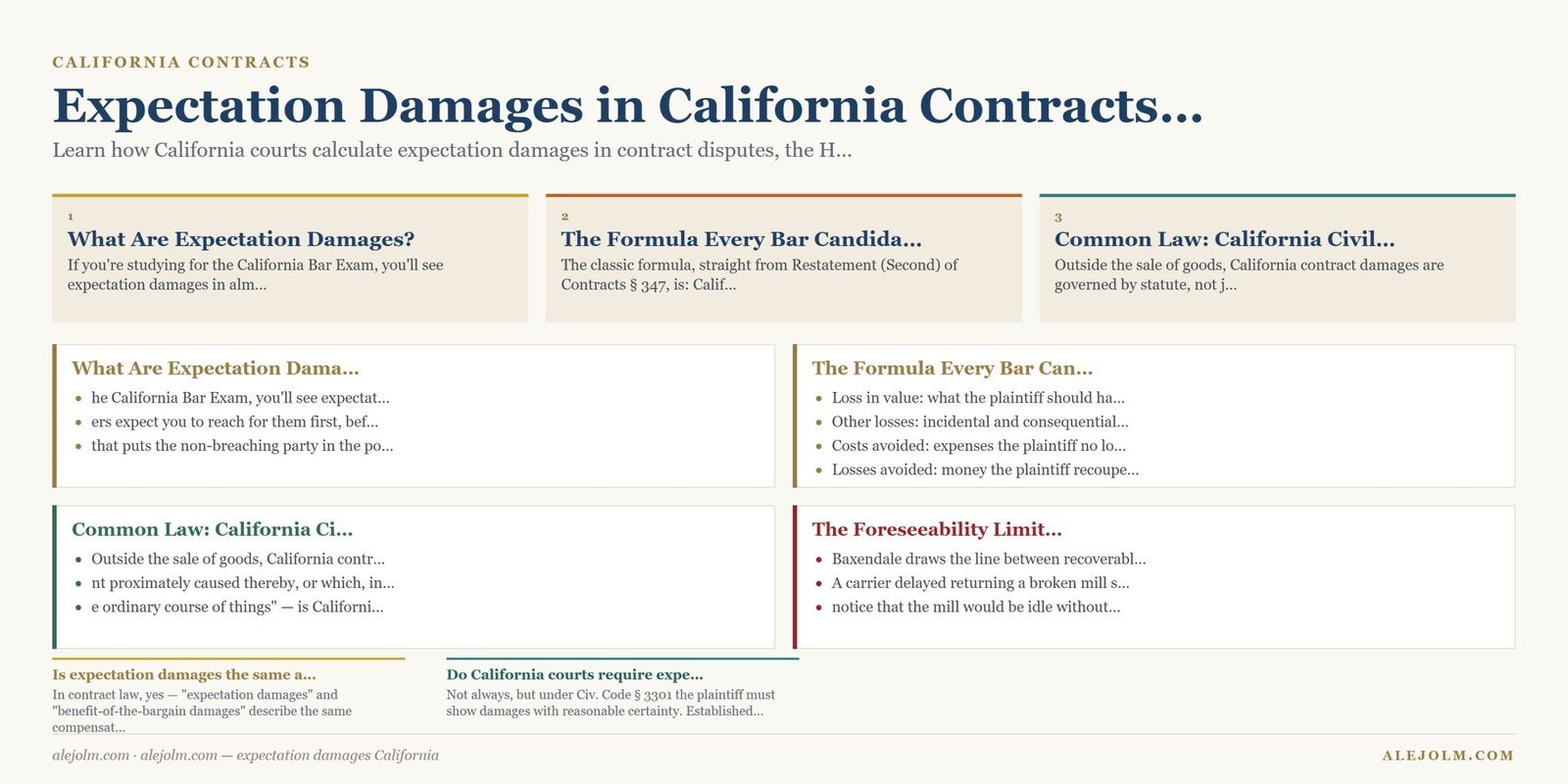
What Are Expectation Damages?
If you’re studying for the California Bar Exam, you’ll see expectation damages in almost every contracts essay that ends in breach. They are the default remedy, and examiners expect you to reach for them first, before reliance damages, before restitution, before anything equitable.
Expectation damages are the money award that puts the non-breaching party in the position it would have occupied had the contract been fully performed. Courts call this the “benefit of the bargain” measure. Unless the facts point you elsewhere — a liquidated damages clause, a promissory estoppel claim, or speculative lost profits — expectation damages are your starting and usually your ending point.
The Formula Every Bar Candidate Must Know
The classic formula, straight from Restatement (Second) of Contracts § 347, is:
Loss in value + Other losses − Costs avoided − Losses avoided
- Loss in value: what the plaintiff should have received minus what it actually got.
- Other losses: incidental and consequential damages (cover costs, shipping, storage).
- Costs avoided: expenses the plaintiff no longer has to pay because it didn’t have to finish performing.
- Losses avoided: money the plaintiff recouped by mitigating, such as resale proceeds.
California codifies this same idea in the Civil Code rather than leaving it purely to case law, which is the first thing that separates a California answer from a generic MBE answer.
Common Law: California Civil Code § 3300 and § 3301
Outside the sale of goods, California contract damages are governed by statute, not just common-law tradition. Cal. Civ. Code § 3300 provides that a breaching party owes “the amount which will compensate the party aggrieved for all the detriment proximately caused thereby, or which, in the ordinary course of things, would be likely to result therefrom.” That phrase — “in the ordinary course of things” — is California’s own codification of the foreseeability principle from Hadley v. Baxendale (1854).
Cal. Civ. Code § 3301 adds a second requirement: damages “must be clearly ascertainable in both their nature and origin.” That statute is the California equivalent of the “reasonable certainty” rule tested nationally. A new business with no earnings history claiming speculative lost profits will lose under § 3301 just as it would under the Restatement.
The Foreseeability Limit: Hadley v. Baxendale
Hadley v. Baxendale draws the line between recoverable and unrecoverable consequential damages. A carrier delayed returning a broken mill shaft, and the mill owner sued for lost profits during the shutdown. The court denied recovery because the carrier had no notice that the mill would be idle without the shaft — the loss was not foreseeable at the time of contracting.
Two categories matter here:
- Ordinary damages — losses that flow naturally from this type of breach — are presumed foreseeable.
- Extraordinary damages — unusual losses like a specific customer’s lost profits — are recoverable only if the breaching party had notice of the special circumstances before the contract was signed.
Foreseeability is judged at formation, not at breach. That timing detail is a favorite examiner trap.
UCC Article 2 (California Commercial Code) Formulas
Once goods are involved, you leave Civil Code § 3300 behind and move into California Commercial Code Division 2, California’s enactment of UCC Article 2. The section numbers mirror the UCC exactly (UCC § 2-712 becomes Cal. Com. Code § 2712), which makes the transition easy once you know to look for it.
| Scenario | Governing Section | Formula |
|---|---|---|
| Buyer covers with substitute goods | Cal. Com. Code § 2712 | Cover price − contract price + incidental/consequential damages |
| Buyer does not cover | Cal. Com. Code § 2713 | Market price at time of breach − contract price + incidental/consequential damages |
| Buyer keeps nonconforming goods | Cal. Com. Code § 2714 | FMV as warranted − FMV as delivered + incidental/consequential damages |
| Seller resells after buyer’s breach | Cal. Com. Code § 2706 | Contract price − resale price + incidental damages |
| Seller does not resell | Cal. Com. Code § 2708 | Contract price − market price (or lost profits for a lost-volume seller) |
The buyer generally gets to choose the cover measure or the market measure, whichever produces the higher, better-supported number — but cannot manufacture a windfall by waiting for the market to drop and then invoking a stale, lower cover figure.
Worked Hypothetical
Facts: Contractor agrees to paint Homeowner’s house in Sacramento for $5,000, completion by July 1. Contractor breaches and never shows up. The market rate for the same job on July 1 is $6,000. On July 15, Homeowner hires a replacement painter for $7,000.
Analysis: Homeowner’s expectation damages equal the cost of cover ($7,000) minus the contract price ($5,000), or $2,000, plus any incidental damages like added home-insurance costs during the delay. Alternatively, Homeowner could calculate damages using the market price on the breach date: $6,000 − $5,000 = $1,000. Because cover was reasonable and actually incurred, Homeowner recovers the higher, better-documented $2,000 figure. If the market price later drops to $4,000, Homeowner still recovers based on the cover price actually paid or the market price at the time of breach — not a cherry-picked later number.
Frequently Asked Questions
Is expectation damages the same as compensatory damages?
In contract law, yes — “expectation damages” and “benefit-of-the-bargain damages” describe the same compensatory measure. California uses “compensatory damages” as the statutory umbrella term in Civ. Code § 3300, but the substance is identical to what the Restatement calls expectation damages.
Do California courts require expert testimony to prove lost profits?
Not always, but under Civ. Code § 3301 the plaintiff must show damages with reasonable certainty. Established businesses can often prove lost profits through historical financial records; new businesses usually cannot, which frequently pushes the analysis toward reliance damages instead.
Does the duty to mitigate reduce expectation damages?
Mitigation limits consequential damages the plaintiff could reasonably have avoided. It does not erase the core loss-in-value figure — the contract-versus-market or cover-versus-contract differential survives regardless of mitigation efforts.
Key Takeaways
- Expectation damages are the default remedy for breach of contract in California and on the Bar Exam.
- Outside goods contracts, apply Cal. Civ. Code §§ 3300–3301: foreseeability (“ordinary course of things”) plus reasonable certainty.
- For goods, switch to California Commercial Code Division 2 (§§ 2706, 2708, 2712, 2713, 2714) — UCC Article 2 as enacted in California.
- Hadley v. Baxendale foreseeability is judged at formation, not at breach.
- Always show your formula: Loss in value + other losses − costs avoided − losses avoided.
This article is educational and is not legal advice. Consult a licensed California attorney about your situation.
Related guides
- duty to mitigate damages
- liquidated damages clauses
- remedies for breach of contract
- consideration in contract law