
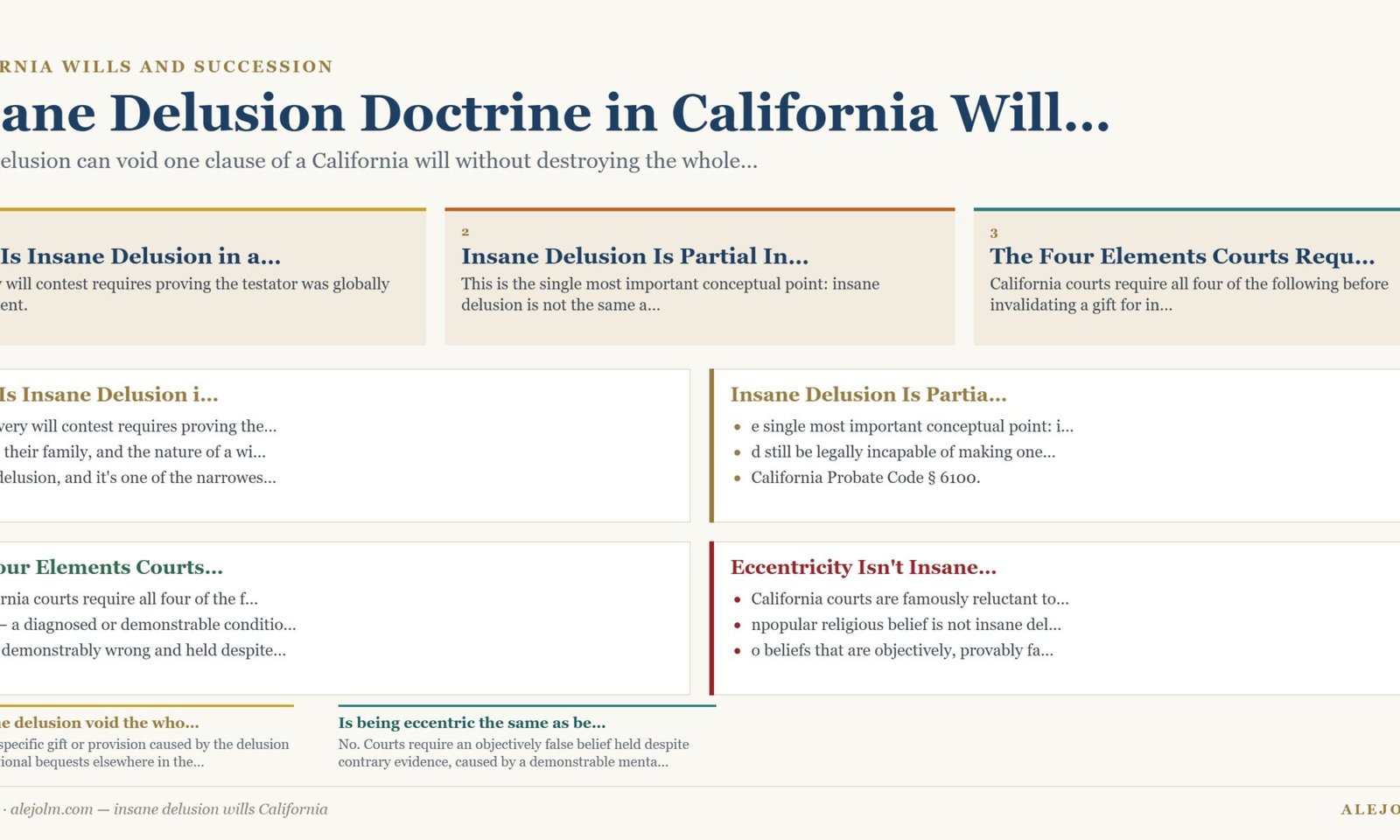
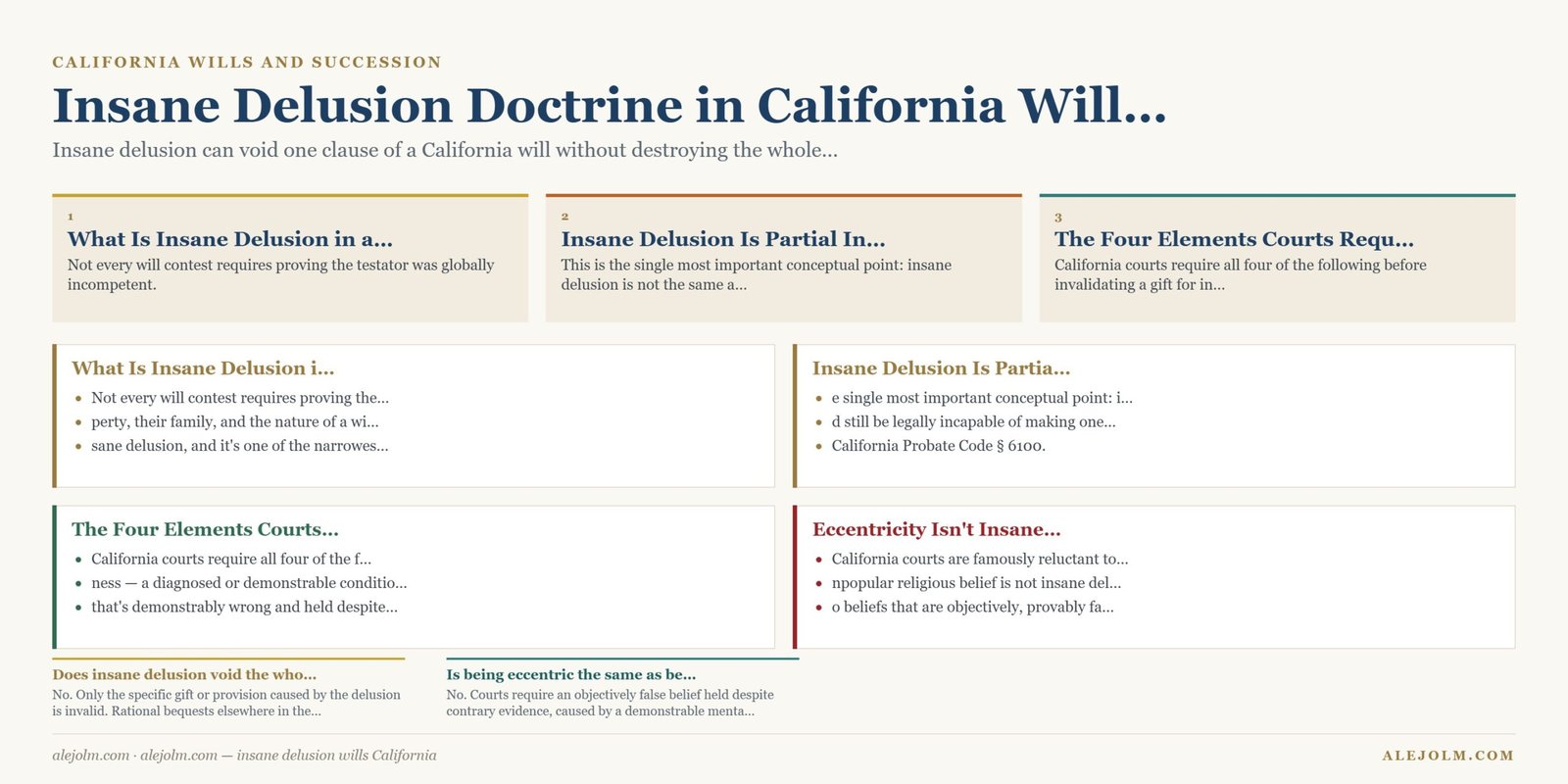
What Is Insane Delusion in a California Will Contest?
Not every will contest requires proving the testator was globally incompetent. Sometimes a person is perfectly capable of understanding their property, their family, and the nature of a will — except for one stubborn, false belief that skews a single gift. California calls this insane delusion, and it’s one of the narrowest, most misunderstood doctrines tested on the California Bar Exam. For families, it’s the doctrine that applies when a will looks fine on its face but one bequest makes no sense given what everyone knows to be true.
Insane delusion, defined in one breath: it’s a persistent, false belief about a fact — one with no rational basis in the available evidence — that causes the testator to make a disposition they would not have made but for that belief, and it invalidates only the tainted gift, not the whole will.
Insane Delusion Is Partial Incapacity, Not Total Incapacity
This is the single most important conceptual point: insane delusion is not the same as lacking testamentary capacity. A testator can understand the nature of a will, know the extent of their property, and recognize the natural objects of their bounty — and still be legally incapable of making one particular gift because a delusion corrupted that specific decision. California Probate Code § 6100.5 codifies this: a will (or a provision in it) is invalid if the testator’s mistaken belief about facts materially affected the disposition.
| Concept | Insane Delusion | Undue Influence | Duress |
|---|---|---|---|
| Basis | False belief despite contrary evidence | Coercive pressure from another person | Overt threats or force |
| Source | Internal — a mental disorder | External — another person’s conduct | External — threats/force |
| Burden | Contestant proves the false belief | Presumption may shift the burden | Contestant proves coercion |
The Four Elements Courts Require
California courts require all four of the following before invalidating a gift for insane delusion:
- A mental disorder or illness — a diagnosed or demonstrable condition (dementia, psychosis, paranoid disorder), not mere eccentricity.
- A false belief without factual basis — a belief about a fact that’s demonstrably wrong and held despite clear contrary evidence, not just a debatable or unpopular opinion.
- Persistence — the delusion must recur or endure over time, not be a one-off moment of confusion.
- But-for causation — the specific gift must be traceable to the delusion; if the testator would have made the same gift anyway, the doctrine doesn’t apply.
Eccentricity Isn’t Insane Delusion — And Courts Guard That Line Carefully
California courts are famously reluctant to second-guess a testator’s values. Distrust of government, an unconventional lifestyle, or an unpopular religious belief is not insane delusion — it’s testamentary freedom, and the law protects it fiercely. The doctrine only applies to beliefs that are objectively, provably false and unmoored from any evidence a reasonable person could credit. This protects testators (and their memory) from having their will second-guessed just because relatives find a bequest strange or unfair.
Worked Example: The Confused Nurse Bequest
Facts: Testator T, diagnosed with Alzheimer’s disease, leaves her entire estate to N, a nurse at her care facility. T’s family contests, offering medical records showing T repeatedly confused N with T’s own daughter (who is alive and estranged from no one). Facility staff confirm T often called N by the daughter’s name. The will, however, names N correctly — “to my nurse N.”
Analysis:
- Mental disorder: Confirmed by the Alzheimer’s diagnosis.
- False belief: T’s belief that N is her daughter is objectively false and contradicted by all available evidence.
- Persistence: Documented over months in medical and facility records.
- But-for causation: This is the crux. If T left everything to N because T believed N was her daughter, the gift is void. But if T’s language (“to my nurse N”) shows T actually intended to benefit N as her caregiver — even while sometimes confusing her identity — the causation element may fail, and the gift stands.
Result: Ambiguous on these facts; a court would need clear evidence that the delusion, not gratitude toward a caregiver, actually drove the bequest.
Only the Tainted Gift Falls
Insane delusion has a built-in mercy: it invalidates only the specific provision the delusion caused, not the entire will. If a testator’s delusion about one relative causes an irrational bequest to a stranger, but the rest of the will rationally distributes property to other family members and a charity, only the tainted clause is struck. The rest of the document is administered as written.
Burden of Proof and Practical Evidence
The party challenging the will bears the burden of proving insane delusion by clear and convincing evidence — the same demanding standard used for duress and undue influence claims. Useful evidence includes medical records, testimony from healthcare providers or family members describing confusion or irrational statements, and behavioral patterns documented over time. The absence of a formal diagnosis doesn’t automatically defeat the claim if behavioral evidence is strong enough, but a diagnosis makes the case considerably easier to prove.
Frequently Asked Questions
Does insane delusion void the whole will?
No. Only the specific gift or provision caused by the delusion is invalid. Rational bequests elsewhere in the same will remain valid, even if the testator had a diagnosed mental illness.
Is being eccentric the same as being delusional under California law?
No. Courts require an objectively false belief held despite contrary evidence, caused by a demonstrable mental disorder. Unusual values, unpopular opinions, or unconventional lifestyle choices don’t qualify, no matter how odd relatives find them.
How is insane delusion different from lacking testamentary capacity?
General testamentary incapacity means the testator failed to understand the nature of a will, the extent of their property, or their natural heirs — it can void the entire will. Insane delusion is narrower: the testator is otherwise competent but held one false, persistent belief that tainted one specific gift.
Key Takeaways
- Insane delusion under Cal. Probate Code § 6100.5 is partial, not total, incapacity — it strikes down only the tainted gift.
- Four elements are required: mental disorder, objectively false belief, persistence, and but-for causation.
- Eccentric or unpopular beliefs are protected testamentary freedom, not insane delusion.
- Only the affected provision is invalidated; rational gifts in the same will survive.
- Contestants must prove the doctrine by clear and convincing evidence, ideally supported by medical records.
- This doctrine is distinct from — and narrower than — general testamentary incapacity and undue influence.
This article is educational and is not legal advice. Consult a licensed California attorney about your situation.