
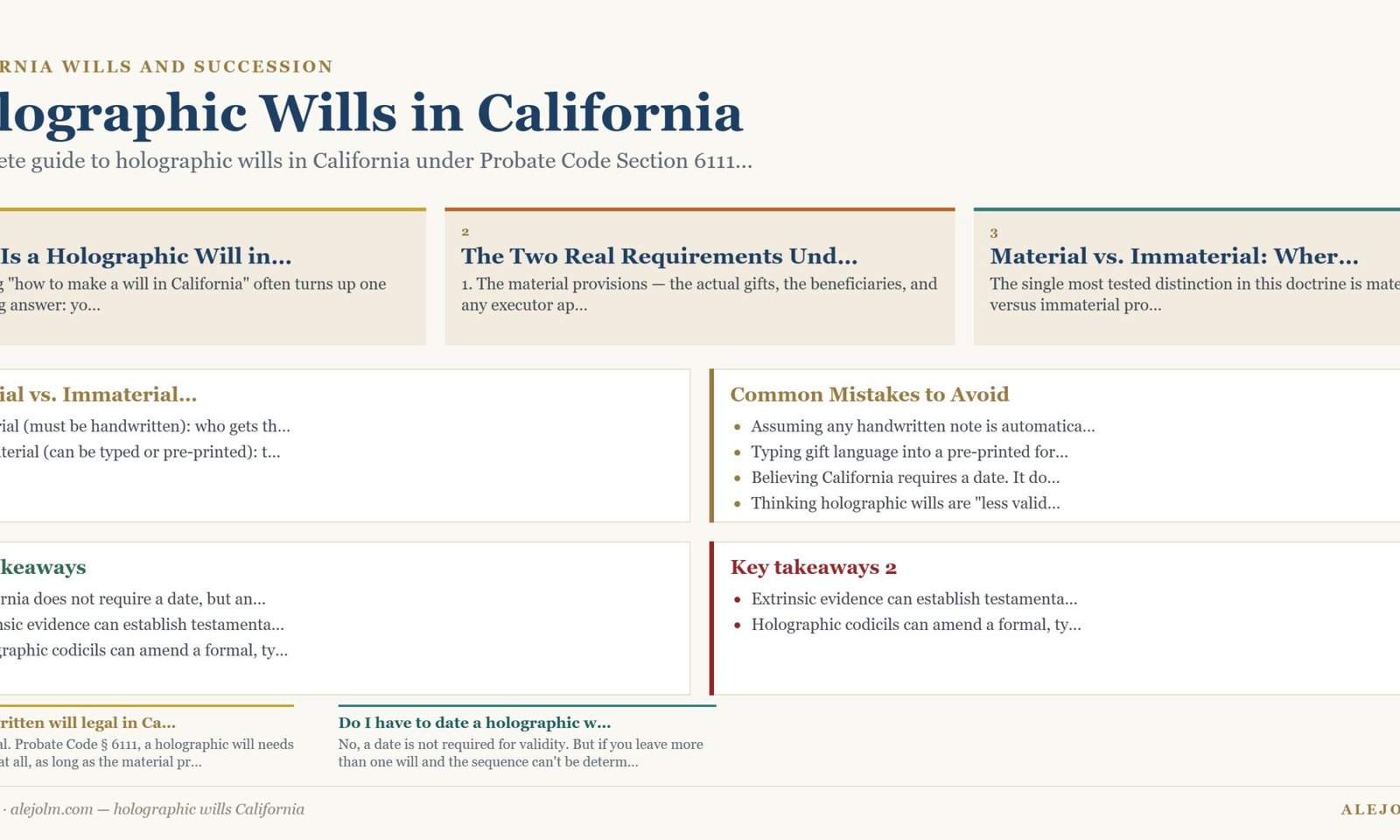
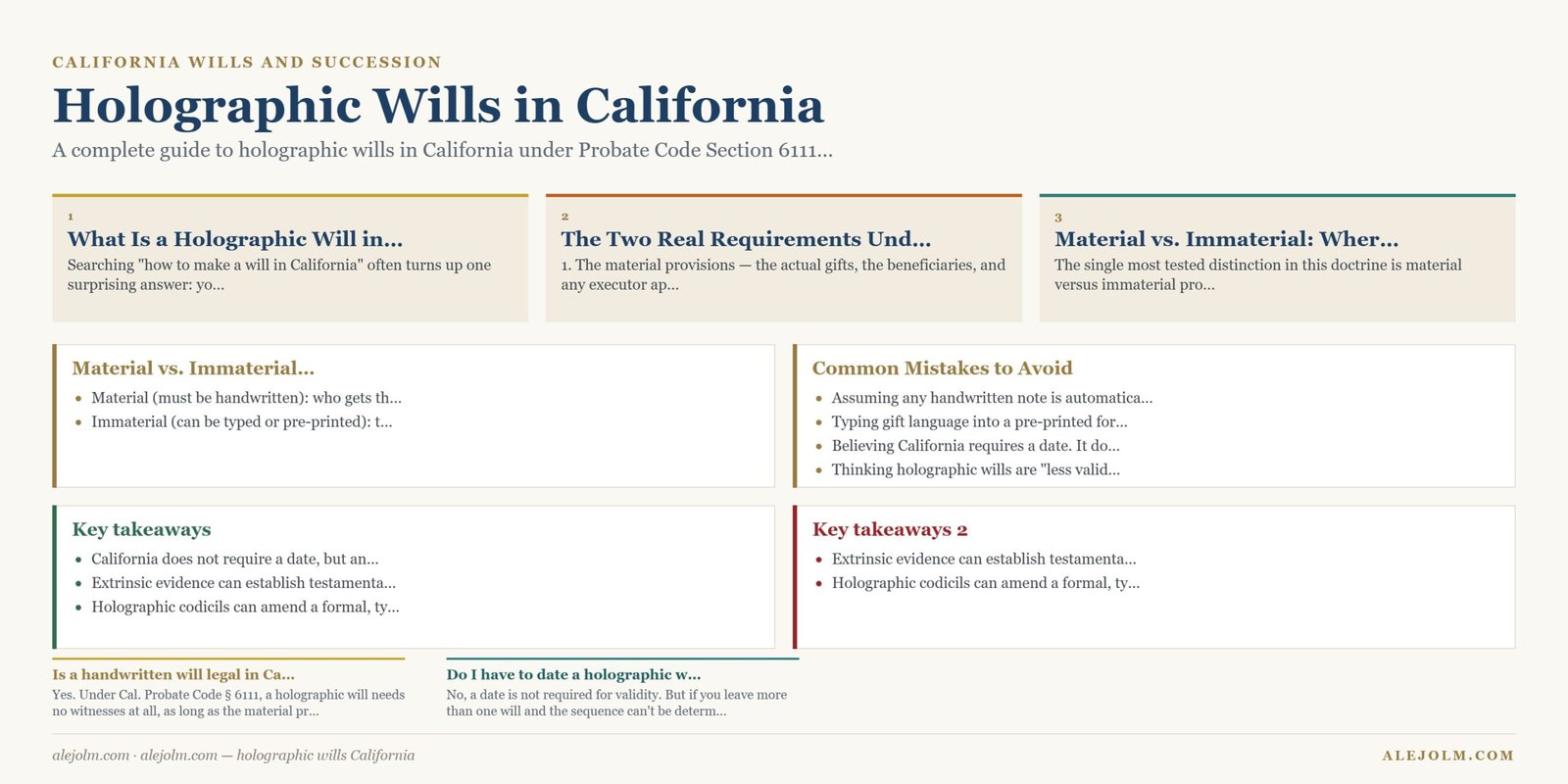
What Is a Holographic Will in California?
Searching “how to make a will in California” often turns up one surprising answer: you can write one by hand, without a lawyer, without witnesses, and it can still be perfectly valid. That’s a holographic will, and California is one of the more permissive states in the country for this kind of do-it-yourself document.
For Bar Exam candidates, holographic wills are a favorite essay topic — tested five times between 2012 and 2025 (Jul-12, Jul-13, Feb-17, Jul-22, Feb-25). For everyday readers, they’re a real, legally recognized option, though not always the smartest one.
Holographic will, defined: a will that skips witness formalities entirely and is valid if its material provisions — who gets what — are entirely in the testator’s own handwriting, and the testator signs it. No attestation, no notarization, no witnesses required.
The Two Real Requirements Under § 6111
Cal. Probate Code § 6111 strips the formalities down to two things:
- The material provisions — the actual gifts, the beneficiaries, and any executor appointment — must be entirely in the testator’s handwriting.
- The testator must sign the document.
That’s it. No witnesses. No notary. This is a sharp contrast to a formal typed will, which under California’s will execution requirements needs two witnesses present at the same time.
Material vs. Immaterial: Where Students (and DIY Testators) Go Wrong
The single most tested distinction in this doctrine is material versus immaterial provisions.
- Material (must be handwritten): who gets the house, who gets the car, who is named executor, the specific dollar amounts or property described.
- Immaterial (can be typed or pre-printed): the date, a pre-printed “Last Will and Testament” heading, boilerplate language like “I am of sound mind.”
That means a testator can buy a pre-printed will form from an office supply store, and as long as they fill in the gifts by hand — “I give my house to my daughter, my car to my son” — the document is a valid holographic will, even though the heading and formal language are printed. Flip it around, though: if the testator types the gift language into the blanks instead of writing it by hand, the holographic exception no longer applies, and the document needs full witness formalities to be valid.
Informal Language Is Enough
Because holographic wills are meant to help testators without access to a lawyer — hospital patients, people in remote areas, soldiers deployed overseas — California courts are generous about how the intent is expressed. You don’t need “I hereby bequeath.” A handwritten note that says “If I die, I want my sister to have my jewelry,” signed by the testator, can be a valid holographic will. Cal. Probate Code § 6111(c) even allows extrinsic evidence — witness testimony, prior statements — to establish testamentary intent when it isn’t obvious from the document itself.
Does a Holographic Will Need a Date?
No. California does not require a holographic will to be dated to be valid. But skipping the date is riskier than it sounds. Under § 6111(b), if a testator leaves multiple, possibly inconsistent testamentary documents and it can’t be established whether the undated will came before or after another one, the undated will is invalid to the extent of the inconsistency. Practical advice: date it anyway. The date isn’t a validity requirement, but it becomes the tiebreaker the moment there’s more than one document in play.
| Element | Required for Validity? | Notes |
|---|---|---|
| Handwritten material provisions | Yes | Must be entirely in testator’s hand |
| Testator’s signature | Yes | Can be informal |
| Witnesses | No | Complete exception to § 6110 |
| Date | No | Recommended anyway — sequencing tool under § 6111(b) |
| Testamentary intent | Yes | Can be proven by extrinsic evidence under § 6111(c) |
Holographic Codicils Can Amend a Formal Will
A holographic will doesn’t have to stand alone. A holographic codicil — a short, handwritten amendment — can modify a formal, lawyer-drafted will. If a testator later handwrites and signs “I want an additional $10,000 to go to my niece,” that amendment is valid under § 6111 even though it never goes through formal witness execution.
Worked Example
Facts: Testator writes on notebook paper, entirely by hand: “If I die, I leave my house to my daughter and my car to my son. I appoint my sister as executor.” She signs and dates it herself.
Analysis: Every material provision — the house, the car, the executor appointment — is handwritten. She signed it. The conditional phrasing (“If I die…”) shows clear testamentary intent. No witnesses are needed. Result: valid holographic will.
Common Mistakes to Avoid
- Assuming any handwritten note is automatically a will. It must show clear testamentary intent and be signed.
- Typing gift language into a pre-printed form. That destroys holographic status and triggers full witness requirements.
- Believing California requires a date. It doesn’t — the date only matters for sequencing multiple documents.
- Thinking holographic wills are “less valid.” They carry the same legal force as a formally executed will once probated.
FAQ
Is a handwritten will legal in California without witnesses?
Yes. Under Cal. Probate Code § 6111, a holographic will needs no witnesses at all, as long as the material provisions are entirely in the testator’s own handwriting and the testator signs it.
Do I have to date a holographic will in California?
No, a date is not required for validity. But if you leave more than one will and the sequence can’t be determined, an undated will can be invalidated to the extent it conflicts with another instrument — so dating it is smart practice, even if not mandatory.
Can I use a pre-printed will form and still have a valid holographic will?
Yes, as long as you fill in the actual gifts, beneficiaries, and executor appointment by hand. If you type those parts instead, the document loses its holographic status and needs two witnesses to be valid.
Key Takeaways
- A holographic will needs only handwritten material provisions and the testator’s signature — no witnesses.
- Only material (dispositive) provisions must be handwritten; dates and headings can be printed.
- California does not require a date, but an undated will can lose to a later, conflicting will.
- Extrinsic evidence can establish testamentary intent if it isn’t clear on the document’s face.
- Holographic codicils can amend a formal, typed will without new formal execution.
This article is educational and is not legal advice. Consult a licensed California attorney about your situation.
Related guides
- testamentary capacity in California
- California will execution requirements
- how to revoke a will in California
- contesting a will in California