
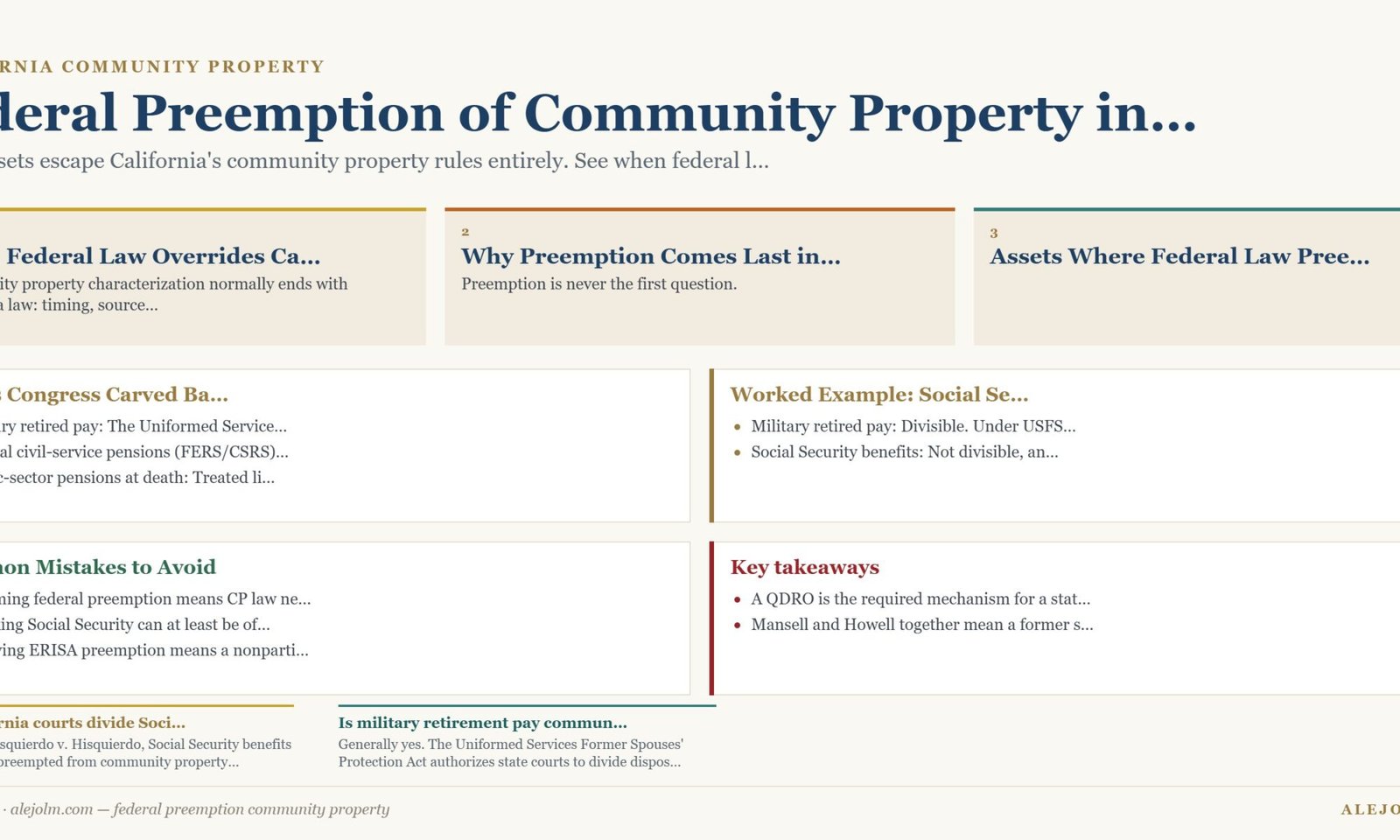
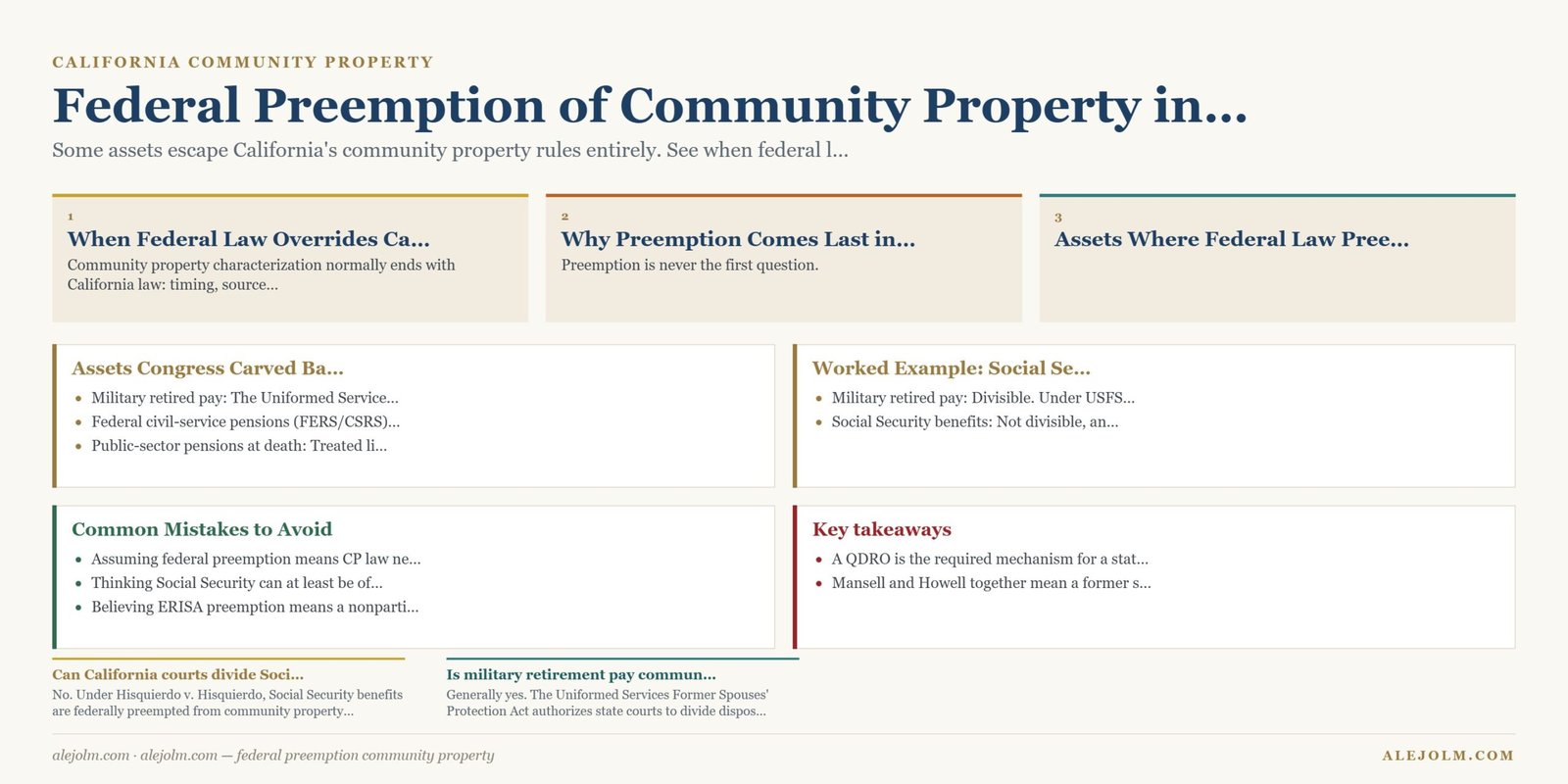
When Federal Law Overrides California’s Community Property Rules
Community property characterization normally ends with California law: timing, source, presumptions, and any post-acquisition agreement between the spouses. But there’s a fifth and final question every thorough analysis must ask — does federal law preempt the result? For a surprising number of common assets, the answer is yes.
Federal preemption in this context means that under the Supremacy Clause, federal law displaces California’s community property rules whenever Congress has created a benefits scheme meant to operate independently of state marital property regimes. This shows up most often with savings bonds, military benefits, ERISA pensions, and Social Security — and it’s a favorite trap on the California Bar Exam because it’s tested only after you’ve already done the state-law characterization correctly.
Why Preemption Comes Last in the Analysis
Preemption is never the first question. You characterize the asset as community, separate, or quasi-community property under ordinary California rules first — then ask whether federal law overrides that result for purposes of disposition or a spouse’s claim. Skipping straight to preemption, without doing the state-law characterization first, misses half the analysis the examiners are testing.
Assets Where Federal Law Preempts California CP Rules
| Asset | Federal rule | Case/authority |
|---|---|---|
| U.S. savings bonds | Registered co-ownership/beneficiary rules control; non-consenting spouse can’t reach the bond or demand offsetting property | Federal savings bond regulations |
| Military disability pay | Belongs solely to the disabled service member; community has no claim | Mansell v. Mansell, 490 U.S. 581 (1989) |
| ERISA pension at death | Nonparticipant spouse’s community interest terminates at her death; she cannot devise it | Boggs v. Boggs, 520 U.S. 833 (1997) |
| Social Security benefits | Categorically not community property; cannot be divided or even offset against other assets | Hisquierdo v. Hisquierdo, 439 U.S. 572 (1979) |
| ERISA beneficiary designations generally | State CP claims preempted unless made through a QDRO | ERISA anti-alienation provisions |
Assets Congress Carved Back Into State Law
Not everything federal is off-limits. Congress has expressly authorized state community property law to govern some federally connected benefits:
- Military retired pay: The Uniformed Services Former Spouses’ Protection Act (USFSPA), 10 U.S.C. § 1408, was enacted in 1982 specifically to override McCarty v. McCarty (1981), which had held military retired pay was not divisible as CP. USFSPA authorizes state courts to treat disposable military retired pay as community property and divide it on divorce.
- Federal civil-service pensions (FERS/CSRS): Federal law expressly permits division under state community property law; there’s no conflict for ordinary retirement pay.
- Public-sector pensions at death: Treated like any other CP asset — the deceased spouse can bequeath his or her half.
The Military Disability Trap: Mansell and Howell
This is one of the densest pockets of preemption doctrine, and it comes up repeatedly. Under Mansell v. Mansell, disposable retired pay a veteran has waived in favor of disability benefits cannot be divided as community property at all — even if a marital settlement agreement already purported to award a share of the full retired pay.
It gets worse for the non-military spouse: in Howell v. Howell, 581 U.S. 214 (2017), the U.S. Supreme Court held that federal law preempts any state-law remedy to make the former spouse whole after a post-judgment disability election — including an indemnification order or an award of spousal support pegged to the lost amount. California courts followed suit in In re Marriage of Cassinelli (2018), reversing a trial court’s attempt to indemnify a former spouse through nonmodifiable spousal support. The former spouse simply bears the risk of a later disability election.
Worked Example: Social Security and Military Retirement Together
Facts: During a 22-year marriage, Husband serves in the Army for 20 years and retires with a pension; he also has $3,000/month in accrued Social Security retirement benefits attributable to his military and post-military employment. Wife has no independent work history. At divorce, Wife asks the court to award her a community interest in both the military pension and the Social Security benefits — or, alternatively, to offset her share of the couple’s other assets to compensate for what she’s losing.
Analysis: These two assets get opposite treatment.
- Military retired pay: Divisible. Under USFSPA, California courts can and routinely do treat disposable military retired pay as community property, since Congress legislatively overrode McCarty. Wife is entitled to her community share of the pension earned during the marriage.
- Social Security benefits: Not divisible, and not even usable as an offset. Under Hisquierdo, Social Security benefits are federally preempted from CP treatment entirely. The court cannot award Wife any interest in Husband’s Social Security, and it cannot compensate her with extra CP assets to make up the difference — that would functionally divide the preempted benefit through the back door. Wife’s only recourse is her own potential derived spousal or divorced-spouse Social Security benefit, which arises under federal Social Security law independent of California’s CP system.
If Husband later elects to convert part of his retired pay into disability benefits, that portion would drop out of the community’s reach under Mansell — and under Howell, Wife could not get indemnification through spousal support even if the timing devastates her expected division.
Common Mistakes to Avoid
- Assuming federal preemption means CP law never applies to federal benefits. Wrong. USFSPA and federal civil-service law expressly authorize state CP division for military and federal-employee retirement pay.
- Thinking Social Security can at least be offset even if it can’t be divided. Wrong — Hisquierdo preemption is categorical; courts cannot offset other assets to compensate either.
- Believing ERISA preemption means a nonparticipant spouse gets nothing from a pension. Wrong. A state court can still award a nonparticipant spouse her community share through a Qualified Domestic Relations Order (QDRO); ERISA preemption is targeted at testamentary transfers and non-QDRO seizure, not total.
FAQ
Can California courts divide Social Security benefits in a divorce?
No. Under Hisquierdo v. Hisquierdo, Social Security benefits are federally preempted from community property division, and courts cannot even offset a spouse’s other assets to compensate for the loss.
Is military retirement pay community property in California?
Generally yes. The Uniformed Services Former Spouses’ Protection Act authorizes state courts to divide disposable military retired pay as community property, overriding the earlier McCarty v. McCarty holding to the contrary.
What happens to a spouse’s ERISA pension interest if she dies before the participant retires?
Her community interest terminates at her death under Boggs v. Boggs — ERISA preempts any attempt by her estate to inherit or redirect that interest, since Congress designed ERISA to protect the plan participant and named beneficiaries.
Key Takeaways
- Federal preemption is the fifth and final step in CP characterization — apply it after, not instead of, ordinary California analysis.
- Social Security, military disability pay, and a deceased nonparticipant spouse’s ERISA interest are categorically preempted from CP division.
- Military retired pay and federal civil-service pensions are expressly carved back into state CP law by statute.
- A QDRO is the required mechanism for a state court to award a nonparticipant spouse her share of an ERISA pension without violating preemption.
- Mansell and Howell together mean a former spouse has no remedy — not even spousal support — for a post-judgment military disability election.
This article is educational and is not legal advice. Consult a licensed California attorney about your situation.
Related guides
- community property presumptions
- federal preemption doctrine
- supremacy clause
- reimbursement and tracing in community property