
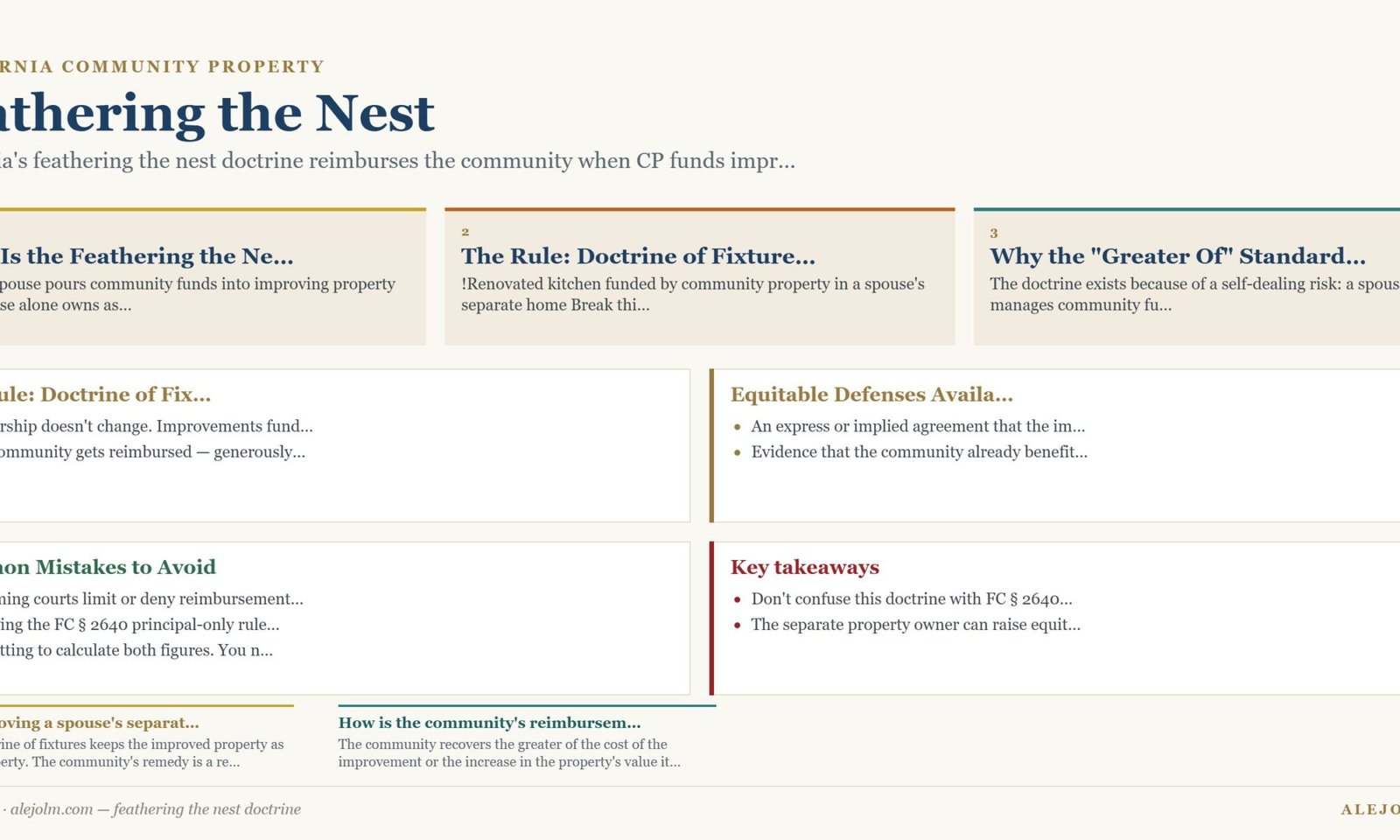
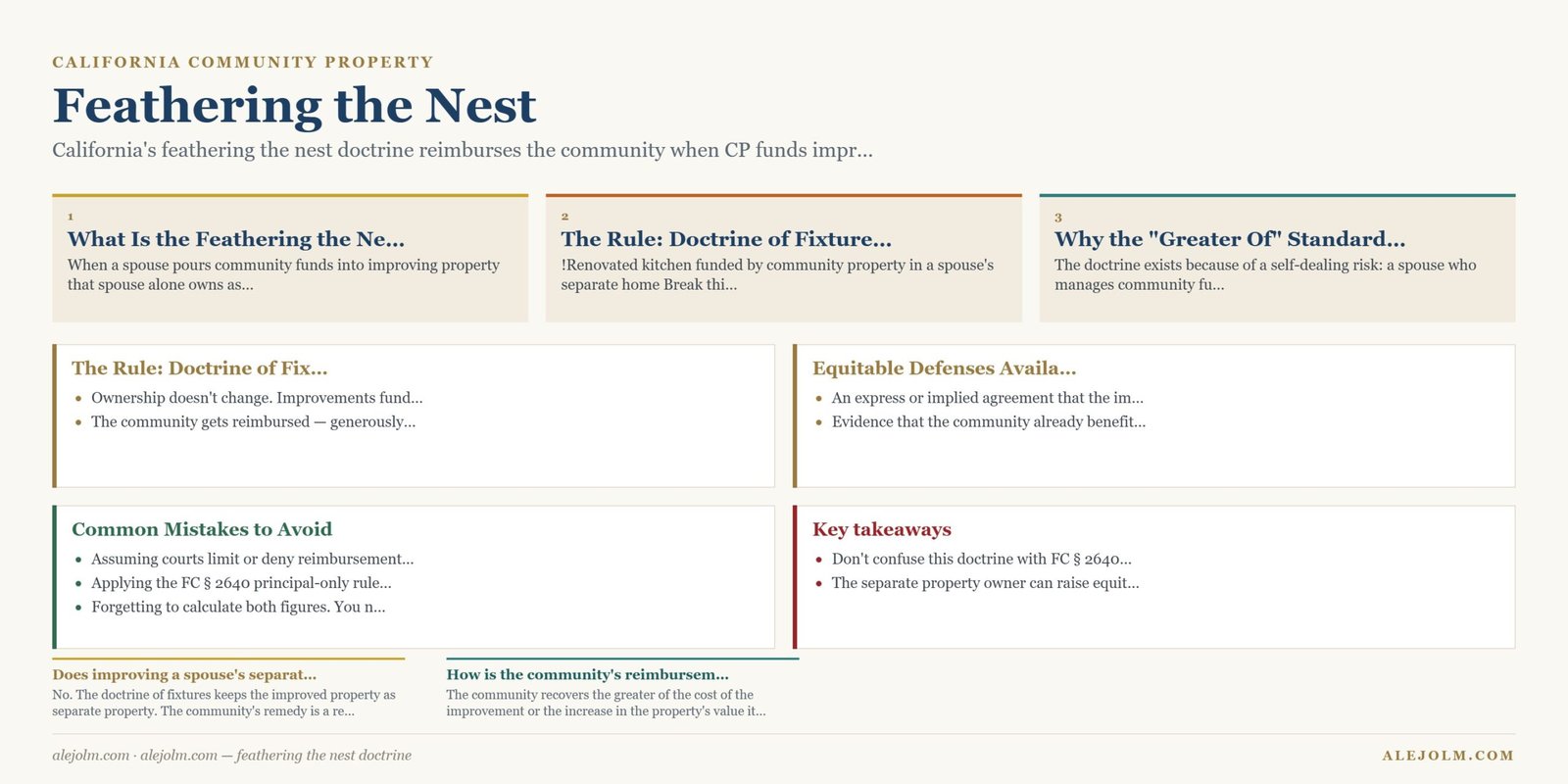
What Is the Feathering the Nest Doctrine?
When a spouse pours community funds into improving property that spouse alone owns as separate property, California doesn’t let the community walk away empty-handed. This is the feathering the nest doctrine: the improved property stays separate, but the community earns a reimbursement claim measured by whichever is greater — the cost of the improvement or the increase in value it created.
The name is deliberately pejorative — it evokes a spouse “feathering their own nest” with shared money — but don’t let the name mislead you. This doctrine actually protects the community, and California Bar Exam questions frequently test whether you understand that the rule favors the non-improving spouse’s interest, not the reverse.
The Rule: Doctrine of Fixtures Plus a Generous Reimbursement
Feathering the nest, defined: when community property funds are used to improve a spouse’s own separate property, the doctrine of fixtures keeps the improvement (and the underlying property) as that spouse’s separate property, but the community is entitled to reimbursement equal to the greater of the cost of the improvement or the resulting increase in the property’s value.
Break this into its two working pieces:
- Ownership doesn’t change. Improvements funded by community money on a spouse’s own separate property don’t convert the property to community property. The doctrine of fixtures attaches the improvement to the real estate, and the real estate stays separate.
- The community gets reimbursed — generously. Instead of capping recovery at the dollars spent, the community recovers whichever figure is larger: cost or value added.
Why the “Greater Of” Standard Exists
The doctrine exists because of a self-dealing risk: a spouse who manages community funds and also owns separate property has an obvious incentive to funnel shared money into an asset only they will keep. That risk, combined with the FC § 721 fiduciary duty not to take unfair advantage of the other spouse, is exactly why courts apply the more generous “greater of cost or value added” measure — as a protection for the community, not a penalty on anyone.
Worked Example 1: Value Added Exceeds Cost
Facts: Before marrying, a spouse owns a rental duplex as separate property. During the marriage, the couple spends $60,000 in community funds renovating the kitchens and the roof. The improvements increase the duplex’s value by $90,000.
Analysis: The duplex remains separate property — the improvements don’t convert it to community property. But the community is entitled to reimbursement of $90,000, the greater of the $60,000 cost or the $90,000 value increase, not merely the amount spent.
Worked Example 2: Cost Exceeds Value Added
Facts: Same duplex, but this time the $60,000 renovation only increases the property’s value by $40,000 — an over-improvement relative to the local market.
Analysis: The community’s reimbursement is still the greater figure. Here that’s the $60,000 cost, not the smaller $40,000 value increase. The rule never shrinks below actual cost.
Feathering the Nest vs. FC § 2640: Don’t Confuse the Two
These two reimbursement doctrines run in opposite directions, and exam-takers regularly mix them up.
| Feathering the nest | FC § 2640 (anti-Lucas) | |
|---|---|---|
| Direction of funds | Community funds improve a spouse’s own separate property | Separate property funds contributed to community property |
| Measure of recovery | Greater of cost or value added | Principal contribution only — no interest, no appreciation |
| Who is reimbursed | The community | The contributing spouse |
If you see community funds flowing into a spouse’s own separate asset, think feathering the nest and the greater-of measure. If you see separate funds flowing into a jointly-titled community asset (like a down payment on the family home), think FC § 2640 and the principal-only measure.
Equitable Defenses Available to the Separate Property Owner
The titled spouse isn’t defenseless. They can raise equitable defenses to reduce or eliminate the reimbursement claim, such as:
- An express or implied agreement that the improvement was intended as a gift to the community.
- Evidence that the community already benefited from rent-free use of the improved property.
What doesn’t work as a defense: simply pointing out that the improving spouse benefits from owning the now-improved separate property. That’s not a defense — it’s precisely the risk the doctrine exists to address.
Common Mistakes to Avoid
- Assuming courts limit or deny reimbursement to punish “feathering the nest.” This gets the doctrine backwards. It’s a pro-community rule — the community’s recovery is enhanced (greater of cost or value), not reduced.
- Applying the FC § 2640 principal-only rule to this fact pattern. That statute governs the opposite direction of contribution — separate funds flowing into community property. Community funds improving a spouse’s own separate property is a different scenario entirely, governed by feathering the nest.
- Forgetting to calculate both figures. You need to compute cost and value added separately, then award the community the larger number. Skipping one calculation is a common way to lose exam points.
Why This Matters for the California Bar Exam
Whenever a fact pattern shows community funds spent renovating, improving, or upgrading property titled solely in one spouse’s name, don’t reach for FC § 2640. Instead, calculate both the cost of the improvement and the resulting increase in value, and award the community the greater of the two. This doctrine pairs naturally with fiduciary duty issues, since the self-dealing concern is baked into the policy rationale.
FAQ
Does improving a spouse’s separate property with community funds convert it to community property?
No. The doctrine of fixtures keeps the improved property as separate property. The community’s remedy is a reimbursement claim, not a change in ownership.
How is the community’s reimbursement calculated?
The community recovers the greater of the cost of the improvement or the increase in the property’s value it produced — whichever figure is larger, not simply the amount spent.
Is feathering the nest the same rule as FC § 2640?
No. FC § 2640 governs separate property funds contributed to community property and limits recovery to principal. Feathering the nest governs the reverse situation — community funds improving a spouse’s own separate property — and uses the more generous greater-of-cost-or-value-added measure.
Key Takeaways
- When community funds improve a spouse’s own separate property, the doctrine of fixtures keeps the property separate, but the community earns a reimbursement claim.
- The reimbursement equals the greater of the cost of the improvement or the increase in value it produced — never less than cost, and potentially far more.
- This is a pro-community rule designed to guard against self-dealing by the spouse managing shared funds, tied closely to the FC § 721 fiduciary duty.
- Don’t confuse this doctrine with FC § 2640, which governs the opposite fact pattern (separate funds contributed to community property) and caps recovery at principal.
- The separate property owner can raise equitable defenses like an intended gift to the community or the community’s rent-free use of the property.
This article is educational and is not legal advice. Consult a licensed California attorney about your situation.
Related guides
- Moore-Marsden apportionment
- community property presumptions
- spousal fiduciary duty
- community credit presumption