
What Is the Spousal Fiduciary Duty Under FC § 721?
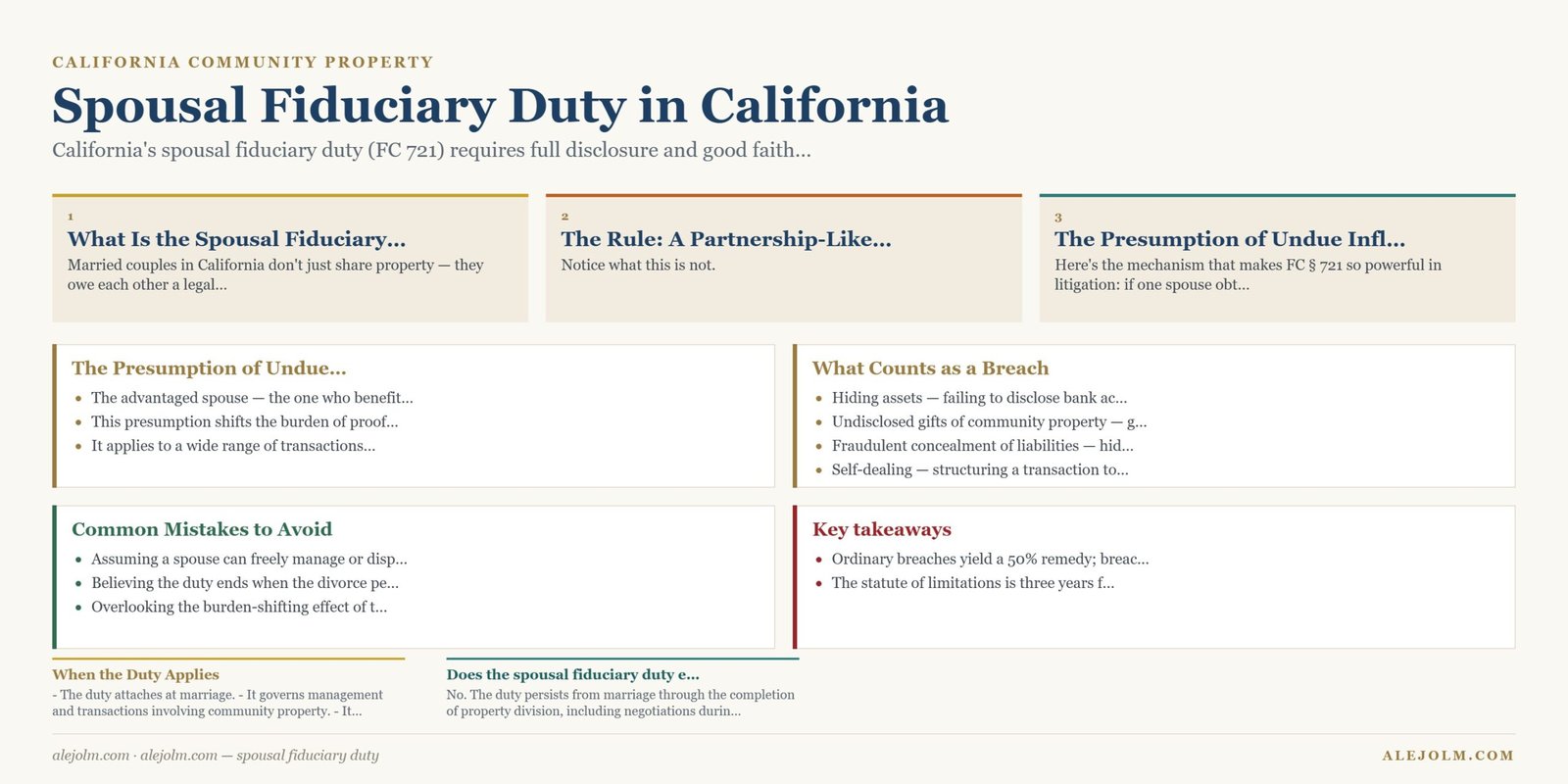
Married couples in California don’t just share property — they owe each other a legal duty of loyalty about it. This is the spousal fiduciary duty, codified at Family Code § 721, and it is one of the most heavily tested doctrines on the California Bar Exam because it decides who wins when one spouse hides money, self-deals, or mismanages the marital estate.
If you’re studying community property or advising a divorcing client, you need to know exactly when this duty applies, what counts as a breach, and how the remedies scale depending on the spouse’s state of mind.
The Rule: A Partnership-Like Standard of Good Faith
Spousal fiduciary duty, defined: under FC § 721(b), spouses managing community property owe each other the duties of the highest good faith and fair dealing — similar to the duty business partners owe one another — including full disclosure of material facts, accounting for any unauthorized benefit, and access to financial records.
Notice what this is not. It is not a full trustee-beneficiary relationship with the strictest possible standard of care. The statute expressly analogizes the duty to what nonmarital business partners owe each other under California’s partnership law. That’s still a demanding standard — but it has a specific legal pedigree worth naming on an exam.
When the Duty Applies
- The duty attaches at marriage.
- It governs management and transactions involving community property.
- It does not end at the divorce judgment — it persists through the entire property-division process, including settlement negotiations and disclosure in the dissolution action itself.
This timing point is a favorite exam trap. Students assume the duty evaporates once a divorce petition is filed. It doesn’t. Spouses negotiating a marital settlement agreement are still fiduciaries to each other.
The Presumption of Undue Influence
Here’s the mechanism that makes FC § 721 so powerful in litigation: if one spouse obtains an advantage from a transaction with the other, California law presumes that spouse exercised undue influence.
- The advantaged spouse — the one who benefited — bears the burden of proving the transaction was fair and made in good faith.
- This presumption shifts the burden of proof, which is a significant procedural advantage for the spouse who was harmed.
- It applies to a wide range of transactions: transfers of community property, gifts of community assets, business dealings between spouses, and agreements restructuring property rights.
What Counts as a Breach
Common breaches of the spousal fiduciary duty include:
- Hiding assets — failing to disclose bank accounts, investments, or business interests.
- Undisclosed gifts of community property — giving away community assets to a third party without the other spouse’s consent.
- Fraudulent concealment of liabilities — hiding debts that affect the community’s true financial picture.
- Self-dealing — structuring a transaction to benefit one spouse at the community’s expense.
- Reckless or negligent mismanagement — careless handling of community investments that squanders marital assets.
Remedies: Ordinary Breach vs. Fraud, Malice, or Oppression
FC § 1101 sets a two-tier remedy structure, and distinguishing the tiers is essential for exam credit.
| Type of breach | Remedy |
|---|---|
| Ordinary breach (negligent or unintentional) | Injured spouse receives 50% of the concealed or diverted asset (or its value) |
| Fraud, malice, or oppression | Injured spouse receives 100% of the concealed or diverted asset (or its value), plus attorney’s fees and costs |
The statute of limitations is three years from discovery of the breach — but a spouse can also raise the claim within a divorce or probate proceeding regardless of that three-year window.
Worked Example: Ordinary Breach vs. Fraud
Facts: Priya and Raj have been married eight years. Priya discovers that Raj quietly transferred $100,000 from their joint community account into a personal account in his name, without telling her or getting her consent.
Ordinary breach analysis: If Raj’s transfer was simply an unauthorized (but not fraudulently disguised) diversion of community funds, the presumption of undue influence arises because Raj benefited and Priya was harmed. Raj must prove he acted in good faith — a difficult showing given the lack of disclosure. If he can’t, Priya recovers 50% of the $100,000, or $50,000, under FC § 1101.
Enhanced remedy analysis: Now suppose Raj didn’t just transfer the money — he created fake invoices from a shell vendor to disguise the diversion and hid the receiving account from Priya entirely. That’s fraud, not mere oversight. Priya now recovers 100% of the $100,000, plus her attorney’s fees and court costs.
The difference between these two outcomes — $50,000 versus $100,000 plus fees — is exactly why examiners test the fraud/malice/oppression distinction so heavily.
Common Mistakes to Avoid
- Assuming a spouse can freely manage or dispose of community property without consequence. Management powers exist, but they’re bounded by the fiduciary duty. Selling off community assets or transferring them to a third party without notice can be a breach even if the spouse had statutory management authority.
- Believing the duty ends when the divorce petition is filed. It continues through the entire property division process, including settlement negotiations.
- Overlooking the burden-shifting effect of the undue influence presumption. Once one spouse shows a benefit-to-detriment transaction, the burden moves to the advantaged spouse — students often forget to flag this shift in their analysis.
Why This Matters for the California Bar Exam
Fiduciary duty essays typically test three things together: disclosure, concealment, and the proportionality of any gain or loss between spouses. Whenever a fact pattern shows one spouse benefiting from a transaction the other didn’t know about, immediately flag the undue influence presumption and shift the burden. Then look for facts suggesting fraud, malice, or oppression, because that’s what unlocks the 100%-plus-fees remedy instead of the standard 50%.
FAQ
Does the spousal fiduciary duty end when spouses separate?
No. The duty persists from marriage through the completion of property division, including negotiations during a pending divorce. It does not end merely because the spouses are living apart or a petition has been filed.
What is the difference between the 50% and 100% remedies under FC § 1101?
An ordinary, non-fraudulent breach entitles the injured spouse to 50% of the concealed or diverted asset. If the breach involved fraud, malice, or oppression, the injured spouse recovers 100% of the asset’s value plus attorney’s fees and costs.
Who has the burden of proof when one spouse benefits from a transaction?
The spouse who obtained the benefit. Because FC § 721 treats spouses as fiduciaries, a benefit-to-detriment transaction triggers a presumption of undue influence, and the advantaged spouse must prove the transaction was fair and made in good faith.
Key Takeaways
- FC § 721 imposes a partnership-like fiduciary standard on spouses managing community property: good faith, fair dealing, full disclosure, and accounting for unauthorized benefits.
- The duty attaches at marriage and continues through the completion of property division — not just until the divorce judgment.
- A transaction that benefits one spouse to the other’s detriment triggers a presumption of undue influence, shifting the burden of proof to the advantaged spouse.
- Ordinary breaches yield a 50% remedy; breaches involving fraud, malice, or oppression yield a 100% remedy plus attorney’s fees under FC § 1101.
- The statute of limitations is three years from discovery, but claims can also be raised within a divorce or probate proceeding regardless of that deadline.
This article is educational and is not legal advice. Consult a licensed California attorney about your situation.