
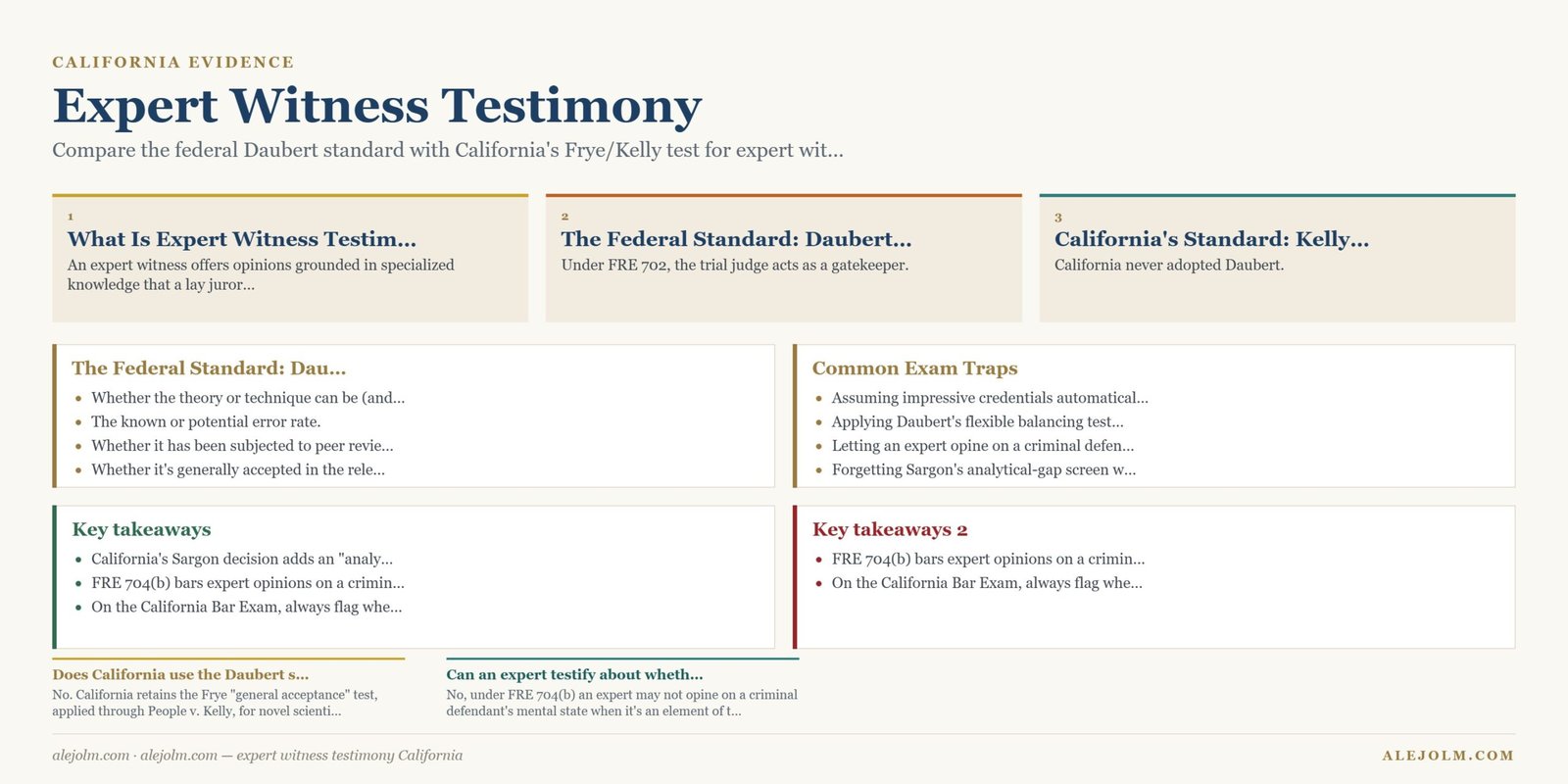
What Is Expert Witness Testimony?
An expert witness offers opinions grounded in specialized knowledge that a lay juror wouldn’t otherwise have — engineering, medicine, forensic science, psychology. Unlike a fact witness, an expert can testify to conclusions, not just observations.
The catch is that experts don’t get a free pass. Before the jury hears a word of the opinion, a judge has to sign off. And this is exactly where California and federal courts part ways — a split tested constantly on the California Bar Exam.
Expert witness testimony is opinion evidence from someone with specialized knowledge, skill, training, or experience, admitted to help the jury understand evidence or decide a fact issue beyond common understanding. Admissibility turns on qualification and methodology reliability, not just credentials.
The Federal Standard: Daubert Gatekeeping
Under FRE 702, the trial judge acts as a gatekeeper. Since a 2023 amendment, FRE 702 makes explicit what Daubert v. Merrell Dow Pharmaceuticals, Inc. (1993) already implied: the proponent must show by a preponderance of the evidence that the expert’s methodology is reliable and reliably applied to the facts.
Daubert lists flexible factors for judging reliability:
- Whether the theory or technique can be (and has been) tested.
- The known or potential error rate.
- Whether it has been subjected to peer review and publication.
- Whether it’s generally accepted in the relevant scientific community.
Kumho Tire Co. v. Carmichael (1999) extended this gatekeeping duty beyond hard science to all expert testimony — engineering, tire-failure analysis, and other technical or experience-based fields. A judge can’t skip Daubert scrutiny just because the expert’s field isn’t a laboratory science.
California’s Standard: Kelly-Frye, Not Daubert
California never adopted Daubert. Instead, it retains the older Frye v. United States (1923) test, applied through People v. Kelly (1976): for novel scientific techniques, the methodology must be “generally accepted” in the relevant scientific field. This is narrower than Daubert‘s flexible multi-factor balancing — general acceptance is essentially the whole ballgame.
California layered on an additional requirement in Sargon Enterprises, Inc. v. University of Southern California (2012): even a generally accepted, reliable methodology must be properly connected to the actual facts of the case. If there’s a gap between the science and its application, the opinion is excludable under Sargon‘s “analytical gap” doctrine — separate from, and in addition to, the Kelly-Frye general-acceptance inquiry.
CEC vs. FRE: The Reliability Gatekeeping Comparison
| Issue | Federal Rule (FRE) | California Rule (CEC) |
|---|---|---|
| Governing standard | Daubert flexible multi-factor reliability test (FRE 702, amended 2023) | Kelly-Frye “general acceptance” test for novel scientific techniques |
| Applies to non-scientific experts? | Yes — Kumho Tire extends gatekeeping to all technical/specialized experts | Kelly-Frye applies specifically to novel scientific evidence; other expert opinion evaluated under CEC § 801 |
| Extra reliability screen | None beyond Daubert factors | Sargon “analytical gap” — methodology must be properly applied to case facts |
| Burden of proof | Preponderance of evidence that methodology is reliable and reliably applied | Proponent must show general acceptance (and, per Sargon, no analytical gap) |
| Opinion on ultimate issue | Permitted (FRE 704(a)), except criminal defendant’s mental state (FRE 704(b)) | Similarly permitted under CEC § 805, with parallel mental-state limits in criminal cases |
The practical upshot: novel forensic techniques (a new DNA-matching algorithm, a new type of tool-mark comparison) can be harder to get into a California courtroom than a federal one, because “generally accepted” is a stricter gate than Daubert‘s balancing test.
The FRE 704(b) Mental-State Trap
Both systems allow experts to opine on the “ultimate issue” that decides the case — a change from old common-law rules that barred it. But FRE 704(b) carves out a sharp exception: in criminal cases, an expert cannot testify about whether the defendant had the specific mental state (intent, knowledge, recklessness) that’s an element of the crime or defense. That call belongs to the jury alone.
A psychiatrist can testify that a defendant has schizotypal personality disorder. She cannot testify that “the defendant lacked the intent to kill.” This distinction shows up constantly in bar exam fact patterns involving insanity defenses and diminished capacity.
Worked Hypothetical
Facts: In a California products-liability suit, plaintiff’s engineer wants to testify that a novel vibration-analysis algorithm — used for the first time in litigation anywhere — proves a manufacturing defect caused a machine failure. The engineer is well credentialed (PhD, 20 years’ experience) but the algorithm has never been peer-reviewed or tested outside this case.
Analysis: Credentials alone don’t get the opinion in. California applies Kelly-Frye: because the vibration-analysis algorithm is a novel scientific technique, the court must find it’s generally accepted in the relevant engineering or forensic community. An untested, unpublished, first-use-in-litigation method almost certainly fails that test. Even if it somehow cleared general acceptance, Sargon requires the court to examine whether the engineer properly applied the method to this machine’s specific facts — a second, independent hurdle. Compare this to a federal courtroom applying Daubert: the flexible multi-factor test might allow more room to argue testability and error rate even without formal peer review, though a brand-new, unvetted method would still face a steep climb.
Common Exam Traps
- Assuming impressive credentials automatically make an opinion admissible — qualification and methodology reliability are separate inquiries.
- Applying Daubert‘s flexible balancing test in a California fact pattern instead of Kelly-Frye’s general-acceptance standard.
- Letting an expert opine on a criminal defendant’s mental state, violating FRE 704(b).
- Forgetting Sargon‘s analytical-gap screen when the methodology is reliable in the abstract but poorly connected to the case facts.
FAQ
Does California use the Daubert standard for expert testimony?
No. California retains the Frye “general acceptance” test, applied through People v. Kelly, for novel scientific techniques. It also adds the Sargon analytical-gap requirement, which has no direct federal parallel.
Can an expert testify about whether a criminal defendant intended to commit the crime?
No, under FRE 704(b) an expert may not opine on a criminal defendant’s mental state when it’s an element of the crime or defense. The expert can describe a diagnosis or condition; the jury draws the intent conclusion.
What is the “analytical gap” under Sargon?
It’s a California-specific reliability check requiring that even a generally accepted, reliable methodology be properly connected to the specific facts of the case. A gap between the science and its application to the facts can get the opinion excluded.
Key Takeaways
- Federal courts use Daubert‘s flexible, multi-factor reliability test; California uses the stricter Kelly-Frye “general acceptance” standard for novel scientific evidence.
- Kumho Tire extends gatekeeping to all expert testimony, not just hard science, in federal court.
- California’s Sargon decision adds an “analytical gap” screen with no federal equivalent.
- FRE 704(b) bars expert opinions on a criminal defendant’s mental state, even though ultimate-issue testimony is otherwise allowed.
- On the California Bar Exam, always flag whether you’re applying Daubert or Kelly-Frye — mixing them up is one of the most common scoring errors.
This article is educational and is not legal advice. Consult a licensed California attorney about your situation.