
What Is the Seven-Card Evidence Essay Approach?
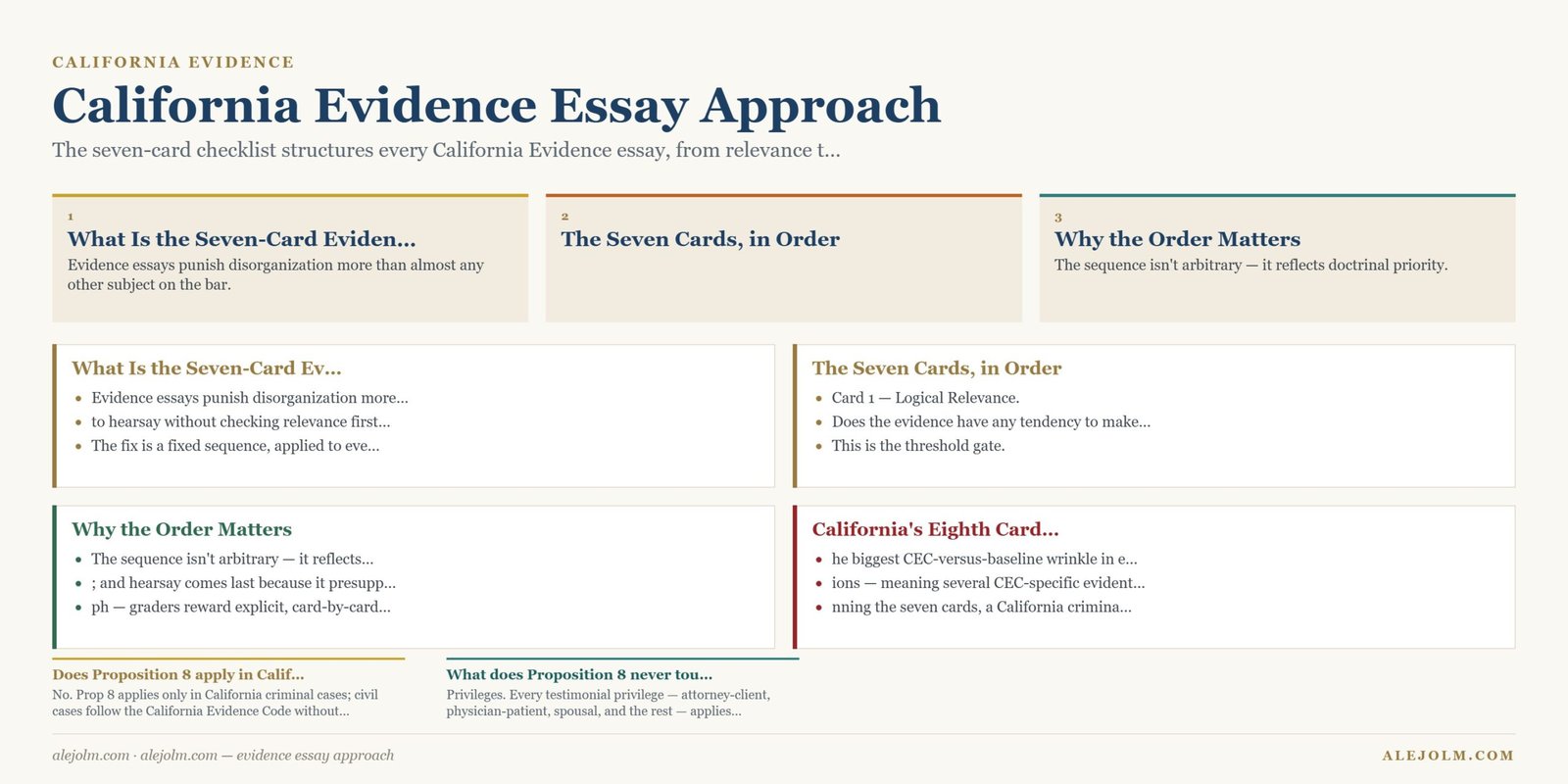
Evidence essays punish disorganization more than almost any other subject on the bar. Jump straight to hearsay without checking relevance first, and a grader sees gaps even if your hearsay analysis is flawless. The fix is a fixed sequence, applied to every single item of evidence in the fact pattern.
The evidence essay approach, defined: a seven-step mnemonic that structures every Evidence essay by walking each item of evidence through relevance filters, foundational requirements, privilege, and substantive doctrine — in a fixed order, mentioning every card explicitly even to dismiss it in a single sentence.
The Seven Cards, in Order
Card 1 — Logical Relevance. Does the evidence have any tendency to make a fact of consequence more or less probable (FRE 401 / CEC § 350)? This is the threshold gate. Fail it, and nothing else matters.
Card 2 — Legal Relevance. FRE 403 / CEC § 352 balancing: is probative value substantially outweighed by unfair prejudice, confusion, or waste of time? Judicial notice (FRE 201 / CEC § 450) belongs here too.
Card 3 — Public Policy Exclusions. Categorical bars that exclude even relevant evidence: subsequent remedial measures, compromise offers, medical-payment offers, plea negotiations, and liability insurance.
Card 4 — Knowledge and Evidence Type. Personal knowledge, lay versus expert opinion, authentication, and the best evidence rule all live here.
Card 5 — Privileges. Attorney-client, physician-patient, psychotherapist-patient, spousal, clergy-penitent, counselor-victim, newsperson’s shield.
Card 6 — Character and Impeachment. Character evidence rules, rape-shield provisions, and the methods of impeaching a witness.
Card 7 — Hearsay. Is the statement hearsay under FRE 801(c) / CEC § 1200? If so, does an exception apply — and for criminal cases, does the Confrontation Clause add a constitutional layer?
Why the Order Matters
The sequence isn’t arbitrary — it reflects doctrinal priority. Relevance gates everything else; public policy can override an otherwise-relevant, well-authenticated item; privileges are near-absolute bars that trump substantive analysis; and hearsay comes last because it presupposes the evidence has already cleared foundation and policy hurdles. Writing “Card 1: logically relevant because it shows motive” in a single sentence, then moving on, earns more credit than a vague, unstructured paragraph — graders reward explicit, card-by-card coverage, even brief coverage, over depth on only one or two issues.
California’s Eighth Card: Proposition 8
This is the biggest CEC-versus-baseline wrinkle in essay strategy, and it only applies in California criminal cases. Proposition 8 (1982) provides that nothing in the California Evidence Code limits certain enumerated protections — meaning several CEC-specific evidentiary bars no longer apply against the prosecution in criminal cases. After running the seven cards, a California criminal essay needs an eighth question: does Prop 8 reverse this result?
| Card / Doctrine | Prop 8 Effect in CA Criminal Cases |
|---|---|
| Public policy exclusions (Card 3) — e.g., CEC § 1152 compromise offers | Generally abrogated unless an enumerated exception applies — evidence often becomes admissible, subject to CEC § 352 |
| Privileges (Card 5) | No effect — Prop 8 expressly preserves all privileges |
| Character evidence, rape shield (Card 6) | Partially abrogated, with specific statutory exceptions preserved (e.g., CEC §§ 1103, 1108, 1109) |
| Hearsay (Card 7) | Several CEC-specific hearsay bars abrogated |
| Confrontation Clause (Card 7) | Preserved — Prop 8 cannot override a federal constitutional floor |
| Fourth Amendment exclusionary rule | Preserved as an enumerated exception |
| Applies in civil cases? | No — Prop 8 has zero effect outside criminal cases |
The practical upshot: in a California criminal fact pattern, treat Prop 8 as a recurring question asked right after each substantive CEC objection — not a one-time aside at the end of the essay.
Worked Example: The Post-Assault Medical Offer
In a California criminal assault trial, the prosecution offers evidence that the defendant offered to pay the victim’s medical bills immediately after the incident. The defendant objects under CEC § 1152 (the medical-payments policy exclusion).
Running the cards: Card 1 (logically relevant — an offer to pay suggests consciousness of fault); Card 2 (no undue-prejudice concern); Card 3 (CEC § 1152 would normally bar this evidence in a civil case). But this is a criminal case, and no enumerated Prop 8 exception covers CEC § 1152. Prop 8 therefore defeats the defendant’s objection, and the evidence is admissible — subject only to ordinary CEC § 352 balancing. In a civil case, the same objection would succeed outright.
Common Mistakes Bar Examiners Test
- Skipping or rushing past a card entirely — even a one-sentence dismissal is better than silence, and graders notice the gap.
- Forgetting to run the Prop 8 “eighth card” in a California criminal essay, missing an entire layer of available points.
- Applying Prop 8 in a civil case fact pattern — it has zero effect outside criminal proceedings.
- Jumping straight to hearsay analysis without first clearing relevance, policy exclusions, and foundation.
Frequently Asked Questions
Does Proposition 8 apply in California civil cases?
No. Prop 8 applies only in California criminal cases; civil cases follow the California Evidence Code without any Prop 8 override.
What does Proposition 8 never touch, even in criminal cases?
Privileges. Every testimonial privilege — attorney-client, physician-patient, spousal, and the rest — applies in criminal cases exactly as it does in civil cases, because Prop 8 expressly preserves privilege rules.
Why does card order matter if I eventually cover every issue?
Graders reward the doctrinal logic of the sequence: relevance before foundation, foundation before privilege, privilege before hearsay. An essay that jumps around loses organizational credit even when every issue is technically addressed somewhere.
Key Takeaways
- The seven-card approach — relevance, legal relevance, public policy, foundation, privilege, character/impeachment, hearsay — structures every Evidence essay in doctrinal order.
- Explicit, card-by-card coverage earns more credit than deep analysis of only one or two issues.
- Proposition 8 adds an “eighth card” for California criminal cases, reversing many CEC-specific public-policy and hearsay exclusions.
- Prop 8 never touches privileges and never applies in civil cases.
- Run the Prop 8 question immediately after each substantive CEC objection in a criminal fact pattern, not as an afterthought.
This article is educational and is not legal advice. Consult a licensed California attorney about your situation.
Mostrando SEO-05-evidence.md.