
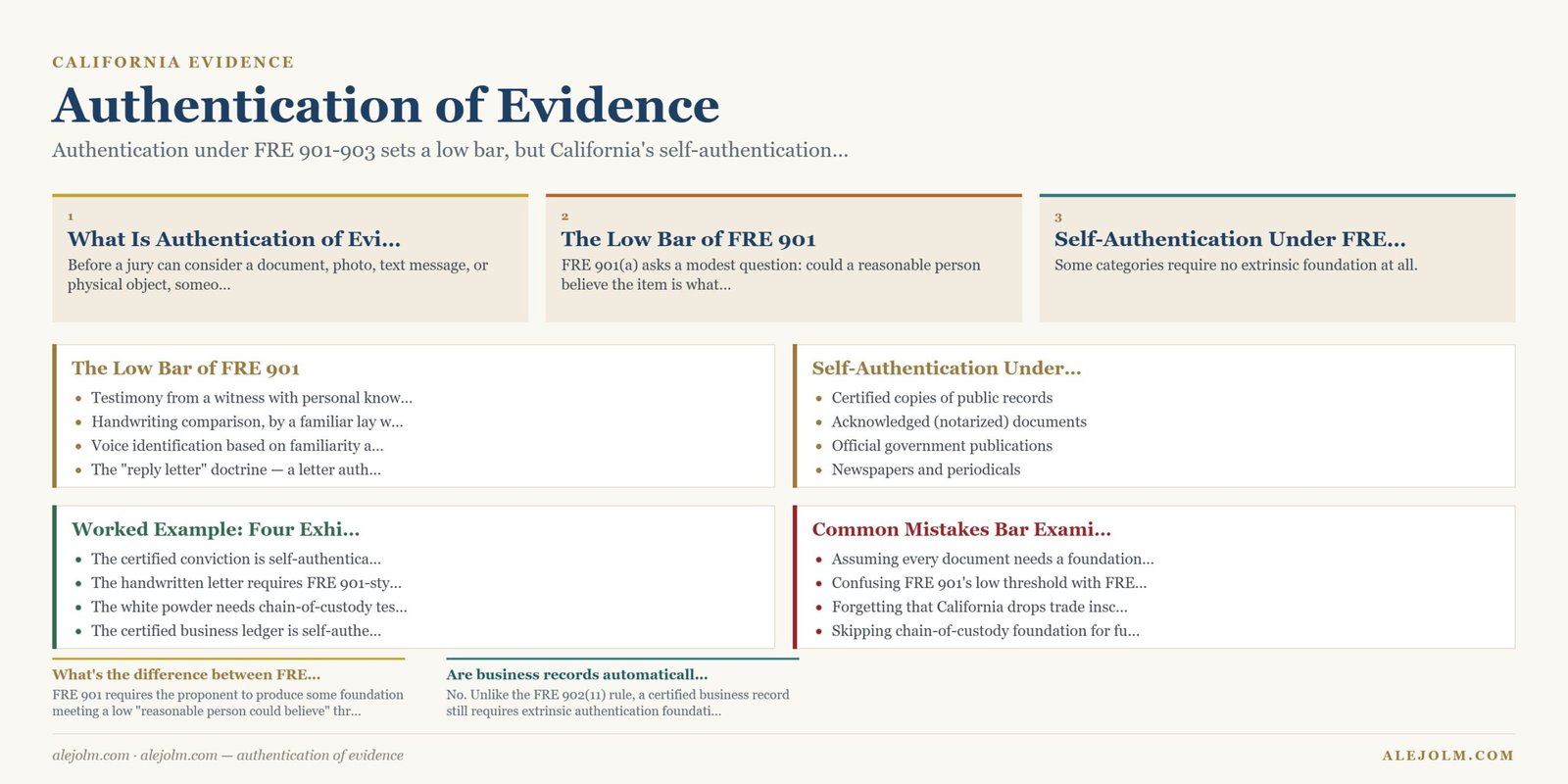
What Is Authentication of Evidence?
Before a jury can consider a document, photo, text message, or physical object, someone has to show it’s actually what it claims to be. That threshold step — often overlooked until it isn’t — is authentication, and it trips up more exam-takers than the substantive hearsay rules that follow it.
Authentication of evidence, defined: the foundational requirement that a proponent produce evidence sufficient to support a finding that an item is what it’s claimed to be (FRE 901), a standard set deliberately below preponderance of the evidence, plus the categories of documents that authenticate themselves without any extrinsic proof (FRE 902).
California and federal law start from the same low bar but diverge sharply on which documents get to skip that foundation entirely.
The Low Bar of FRE 901
FRE 901(a) asks a modest question: could a reasonable person believe the item is what the proponent claims? This is a conditional-relevance question under FRE 104(b) — the proponent need only make a prima facie showing. If that low threshold is met, the evidence comes in, and the jury (not the judge) resolves any lingering dispute about authenticity.
FRE 901(b) lists illustrative — not exhaustive — ways to authenticate:
- Testimony from a witness with personal knowledge
- Handwriting comparison, by a familiar lay witness, an expert, or the jury itself
- Voice identification based on familiarity acquired at any time
- The “reply letter” doctrine — a letter authenticates itself as a reply to one sent to a specific person
- A reliable process or system, used for computer output, X-rays, breathalyzers, and radar readings
- Chain of custody, for fungible items like drugs or blood samples
Self-Authentication Under FRE 902
Some categories require no extrinsic foundation at all. Under FRE 902, these documents come in on their own:
- Certified copies of public records
- Acknowledged (notarized) documents
- Official government publications
- Newspapers and periodicals
- Trade inscriptions — labels or tags appearing to have been affixed in the ordinary course of business (think “Made in USA” or a company logo)
- Certified business records (FRE 902(11))
There’s also the ancient documents doctrine: a document at least 20 years old under the FRE, free of suspicious irregularities, and found in a place of natural custody authenticates itself without further proof.
California’s Narrower Self-Authentication Rules
This is the high-value CEC-versus-FRE split. California’s CEC § 1400 et seq. tracks FRE 901’s general authentication standard closely — but California’s self-authentication list under CEC § 1452 is meaningfully narrower than FRE 902.
| Issue | FRE 901–903 (Federal) | CEC §§ 1400, 1452 (California) |
|---|---|---|
| General authentication standard | Evidence sufficient to support a reasonable finding (below preponderance) | Same standard |
| Certified public records | Self-authenticating | Self-authenticating |
| Acknowledged (notarized) documents | Self-authenticating | Self-authenticating |
| Newspapers and periodicals | Self-authenticating | Self-authenticating |
| Trade inscriptions (labels, tags, trademarks) | Self-authenticating | Not self-authenticating — requires FRE 901-style extrinsic foundation |
| Certified business records | Self-authenticating (FRE 902(11)) | Not self-authenticating — extrinsic foundation still required |
| Ancient documents doctrine | 20 years old | 30 years old |
Students trained on the federal rule tend to assume California self-authenticates just as broadly — it doesn’t. A product label or a certified business record that walks straight into a federal courtroom will need a live foundation witness in California state court.
Worked Example: Four Exhibits, One Trial
In a criminal case, the prosecution offers: (1) a certified copy of the defendant’s prior felony conviction, (2) a handwritten letter allegedly from the defendant to a confidential informant, (3) a bag of white powder seized during a search, and (4) a business ledger from the defendant’s company, certified under the business-records exception.
- The certified conviction is self-authenticating under both FRE 902 and CEC § 1452 — no foundation witness needed.
- The handwritten letter requires FRE 901-style foundation everywhere — a witness familiar with the defendant’s handwriting, or the reply-letter doctrine if it responds to an earlier communication.
- The white powder needs chain-of-custody testimony in both systems: an officer who seized, marked, and transported it, showing the item offered is the one collected.
- The certified business ledger is self-authenticating in federal court under FRE 902(11) — but in California, the prosecution still needs a foundation witness (someone with knowledge of how the ledger was kept) to authenticate it, even though it may separately qualify as an exception to the hearsay rule.
Common Mistakes Bar Examiners Test
- Assuming every document needs a foundation witness — self-authenticating documents under FRE 902 don’t.
- Confusing FRE 901’s low threshold with FRE 902’s total dispensation of foundation — they’re two different pathways.
- Forgetting that California drops trade inscriptions and certified business records from the self-authenticating list.
- Skipping chain-of-custody foundation for fungible items like drugs, fibers, or blood samples, which can’t be authenticated by appearance alone.
Frequently Asked Questions
What’s the difference between FRE 901 and FRE 902?
FRE 901 requires the proponent to produce some foundation meeting a low “reasonable person could believe” threshold. FRE 902 dispenses with foundation entirely for specific categories of documents.
Are business records automatically authenticated in California once they’re certified?
No. Unlike the FRE 902(11) rule, a certified business record still requires extrinsic authentication foundation under California law, even if it separately satisfies the business-records hearsay exception.
How old must a document be to qualify under the ancient documents doctrine?
20 years under the FRE, but 30 years under California’s version of the doctrine — a frequently tested numerical trap.
Key Takeaways
- Authentication requires only a low, “reasonable person could believe” threshold under FRE 901 and CEC § 1400.
- FRE 902 lets specified categories of documents skip foundation entirely — but California’s CEC § 1452 list is narrower.
- California does not self-authenticate trade inscriptions or certified business records, unlike the FRE.
- California’s ancient documents doctrine requires 30 years of age, not the FRE’s 20.
- Fungible, non-unique items always require chain-of-custody testimony regardless of jurisdiction.
This article is educational and is not legal advice. Consult a licensed California attorney about your situation.