
What Is Foreclosure?
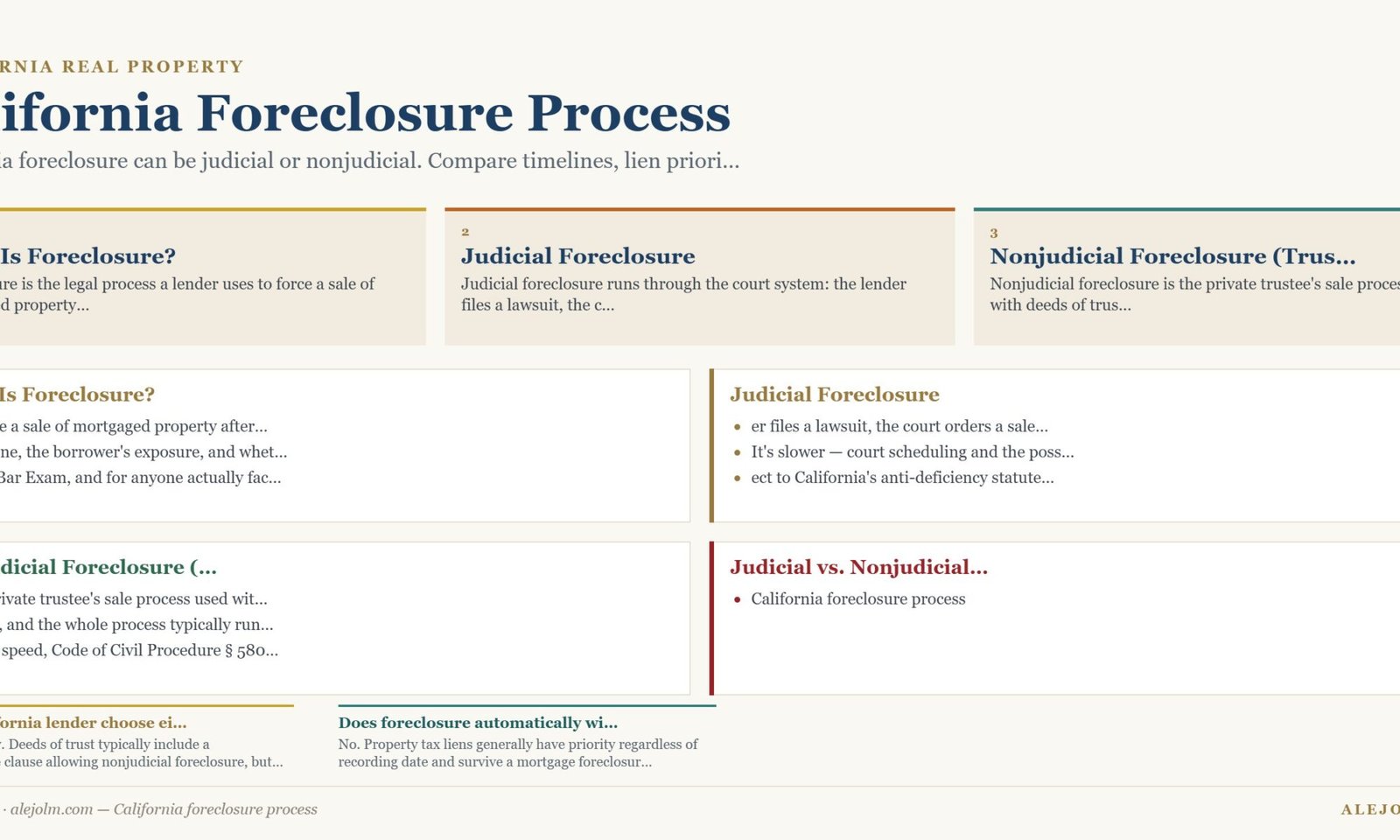
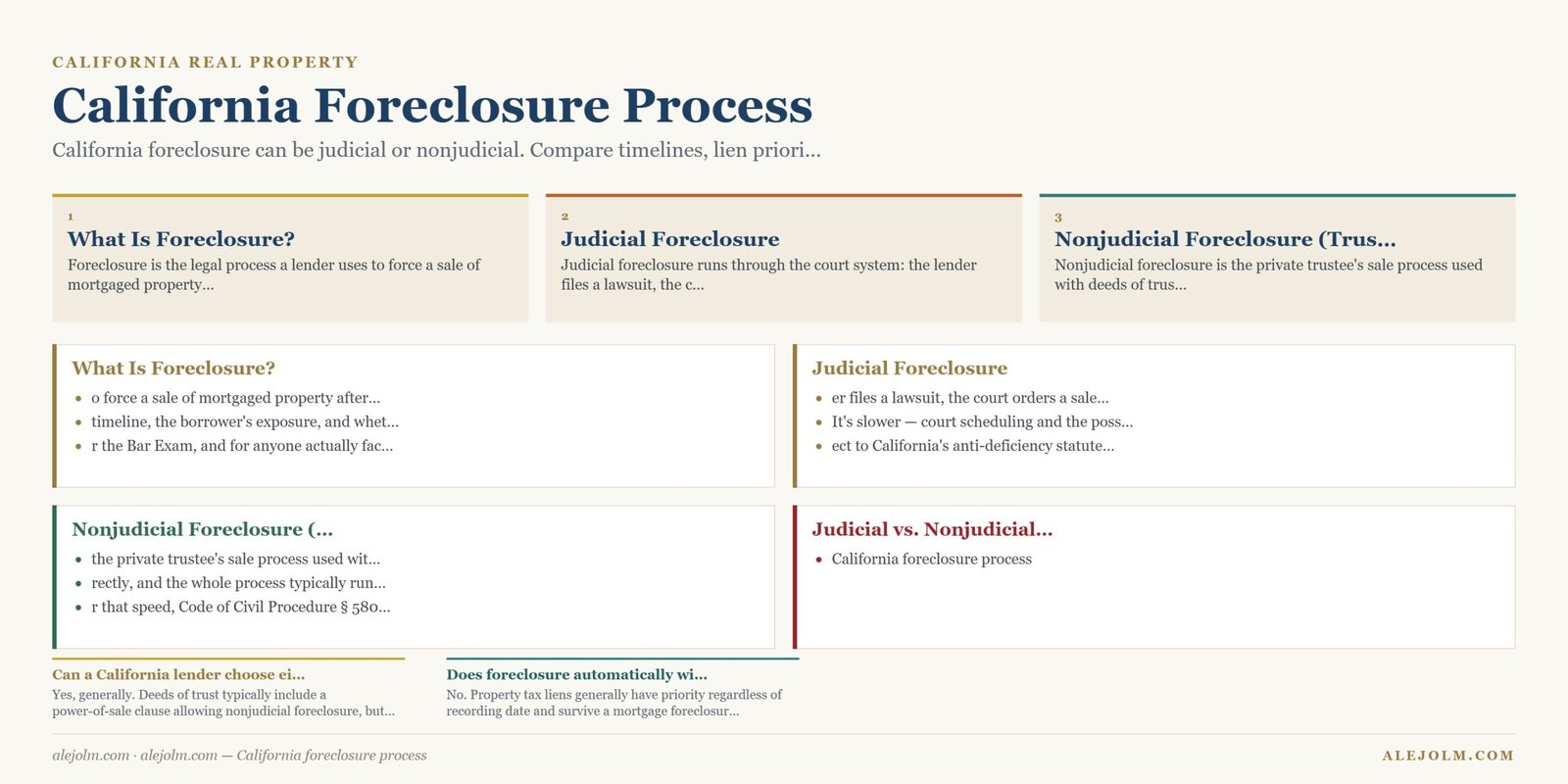
Foreclosure is the legal process a lender uses to force a sale of mortgaged property after the borrower defaults, so the proceeds can pay down the unpaid debt. California recognizes two very different paths to get there, and which one a lender picks changes the timeline, the borrower’s exposure, and whether the lender can chase the borrower personally for any shortfall.
This is one of the highest-value topics in California real property law — for law students prepping for the Bar Exam, and for anyone actually facing default, buying a distressed property, or holding a junior lien.
In one sentence: foreclosure is a legal proceeding — judicial or nonjudicial — that terminates a defaulting borrower’s interest in mortgaged real property and applies the sale proceeds to the unpaid debt in a strict order of priority.
Judicial Foreclosure
Judicial foreclosure runs through the court system: the lender files a lawsuit, the court orders a sale, and the process is available in every state, including California. It’s slower — court scheduling and the possibility of appeals stretch it out, often past a year. Its upside for the lender is that, subject to California’s anti-deficiency statutes, a deficiency judgment may be available after a judicial sale.
Nonjudicial Foreclosure (Trustee’s Sale)
Nonjudicial foreclosure is the private trustee’s sale process used with deeds of trust — the dominant financing instrument in California. There’s no lawsuit and no judge; a trustee handles notice and the sale directly, and the whole process typically runs about four months from the notice of default to the sale date. In exchange for that speed, Code of Civil Procedure § 580d bars any deficiency judgment after a nonjudicial sale, period.
Judicial vs. Nonjudicial at a Glance
| Feature | Judicial Foreclosure | Nonjudicial (Trustee’s) Sale |
|---|---|---|
| Court involvement | Yes — lawsuit and court order | No — private trustee process |
| Typical timeline | A year or more | About 4 months |
| Deficiency judgment | Possibly available, subject to §§ 580b/726 | Barred entirely under § 580d |
| Borrower’s post-sale redemption | Possible statutory redemption in some judicial cases | Generally not available in California |
Where the Sale Proceeds Go
California follows a strict priority order for distributing foreclosure sale proceeds — no pro rata sharing among lienholders:
- Sale expenses, attorneys’ fees, and court costs.
- The foreclosing lender’s principal and accrued interest.
- Junior lienholders, in strict priority order — each paid in full before the next junior lienholder sees a dollar.
- Any surplus goes back to the borrower.
Junior vs. Senior Liens
A senior lien is never affected by a junior lienholder’s foreclosure — the buyer at a junior foreclosure sale takes subject to all senior liens, and the senior lender can still foreclose later if its own debt goes unpaid.
A junior lien is generally wiped out when the senior lien forecloses — but only if the junior lienholder was properly joined as a necessary party. If a junior lienholder isn’t joined, that lien survives the sale, and the foreclosure buyer takes the property still subject to it.
The Three Anti-Deficiency Statutes Working Together
California layers three separate statutes that a bar exam question — or a real foreclosure — will often combine:
- CCP § 580b bars a deficiency judgment on a purchase-money loan secured by owner-occupied 1–4 unit residential property, in either judicial or nonjudicial foreclosure.
- CCP § 580d bars a deficiency judgment after any nonjudicial trustee’s sale, regardless of loan type or property use.
- CCP § 726 — the one-action rule — forces a lender to foreclose on the security first before suing on the note; a lender can’t skip straight to a personal judgment.
Foreclosure and Existing Tenants
If the defaulting borrower was also a landlord, foreclosure generally terminates a tenant’s lease if that lease is junior to the mortgage — the new owner takes the property free of it. California law provides some protections for residential tenants in specific circumstances (Civ. Code § 2924h), but the default rule still favors the foreclosure buyer over a junior leasehold.
Worked Example
A lender forecloses on a $150,000 first mortgage; the property sells at the foreclosure sale for $120,000. A second lender, BankB, holds a $50,000 junior mortgage and was properly joined in the proceeding.
How is the $120,000 distributed, and what happens to BankB’s lien?
Sale costs come off the top, then the first lender’s $150,000 debt gets priority — but only $120,000 is available, leaving the first lender with an unsecured $30,000 shortfall. BankB, as a properly joined junior lienholder, gets nothing from the proceeds, and its lien is terminated by the sale regardless. BankB’s only remaining option is to pursue a personal judgment against the borrower directly on the underlying $50,000 debt — the foreclosure sale itself doesn’t provide BankB any recovery.
FAQ
Can a California lender choose either judicial or nonjudicial foreclosure on a deed of trust?
Yes, generally. Deeds of trust typically include a power-of-sale clause allowing nonjudicial foreclosure, but the lender can still elect judicial foreclosure if it wants to preserve a possible deficiency claim.
Does foreclosure automatically wipe out property tax liens?
No. Property tax liens generally have priority regardless of recording date and survive a mortgage foreclosure sale; the new owner typically takes the property still subject to unpaid property taxes.
What happens if a junior lienholder isn’t given notice of a senior foreclosure?
The junior lien survives the sale. The foreclosure buyer takes the property still encumbered by that unextinguished junior lien, and the junior lienholder can later pursue its own foreclosure remedy.
Key Takeaways
- California allows both judicial foreclosure (court-supervised, slower, deficiency possible) and nonjudicial trustee’s sales (faster, deficiency barred under § 580d).
- Sale proceeds are distributed in strict priority: costs, then the foreclosing lien, then junior liens in order, then any surplus to the borrower.
- A senior lien always survives a junior foreclosure; a junior lien is extinguished by a senior foreclosure only if the junior lienholder was properly joined.
- CCP §§ 580b, 580d, and 726 work together to sharply limit when a California lender can collect a deficiency judgment.
- Tenant leases junior to the foreclosed mortgage are generally terminated, subject to limited statutory protections.
This article is educational and is not legal advice. Consult a licensed California attorney about your situation.
Related guides
- California deed of trust basics
- deficiency judgments in California
- equity of redemption before a foreclosure sale