
What Does Rule 1.2(d) Prohibit?
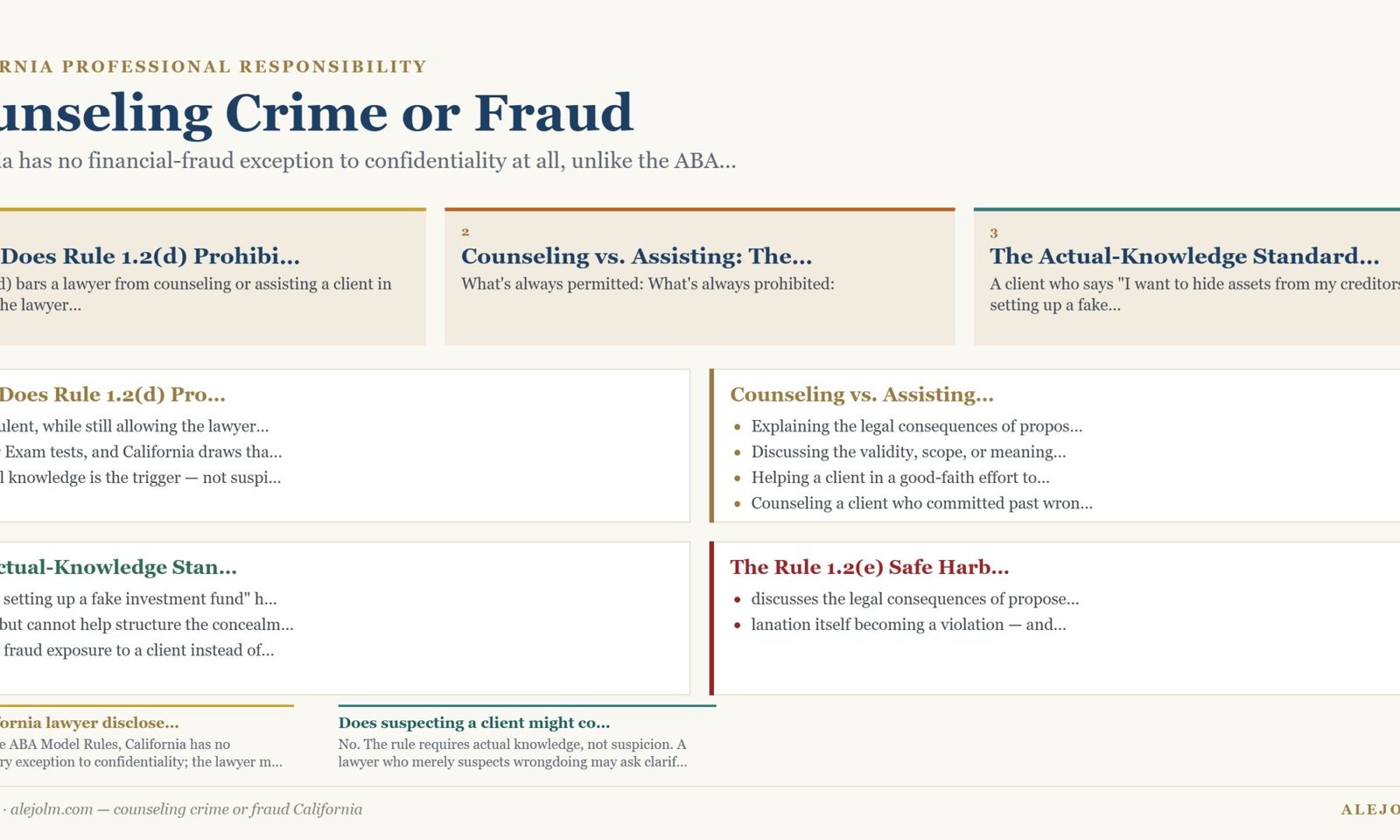
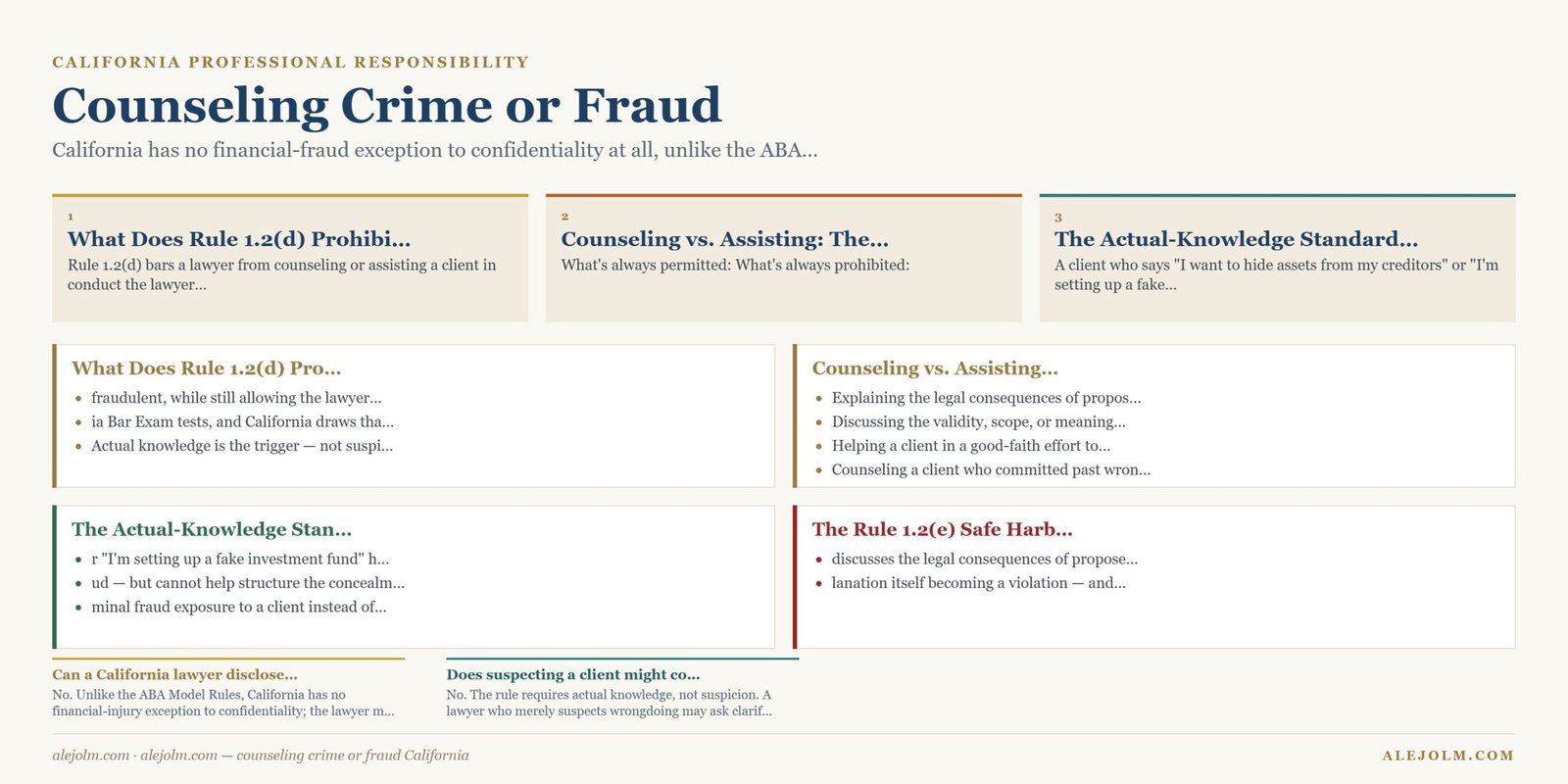
Rule 1.2(d) bars a lawyer from counseling or assisting a client in conduct the lawyer actually knows is criminal or fraudulent, while still allowing the lawyer to explain the legal consequences of what the client is proposing. The line between “advising against” and “assisting” is exactly what the California Bar Exam tests, and California draws that line differently from the ABA once the fraud is already in motion.
Actual knowledge is the trigger — not suspicion, not “should have known.” Until a lawyer actually knows the client’s purpose is criminal or fraudulent, ordinary counseling and legal analysis are fair game.
Counseling vs. Assisting: The Core Distinction
What’s always permitted:
- Explaining the legal consequences of proposed conduct.
- Discussing the validity, scope, or meaning of a law or regulation.
- Helping a client in a good-faith effort to determine whether proposed conduct is legal.
- Counseling a client who committed past wrongdoing and now wants to stop or come clean.
What’s always prohibited:
- Structuring a transaction to help hide the client’s intended fraud.
- Drafting documents that further a scheme the lawyer actually knows is fraudulent.
- Referring the client to a third party the lawyer knows will help commit the wrongdoing — indirect facilitation counts.
The Actual-Knowledge Standard in Practice
A client who says “I want to hide assets from my creditors” or “I’m setting up a fake investment fund” has crossed the actual-knowledge line the moment the lawyer hears it. From that point, the lawyer can explain the criminal exposure — wire fraud, money laundering, bankruptcy fraud — but cannot help structure the concealment or pick a low-disclosure jurisdiction to make the hiding easier.
The Rule 1.2(e) Safe Harbor
Rule 1.2(e) protects candid legal analysis: a lawyer who discusses the legal consequences of proposed conduct is not deemed to be assisting the client in committing it. This safe harbor is what lets a criminal defense lawyer explain “here’s what happens if you do X” without that explanation itself becoming a violation — and it’s often what talks a client out of the scheme in the first place.
California’s No-Exception Rule on Financial Fraud
This is the split. The ABA and California start from the same prohibition on assisting ongoing wrongdoing, but they diverge sharply on what the lawyer may do after learning the client is using the lawyer’s own services to commit financial fraud.
| Issue | ABA Model Rule 1.6(b)(2)–(3) | California |
|---|---|---|
| Disclosure to prevent future financial fraud reasonably certain to cause substantial injury | Permitted (not required) | Not permitted — no such exception exists |
| Disclosure to rectify financial fraud already committed using the lawyer’s services | Permitted (not required) | Not permitted |
| Lawyer’s available response | May counsel, withdraw, or disclose | May only counsel and withdraw — never disclose |
| “Noisy withdrawal” (disaffirming tainted work product) | Available | Available, and often the only tool left |
Under the ABA rule, a lawyer who learns a client used the lawyer’s services to commit a financial fraud reasonably certain to cause substantial injury may disclose enough confidential information to prevent or rectify it — disclosure is optional, but it’s on the table. California has no equivalent exception anywhere in Business and Professions Code § 6068(e) or CRPC 1.6. A California lawyer in the identical situation must withdraw and stay completely silent about the fraud, full stop.
Ponzi Schemes and Tax Fraud: The Classic Fact Patterns
Two scenarios dominate bar exam testing here. First, a client proposing an offshore structure to hide assets or a fake investment vehicle — the lawyer can counsel against it and explain the criminal exposure, but cannot help design the concealment. Second, a client asking how to falsely report income — if the question is asked with fraudulent intent the lawyer actually knows about, the lawyer cannot help draft the false return, though the lawyer can still counsel about penalties, audit risk, and options like amended returns for past filings.
Worked Example: The Under-the-Table Settlement
Client tells Lawyer: “I plan to tell the defendant in my personal-injury case that I’ll drop the lawsuit if he pays me $100,000 under the table, and I won’t report it to the IRS.” Lawyer responds: “If you do that, you’ll violate tax law and potentially commit fraud on the government. Here are the legal consequences.”
Analysis: No violation. Lawyer counseled against the wrongdoing by explaining legal consequences — exactly what Rule 1.2(e) protects. If Lawyer had instead said “here’s how to structure the payment so the IRS won’t notice,” Lawyer would have crossed into impermissibly assisting an ongoing fraud, risking both discipline and co-conspirator criminal liability.
FAQ
Can a California lawyer disclose a client’s ongoing financial fraud to prevent harm to a third party?
No. Unlike the ABA Model Rules, California has no financial-injury exception to confidentiality; the lawyer may only counsel against the conduct and withdraw.
Does suspecting a client might commit fraud trigger Rule 1.2(d)?
No. The rule requires actual knowledge, not suspicion. A lawyer who merely suspects wrongdoing may ask clarifying questions but isn’t required to investigate.
Can a lawyer advise a client on legitimate tax planning even after refusing to assist a fraudulent scheme?
Yes. The lawyer can continue advising on lawful tax treatment and past-conduct remediation options; the prohibition targets only the specific fraudulent assistance the lawyer actually knows about.
Key Takeaways
- Rule 1.2(d) requires actual knowledge of criminal or fraudulent conduct before the prohibition kicks in.
- Explaining legal consequences is always protected under the Rule 1.2(e) safe harbor.
- The ABA permits (but doesn’t require) disclosure of ongoing financial fraud using the lawyer’s services; California permits none.
- California’s only tools once fraud is discovered are counseling against it and withdrawal — including a noisy withdrawal.
- Indirect facilitation, like referring a client to a third party who will help commit fraud, is treated the same as direct assistance.
This article is educational and is not legal advice. Consult a licensed California attorney about your situation.
Related guides
- Attorney Withdrawal Rules in California
- California Attorney Fee Agreements
- Prosecutor Ethical Duties in California