
What Are the California Lawyer Advertising Rules?
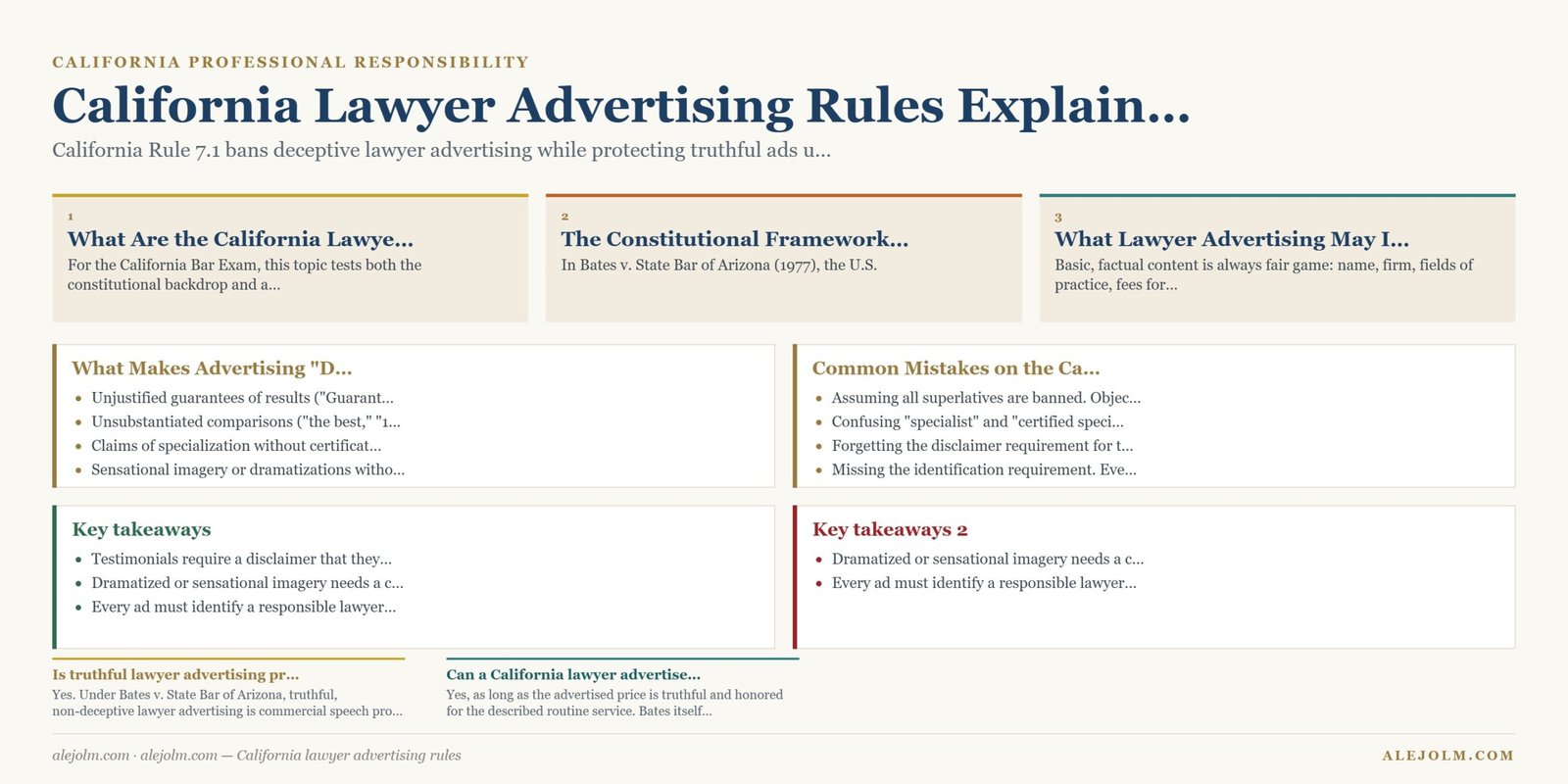
California lawyer advertising rules under Rule 7.1 permit truthful communication about a lawyer’s services directed at the public generally, while banning anything false or misleading. Advertising differs from solicitation: advertising targets the public at large, while solicitation targets a specific person the lawyer knows needs legal help. Truthful advertising is protected commercial speech under the First Amendment; deceptive advertising gets no such protection and can be banned outright.
For the California Bar Exam, this topic tests both the constitutional backdrop and a long list of specific content rules — know both.
The Constitutional Framework: Bates v. State Bar of Arizona
In Bates v. State Bar of Arizona (1977), the U.S. Supreme Court struck down a state-bar ban on truthful newspaper advertising of legal fees for routine services. The Court held that truthful lawyer advertising is commercial speech, subject to intermediate scrutiny: a restriction on non-deceptive advertising is valid only if there’s a substantial government interest and the restriction is narrowly tailored. Deceptive advertising, by contrast, receives no First Amendment protection and can be prohibited outright.
What Lawyer Advertising May Include
Basic, factual content is always fair game: name, firm, fields of practice, fees for routine services, date and place of admission, degrees, professional memberships, licenses, foreign-language ability, and references. Every ad must identify at least one responsible lawyer or firm along with contact information.
What Makes Advertising “Deceptive” Under Rule 7.1
An ad is false or misleading if it contains a material misrepresentation of fact or law, or omits something necessary to keep the statement from being misleading. Watch for these recurring categories:
- Unjustified guarantees of results (“Guaranteed $1 million recovery”). Testimonials and endorsements need a disclaimer that they don’t guarantee a specific outcome — simply listing past results is generally fine if it’s not framed as a promise.
- Unsubstantiated comparisons (“the best,” “#1 in the city”) unless backed by objective, external criteria, like an independent rating organization.
- Claims of specialization without certification — a lawyer may call herself a “specialist” based on genuine experience, but may only claim to be a “certified specialist” if actually certified by a recognized body (like the State Bar’s Board of Legal Specialization), and the certifying organization must be named.
- Sensational imagery or dramatizations without a disclaimer — a pit-bull lawyer growling through insurance paperwork needs a clear disclaimer that it’s a dramatization.
California specifics: guarantees or warranties of results are prohibited outright; advertising must not be false, deceptive, or confusing; and lawyers must retain a copy or record of their advertising (older bar answers cite roughly two years).
Worked Example: The Guarantee Billboard
A billboard reads: “GUARANTEED $1 MILLION RECOVERY OR YOUR MONEY BACK.” This violates Rule 7.1 because no lawyer can guarantee a specific dollar outcome — verdicts depend on judges, juries, witnesses, and facts that develop at trial. The guarantee is a material misrepresentation and is banned under both ABA and California rules.
Worked Example: Certification Claims
A website states “Board Certified Specialist in Personal Injury Law — California State Bar Board of Legal Specialization.” That’s fine, if true — the certifying body is named and the lawyer actually holds the certification. But a lawyer with 15 years of experience and no actual certification cannot use “Board Certified.” She can say “Specialist in Personal Injury Law Based on 15 Years of Experience” — dropping “certified” avoids the misrepresentation, since “Board Certified” has a specific, regulated meaning.
Worked Example: The Uncensored Dramatization
A TV commercial portrays a lawyer as a growling pit bull tearing through insurance paperwork, with dramatic music and smoke. Without a disclaimer explaining it’s a dramatization, this violates Rule 7.1 — viewers could form false expectations about how the lawyer actually operates. A disclaimer like “This is a dramatization and does not depict actual attorney activities” fixes the problem.
Worked Example: The Protected Fee Ad
A newspaper ad reads: “Divorce — flat fee $1,500; Simple Will — flat fee $300.” This is exactly the kind of truthful, factual advertising Bates protects — no guarantee, no misrepresentation, no deceptive omission. As long as the lawyer actually honors the advertised prices for the described routine services, this ad is fully compliant.
| Ad Feature | Permitted | Prohibited |
|---|---|---|
| Listing past case results | Yes, with disclaimer that results aren’t guaranteed | No, if framed as a promise |
| “Specialist” based on experience | Yes | — |
| “Certified specialist” without certification | — | Yes, prohibited |
| Flat-fee pricing for routine services | Yes | — |
| Dramatized imagery with disclaimer | Yes | No, if no disclaimer |
Common Mistakes on the California Bar Exam
- Assuming all superlatives are banned. Objectively substantiated claims (based on an independent rating organization) can be permissible; unsubstantiated “best” claims are not.
- Confusing “specialist” and “certified specialist.” Experience-based specialization claims are fine; certification claims require actual certification and naming the certifying body.
- Forgetting the disclaimer requirement for testimonials. Past results can be listed, but must be paired with a disclaimer that they don’t guarantee a future outcome.
- Missing the identification requirement. Every ad needs at least one named, responsible lawyer or firm with contact information.
- Treating advertising and solicitation as the same rule. Advertising is public-facing and governed by Rule 7.1; targeted communication to a specific needy person is solicitation, governed by Rule 7.3.
FAQ
Is truthful lawyer advertising protected by the First Amendment?
Yes. Under Bates v. State Bar of Arizona, truthful, non-deceptive lawyer advertising is commercial speech protected by intermediate scrutiny — restrictions must serve a substantial government interest and be narrowly tailored.
Can a California lawyer advertise flat fees for services?
Yes, as long as the advertised price is truthful and honored for the described routine service. Bates itself protected truthful advertising of legal fees for routine services like uncontested divorces.
What’s the difference between “specialist” and “certified specialist” in advertising?
“Specialist” can describe genuine experience in a practice area. “Certified specialist” requires actual certification from a recognized body, like the State Bar’s Board of Legal Specialization, and the ad must name that certifying organization.
Key Takeaways
- Truthful lawyer advertising is protected commercial speech under Bates v. State Bar of Arizona; deceptive advertising can be banned outright.
- Guarantees of results, unsubstantiated superlatives, and false certification claims are all prohibited under Rule 7.1.
- Testimonials require a disclaimer that they don’t guarantee a specific future result.
- Dramatized or sensational imagery needs a clear disclaimer.
- Every ad must identify a responsible lawyer or firm and contact information.
This article is educational and is not legal advice. Consult a licensed California attorney about your situation.
Related guides
- California solicitation Rule 7.3 for lawyers
- California referral fee rules for lawyers
- Fee splitting between lawyers under California Rule 1.5.1