
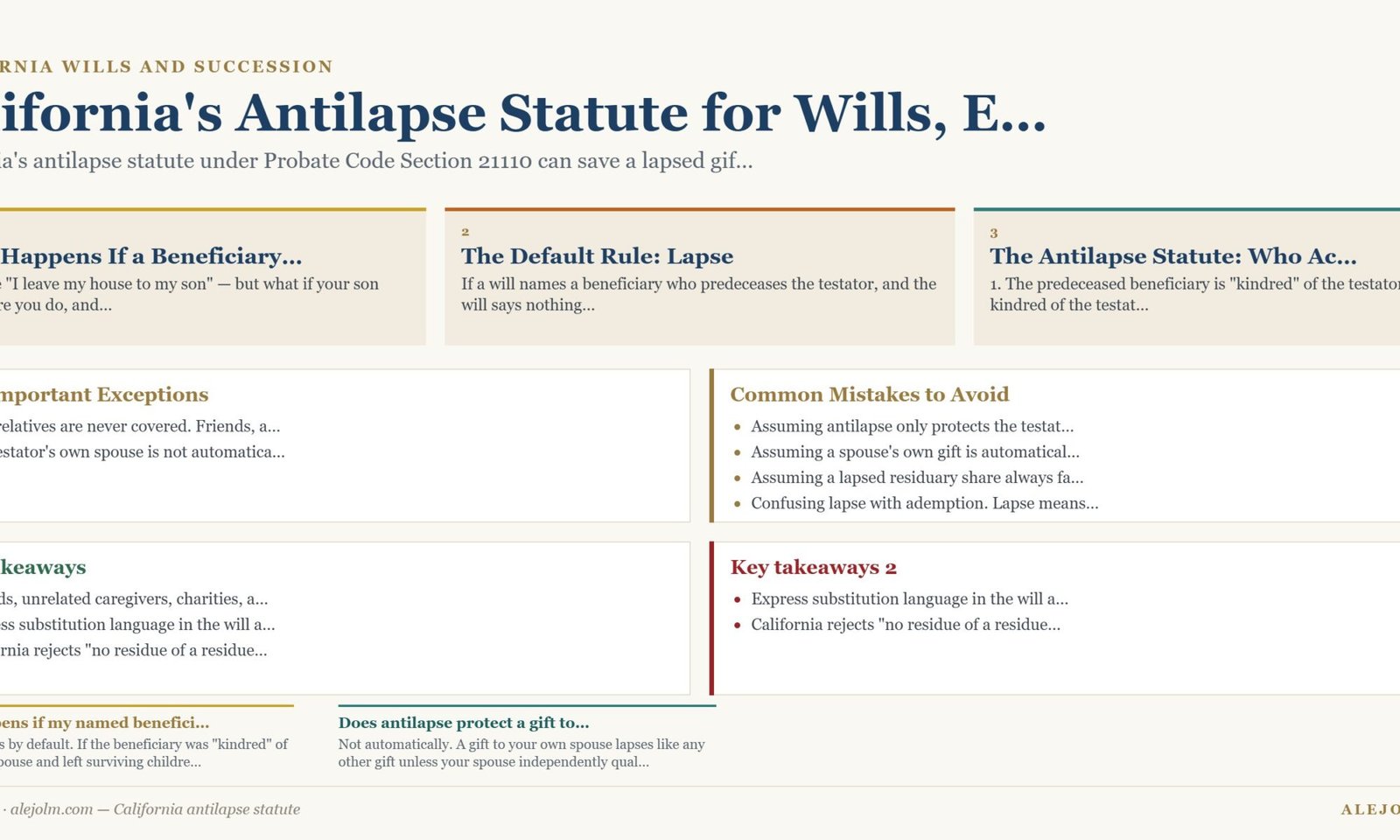
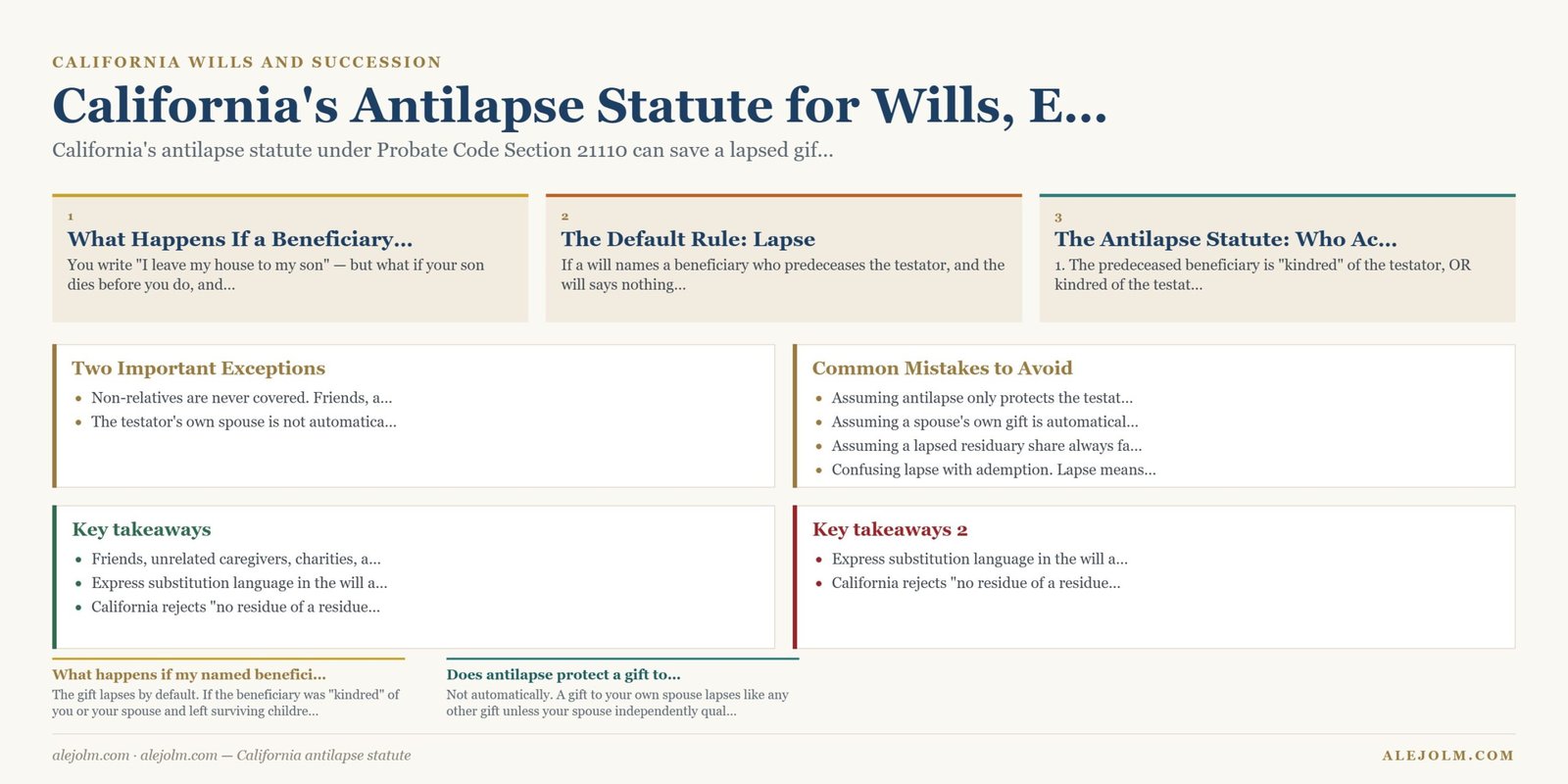
What Happens If a Beneficiary Dies Before You in California?
You write “I leave my house to my son” — but what if your son dies before you do, and you never update the will? This is one of the most practical questions in estate planning, and California has a statute specifically built to answer it: the antilapse statute. It’s also one of the most heavily tested doctrines on the California Bar Exam, because it forces you to work through statutory interpretation and testator intent all at once.
Lapse, defined: the default rule that a bequest fails if the named beneficiary dies before the testator. California’s antilapse statute is an exception that can rescue the gift for the beneficiary’s own children, but only if specific conditions are met.
The Default Rule: Lapse
If a will names a beneficiary who predeceases the testator, and the will says nothing about what happens in that case, the gift lapses — it fails. It does not automatically go to the deceased beneficiary’s children. Instead, it falls into the residuary estate (whatever’s left after specific gifts) or, if there’s no residuary clause, it passes by intestate succession. This default rule assumes the testator meant to benefit that person specifically, not a substitute.
The Antilapse Statute: Who Actually Qualifies
Cal. Probate Code § 21110 softens the harsh lapse rule — but only for a specific, and broader-than-expected, category of people. The gift is saved, passing instead to the deceased beneficiary’s surviving issue “by right of representation,” if:
- The predeceased beneficiary is “kindred” of the testator, OR kindred of the testator’s surviving, deceased, or former spouse; AND
- That beneficiary left issue (children or descendants) who survive the testator.
Here’s the detail students consistently underestimate: “kindred” isn’t limited to the testator’s own blood relatives. It also covers relatives of the testator’s spouse — meaning a gift to a stepchild, or to a spouse’s sibling, can be antilapse-protected even though that person shares no blood with the testator at all.
Two Important Exceptions
Antilapse does not save every gift:
- Non-relatives are never covered. Friends, an unmarried partner, unrelated caregivers, and charities all fall outside the statute. If they predecease the testator, the gift simply lapses.
- The testator’s own spouse is not automatically protected, despite being family. A gift to the testator’s spouse lapses like anyone else’s unless the spouse independently qualifies as “kindred” (say, they’re also a cousin) or the will provides an alternative gift.
| Beneficiary Type | Antilapse Protection? | Why |
|---|---|---|
| Testator’s child, grandchild, sibling | Yes | Testator’s own kindred |
| Testator’s stepchild, spouse’s sibling | Yes | Kindred of testator’s spouse |
| Testator’s own spouse | No (unless independently kindred) | Marriage alone isn’t “kindred” |
| Friend, unmarried partner, charity | No | Not kindred at all |
Express Provisions Always Win
If the testator’s will explicitly addresses the contingency — “to my daughter, or if she predeceases me, to my son” — that language controls completely, overriding both lapse and antilapse. Courts read these substitution clauses carefully; phrases like “or if none” are treated as showing contrary intent, which defeats antilapse even for an otherwise-qualifying beneficiary.
California Rejects “No Residue of a Residue”
The residuary clause — “I give the rest of my estate to…” — has its own wrinkle when one of several residuary beneficiaries predeceases the testator and antilapse doesn’t save the gift. At common law, the old “no residue of a residue” rule sent that lapsed share straight to intestacy, even though a residuary clause existed. California rejects this rule. Under Cal. Probate Code § 21111, a lapsed residuary share instead passes proportionally to the other surviving residuary beneficiaries — intestacy only kicks in if there are no surviving residuary beneficiaries left at all.
The analytical order on the exam (and in practice) is always the same:
- Does antilapse (§ 21110) save the gift for the deceased beneficiary’s issue?
- If not, does the lapsed share pass to the other residuary beneficiaries under § 21111?
- Only if no residuary beneficiary survives does the property pass by intestacy.
Worked Example 1: Antilapse Saves the Gift
Facts: A will states, “I leave my estate equally to my three children: A, B, and C.” A dies before the testator, leaving two children of her own (A1 and A2). B and C survive.
Analysis: A is the testator’s own child — squarely within “kindred” — and left surviving issue. Antilapse applies. A’s one-third share passes to A1 and A2 by representation (each gets one-sixth of the total estate). B and C keep their one-third shares each.
Worked Example 2: Antilapse Fails, But Intestacy Is Avoided Anyway
Facts: After specific bequests to family, a will states: “I give the residue of my estate in equal shares to my friends Alice, Bob, and Carla.” Alice predeceases the testator, leaving no issue and no blood relationship to the testator or the testator’s spouse. Bob and Carla survive.
Analysis: Antilapse doesn’t apply — Alice is a friend, not kindred, and left no issue anyway. Under the old common-law rule, her one-third share would fall to intestacy despite the residuary clause. California’s § 21111 changes that outcome: Alice’s lapsed one-third is reallocated proportionally between Bob and Carla. Result: Bob and Carla each end up with half the residue; nothing passes by intestacy.
Common Mistakes to Avoid
- Assuming antilapse only protects the testator’s own blood relatives. It also covers kindred of the testator’s spouse.
- Assuming a spouse’s own gift is automatically antilapse-protected. It isn’t, absent an independent kindred relationship.
- Assuming a lapsed residuary share always falls to intestacy. In California, it goes to the other residuary beneficiaries first.
- Confusing lapse with ademption. Lapse means the beneficiary died; ademption means the specific gifted property is gone. Different doctrines, different fixes.
FAQ
What happens if my named beneficiary dies before me in California?
The gift lapses by default. If the beneficiary was “kindred” of you or your spouse and left surviving children, California’s antilapse statute (Cal. Probate Code § 21110) passes the gift to those children instead. Otherwise, it falls to your residuary estate or, absent that, to intestacy.
Does antilapse protect a gift to my spouse if my spouse dies before me?
Not automatically. A gift to your own spouse lapses like any other gift unless your spouse independently qualifies as your “kindred” or your will names an alternate beneficiary for that gift.
If one of my residuary beneficiaries dies before me, does their share go to my other heirs by law?
Only if antilapse doesn’t save it and no residuary beneficiaries survive at all. Otherwise, under Cal. Probate Code § 21111, California reallocates the lapsed residuary share proportionally among your surviving residuary beneficiaries first — intestacy is a last resort, not the default.
Key Takeaways
- Lapse is the default: a gift to a predeceased beneficiary fails unless a rescuing rule applies.
- Cal. Probate Code § 21110’s antilapse statute protects kindred of the testator or of the testator’s spouse — broader than most people assume.
- Friends, unrelated caregivers, charities, and (usually) the testator’s own spouse are not antilapse-protected.
- Express substitution language in the will always overrides both lapse and antilapse.
- California rejects “no residue of a residue”: under § 21111, a lapsed residuary share goes to surviving residuary beneficiaries before intestacy.
This article is educational and is not legal advice. Consult a licensed California attorney about your situation.
Related guides
- contesting a will in California
- how to revoke a will in California
- testamentary capacity in California
- California will execution requirements