
What Is the Duty of Confidentiality?
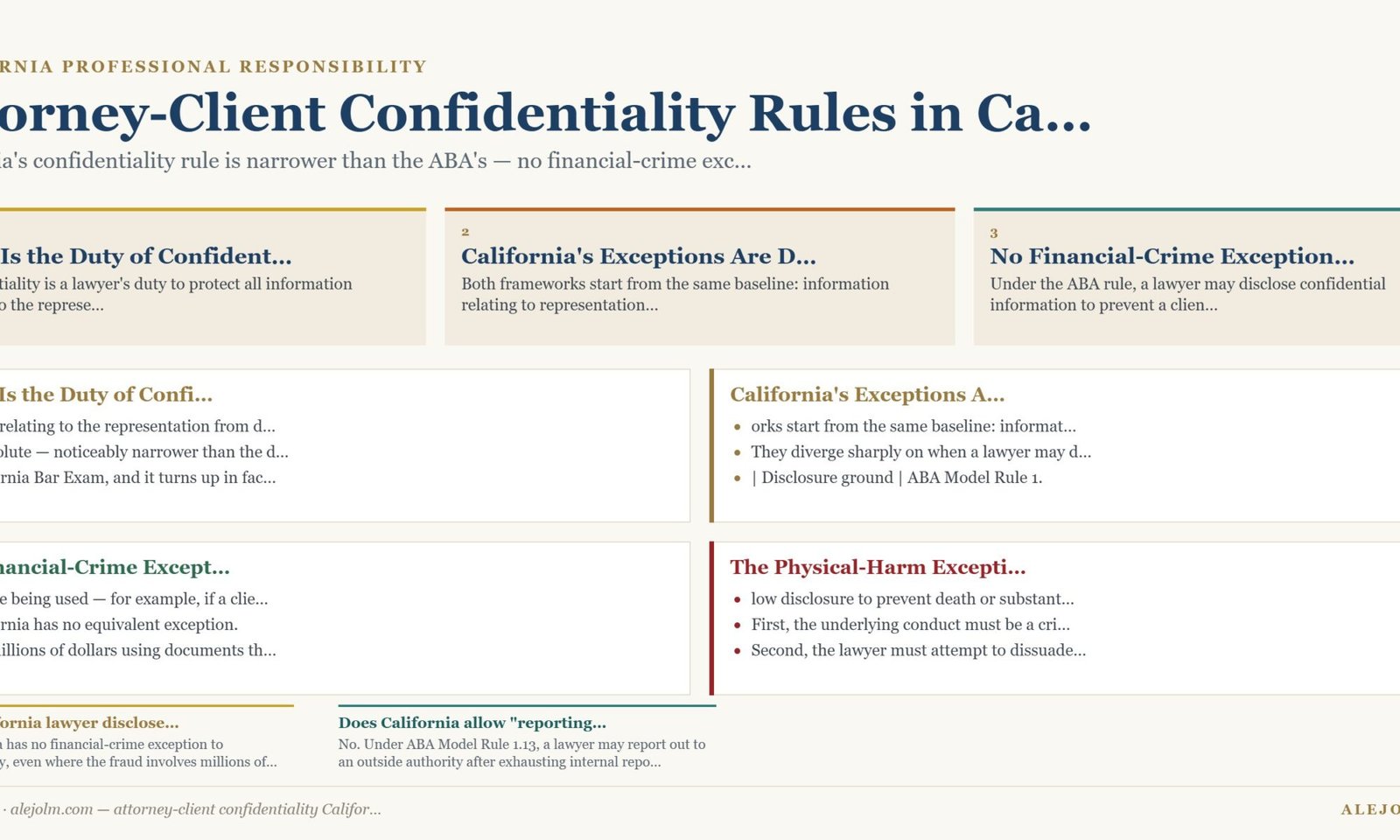
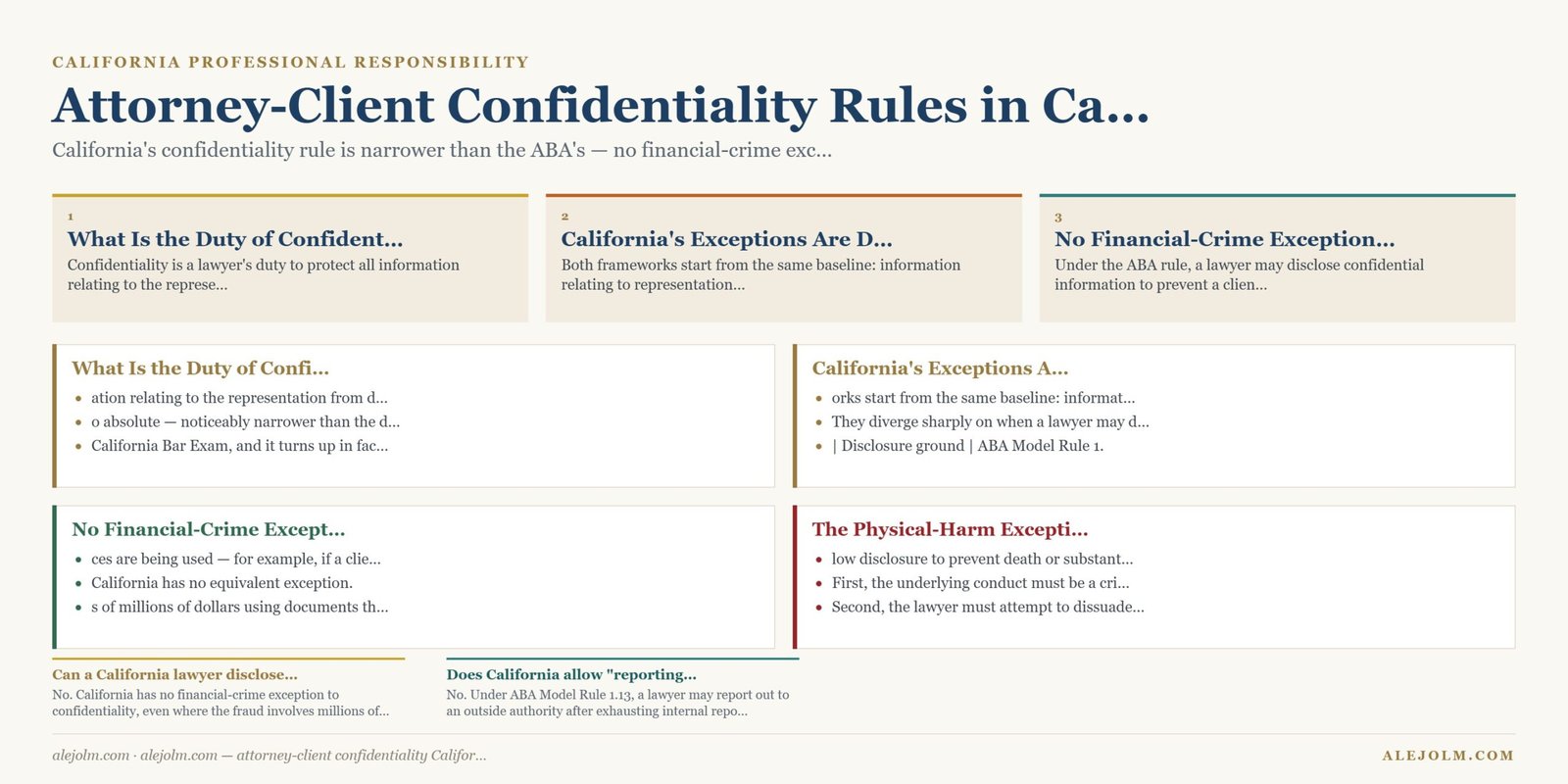
Confidentiality is a lawyer’s duty to protect all information relating to the representation from disclosure to third parties, except in narrow, defined circumstances. In California, that duty is close to absolute — noticeably narrower than the discretion the ABA Model Rules give lawyers elsewhere in the country.
This gap between California and the ABA is arguably the single most heavily tested confidentiality distinction on the California Bar Exam, and it turns up in fact patterns involving fraud, embezzlement, and corporate wrongdoing.
California’s Exceptions Are Deliberately Narrow
Both frameworks start from the same baseline: information relating to representation is protected absent informed consent. They diverge sharply on when a lawyer may disclose it anyway.
| Disclosure ground | ABA Model Rule 1.6 | California Rule 1.6 |
|---|---|---|
| Prevent death or substantial bodily injury | Yes, for injury from a client’s crime or fraud (discretionary) | Yes, but ONLY for a criminal act likely to cause death or SBI, and only after attempting to dissuade the client first |
| Financial crime using the lawyer’s services | Yes (discretionary) | No such exception exists |
| Reporting out organizational wrongdoing | Yes, after internal reporting fails (Rule 1.13) | Prohibited — withdrawal is the only recourse |
| Comply with court order or law | Yes | Yes |
| Secure legal advice on the lawyer’s own ethical compliance | Yes | Yes |
No Financial-Crime Exception in California
Under the ABA rule, a lawyer may disclose confidential information to prevent a client from committing a financial crime in which the lawyer’s own services are being used — for example, if a client wants the lawyer’s help drafting fraudulent investor disclosures. California has no equivalent exception. A California lawyer who learns a client is defrauding investors of millions of dollars using documents the lawyer prepared cannot report to investors, regulators, or police. The lawyer’s only options are to counsel against the conduct and, if the client persists, withdraw — potentially through a “noisy withdrawal” that disaffirms prior work product without revealing client confidences.
This distinction is tested constantly because it feels counterintuitive: students instinctively assume large-scale financial fraud must be reportable. In California, it usually isn’t.
The Physical-Harm Exception Is Narrower Too
Both jurisdictions allow disclosure to prevent death or substantial bodily injury, but California’s version is stricter in two ways. First, the underlying conduct must be a criminal act. Second, the lawyer must attempt to dissuade the client before disclosing. A vague threat to “get even” with a former employee likely doesn’t meet the substantial-bodily-injury threshold; a specific plan to kill a business partner does.
Reporting Out Is Banned in California
When a lawyer represents an organization and internal reporting of misconduct fails, the ABA permits — but does not require — the lawyer to report out to an outside authority such as the SEC or law enforcement. California’s Rule 1.6, read together with Rule 1.13, forecloses that option entirely. Even where a corporation is actively bribing officials or committing ongoing fraud, a California lawyer who has exhausted internal reporting may only withdraw. This is one of the most lawyer-protective (and client-organization-protective) confidentiality rules in the country, reflecting California’s policy judgment that entities will only be candid with counsel if guaranteed absolute confidentiality.
Inadvertent Disclosure Counts Too
Confidentiality is not just about what a lawyer chooses to say — it also covers what a lawyer fails to protect. Sending client financial records over unencrypted email, leaving a case file visible to opposing counsel, or storing files on an unsecured cloud account can all violate Rule 1.6, even if no one actually accesses the information. This overlaps directly with the technology-competence duty under Rule 1.1.
Worked Example: The $50 Million Fraud
Facts: A client tells California attorney Patel that the client plans to use forged financial statements — some of which Patel helped prepare — to defraud investors of $50 million, and has already sent false statements to three investors. Patel wants to stop it.
Analysis: Patel may not disclose. The underlying misconduct is fraud, not a criminal act threatening death or substantial bodily injury, so the physical-harm exception doesn’t apply. California has no financial-crime exception at all, unlike the ABA. Patel must counsel the client against continuing and, if the client persists, may withdraw and disaffirm any documents Patel prepared that furthered the fraud — but Patel cannot alert the investors, the SEC, or law enforcement to the underlying fraud itself.
FAQ
Can a California lawyer disclose a client’s financial fraud to protect investors?
No. California has no financial-crime exception to confidentiality, even where the fraud involves millions of dollars. Disclosure is permitted only to prevent a criminal act likely to cause death or substantial bodily injury.
Does California allow “reporting out” organizational wrongdoing like the ABA does?
No. Under ABA Model Rule 1.13, a lawyer may report out to an outside authority after exhausting internal reporting. California Rule 1.13 prohibits reporting out entirely; withdrawal is the lawyer’s only recourse.
Is sending client documents over unencrypted email a confidentiality violation?
It can be. Both California and the ABA require reasonable precautions to prevent unauthorized access to client information, tying confidentiality directly to technology competence.
Key Takeaways
- California’s confidentiality exceptions are narrower than the ABA’s: no financial-crime exception and no reporting-out exception.
- Disclosure to prevent physical harm requires a criminal act likely to cause death or substantial bodily injury, plus an attempt to dissuade the client first.
- When internal reporting of organizational wrongdoing fails, California lawyers may only withdraw — never report out.
- Inadvertent disclosure through poor technology practices can violate Rule 1.6 just like an intentional leak.
- Business and Professions Code § 6068(e) independently codifies California’s confidentiality duty as a statutory obligation.
- The California-ABA confidentiality split is one of the most exam-tested topics in California professional responsibility.
This article is educational and is not legal advice. Consult a licensed California attorney about your situation.
Related guides
- attorney-client communication duties
- conflicts of interest
- corporate client representation and reporting duties
- California attorney competence rule