
Transferring a Right You Already Have
Assignment doesn’t create new obligations — it moves an existing right from one party’s hands to another’s. Once you spot the phrase “transferred her right to receive payment” in a fact pattern, you’re in assignment territory, and a distinct rule set applies.
An assignment of rights is the transfer of a party’s right to receive performance under a contract to a third party, the assignee. Unlike a third-party beneficiary — created at the moment of contracting — an assignment happens after the contract already exists, transferring rights that have already accrued. The assignee “stands in the shoes” of the assignor but never acquires more than the assignor had.
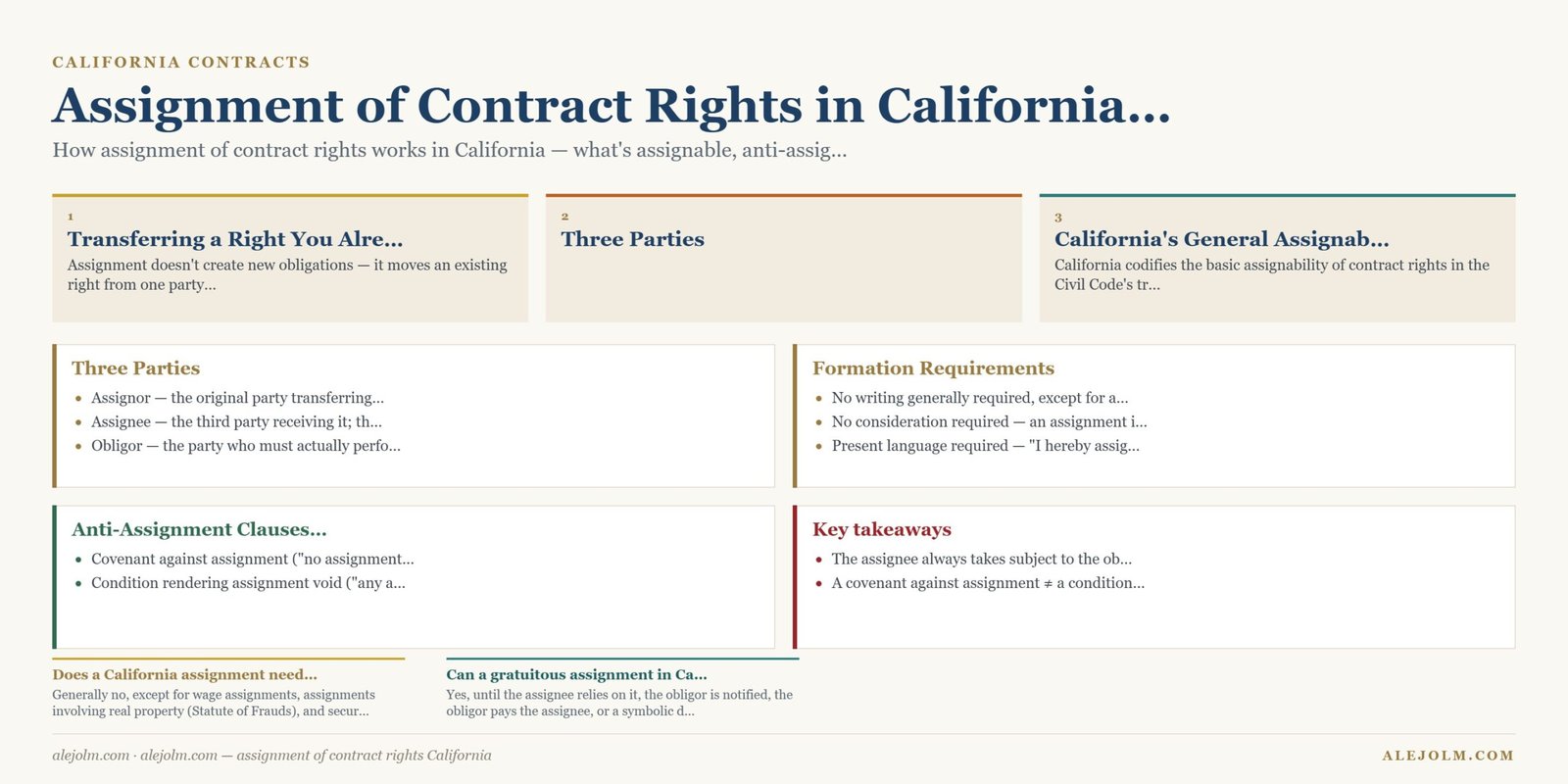
Three Parties
- Assignor — the original party transferring the right.
- Assignee — the third party receiving it; the new right-holder.
- Obligor — the party who must actually perform (usually pay) — now to the assignee instead of the assignor.
California’s General Assignability Rule: Cal. Civ. Code § 954
California codifies the basic assignability of contract rights in the Civil Code’s transfer provisions. Cal. Civ. Code § 954 provides that a thing in action — including a contractual right to payment — “may be transferred by the owner.” This is the statutory foundation underlying the common-law rule that a pure right to money is freely assignable: the obligor’s identity-based interest is minimal because the obligor pays the same amount regardless of who receives it.
Formation Requirements
- No writing generally required, except for assignments of wages (statutory writing requirements apply), assignments of real-property interests (Statute of Frauds), and assignments of security interests (California Commercial Code Division 9 requires an authenticated security agreement).
- No consideration required — an assignment is a present transfer, not a promise. A gratuitous assignment is effective but remains revocable until the assignee relies, the obligor is notified, the obligor pays the assignee, or the assignor delivers a symbolic document (like a stock certificate).
- Present language required — “I hereby assign” creates an assignment; “I will assign” or “I promise to assign” creates only a future promise, enforceable solely with consideration.
What Rights Are Assignable
| Right type | Assignable? | Why |
|---|---|---|
| Pure right to payment | Always | Obligor’s payment obligation doesn’t change based on recipient |
| Personal-service rights | No | Obligor’s identity, skill, or trust is material (e.g., a surgeon’s services) |
| Requirements/output contract rights | Only if no unreasonably disproportionate change in obligor’s burden | Protects the obligor from radically increased exposure |
Anti-Assignment Clauses: Covenant vs. Condition
A contract may try to block assignment outright, but the clause’s drafting determines its effect:
- Covenant against assignment (“no assignment without consent”): the assignment is still valid, but the assignor has breached the covenant and owes damages. The assignee can still enforce the assigned right.
- Condition rendering assignment void (“any assignment is void”): the assignment is actually void — the assignee acquires nothing.
The Defense-Following Rule
The single most tested principle in assignment: the assignee takes subject to every defense the obligor has against the assignor. If the obligor could raise fraud, breach of warranty, or setoff against the assignor, the obligor can raise the exact same defense against the assignee. An assignment never improves the assignor’s bargaining position.
Payments before notice made to the assignor remain effective against the assignee; once the obligor has notice of the assignment, payment must go to the assignee.
Multiple Assignments: Priority
If the same right is assigned twice, California and the majority of jurisdictions follow the first-assignee-for-value rule — the first assignee who gave value prevails, not merely the first to give notice. A minority “English rule” (Dearle v. Hall) instead prioritizes the first assignee to notify the obligor in good faith.
Worked Hypothetical
Facts: Construction Company contracts with Homeowner to build a deck for $20,000, payable on completion. Construction Company assigns the right to that $20,000 payment to Finance Company for $18,000 cash — a discounted sale. Before completion, Homeowner discovers the deck doesn’t meet code and refuses to pay. Finance Company sues Homeowner for the full $20,000.
Analysis: Homeowner wins the defense. Finance Company, as assignee, takes the contract subject to all defenses Homeowner has against Construction Company. The code violation is a defense to payment (defective performance), and it applies equally against Finance Company. Finance Company cannot collect more than Construction Company itself could have — Homeowner can withhold payment or claim an offset for repair costs against Finance Company exactly as it could against Construction Company.
Frequently Asked Questions
Does a California assignment need to be in writing?
Generally no, except for wage assignments, assignments involving real property (Statute of Frauds), and security-interest assignments under California Commercial Code Division 9.
Can a gratuitous assignment in California be revoked?
Yes, until the assignee relies on it, the obligor is notified, the obligor pays the assignee, or a symbolic document is delivered. An assignment made for consideration is irrevocable once made.
Does an anti-assignment clause always block the transfer?
Not necessarily. A mere covenant against assignment makes the assignment valid but breaches the contract (damages only); only a clause phrased as a condition (“any assignment is void”) actually voids the transfer.
Key Takeaways
- Cal. Civ. Code § 954 confirms that things in action, including contract payment rights, are generally transferable.
- Present language (“I assign”) creates an assignment; future language (“I will assign”) creates only a promise.
- Personal-service rights are not assignable; pure payment rights almost always are.
- The assignee always takes subject to the obligor’s defenses against the assignor.
- A covenant against assignment ≠ a condition voiding assignment — read the clause carefully.
This article is educational and is not legal advice. Consult a licensed California attorney about your situation.
Related guides
- delegation of duties in California contracts
- third-party beneficiaries in California contracts
- consideration in contract law