
What Is Alienability of Beneficiary Interests?
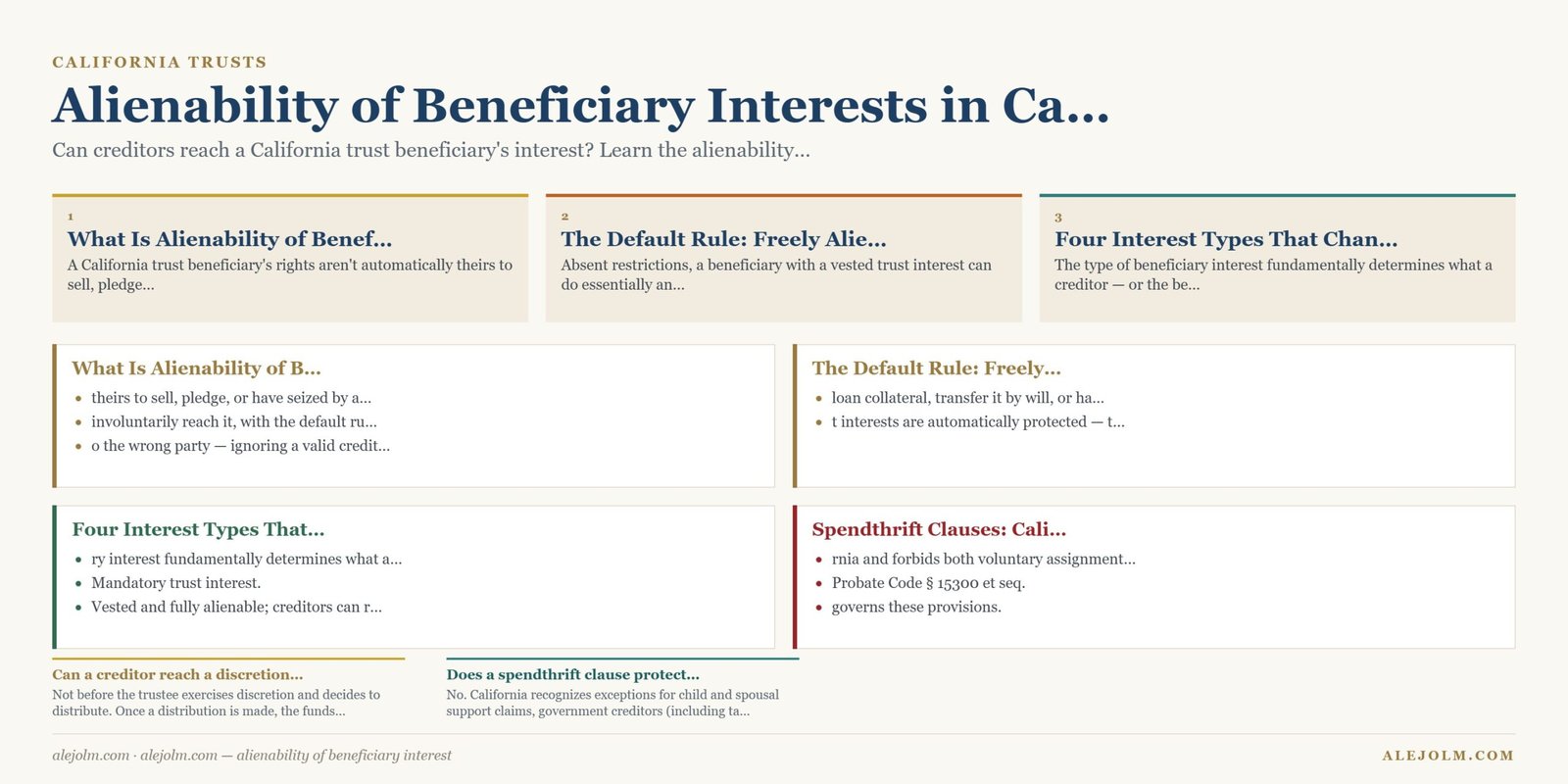
A California trust beneficiary’s rights aren’t automatically theirs to sell, pledge, or have seized by a creditor — it depends entirely on what kind of interest they hold. Alienability refers to whether a beneficiary can voluntarily transfer their trust interest, and whether creditors can involuntarily reach it, with the default rule being free alienability unless the trust instrument restricts it. This is a critical companion topic to trustee duties California doctrine, because a trustee who distributes to the wrong party — ignoring a valid creditor claim or a spendthrift restriction — can face personal liability.
The Default Rule: Freely Alienable
Absent restrictions, a beneficiary with a vested trust interest can do essentially anything an owner of property can do: assign the interest to a third party, pledge it as loan collateral, transfer it by will, or have it seized by a creditor through ordinary judgment and execution. This baseline matters because it’s easy to assume trust interests are automatically protected — they’re not, unless something in the trust or the law says otherwise.
Four Interest Types That Change the Analysis
The type of beneficiary interest fundamentally determines what a creditor — or the beneficiary themselves — can actually do with it.
- Mandatory trust interest. Vested and fully alienable; creditors can reach it without limitation (absent a spendthrift clause).
- Discretionary trust interest. No vested interest exists until the trustee actually exercises discretion, so creditors cannot reach it before distribution.
- Support trust interest (HEMS standard). Limited protection; providers of necessaries can often still reach distributions meant for health, education, maintenance, and support.
- Spendthrift-protected interest. Both voluntary assignment and involuntary creditor attachment are blocked until the trustee actually distributes funds.
Spendthrift Clauses: California’s Primary Protection Tool
A spendthrift clause is enforceable in California and forbids both voluntary assignment by the beneficiary and involuntary attachment by ordinary creditors. Probate Code § 15300 et seq. governs these provisions. The clause creates an odd but valid arrangement: the beneficiary holds a real equitable interest but cannot transfer it, pledge it, or have it seized — as long as the funds remain in the trustee’s hands, undistributed.
The Exceptions That Break Through Spendthrift Protection
Spendthrift clauses are strong, but not absolute. California recognizes specific categories of creditors who can reach spendthrift-protected interests despite the restriction:
- Child and spousal support creditors — family support obligations override spendthrift protection as a matter of public policy
- Government creditors — tax claims and certain restitution obligations can often pierce spendthrift protection
- Providers of necessaries — those who supplied medical care, food, housing, or clothing to the beneficiary have recognized claims
Worked Example: Two Creditors, Two Outcomes
Trust: “Spendthrift trust — equal income to Marisol for life.” Marisol owes $8,000 on a personal credit card and separately owes $6,000 in unpaid child support. Her credit card company cannot reach her trust interest — that’s an ordinary creditor blocked by the spendthrift clause. Her child support creditor, however, can reach the trust distributions despite the spendthrift language, because family support claims are a recognized statutory exception. Once the trustee actually pays Marisol her quarterly distribution, though, that money loses its spendthrift protection entirely — it’s now her personal property, reachable by any creditor, including the credit card company.
Timing Is Everything
The single most tested principle in this area is that spendthrift protection only covers undistributed funds still held by the trustee. The moment a distribution reaches the beneficiary’s hands, the shield disappears — the money becomes ordinary personal property subject to garnishment and levy like any other asset.
| Interest / Protection | Reachable Before Distribution? | Reachable After Distribution? |
|---|---|---|
| Mandatory (no spendthrift) | Yes | Yes |
| Discretionary | No (no vested interest yet) | Yes |
| Spendthrift-protected | No (except statutory exceptions) | Yes |
| Support trust (HEMS) | Limited (necessaries providers) | Yes |
Remainder Interests Are Harder to Reach
Current income interests are generally easier for creditors to pursue than remainder interests, which are often contingent or not yet vested. A creditor of a remainder beneficiary typically cannot force early distribution or reach the interest until it actually vests — though a vested (not merely contingent) remainder interest is not automatically immune.
Common Mistakes to Avoid
Don’t assume spendthrift protection covers every creditor — child support, government claims, and necessaries providers are recognized exceptions. Don’t confuse discretionary trust protection (no vested interest yet) with spendthrift protection (contractual restriction on transfer) — they’re different mechanisms that happen to produce similar creditor protection. And don’t assume remainder interests are automatically untouchable; vested remainders can still be reached.
Frequently Asked Questions
Can a creditor reach a discretionary trust beneficiary’s interest?
Not before the trustee exercises discretion and decides to distribute. Once a distribution is made, the funds become the beneficiary’s property and are reachable by creditors like any other asset.
Does a spendthrift clause protect against all creditors?
No. California recognizes exceptions for child and spousal support claims, government creditors (including tax claims), and providers of necessaries such as medical care and housing.
Once a trustee distributes money, is it still protected?
No. Spendthrift and other trust-based protections apply only to undistributed funds held by the trustee. Once distributed, the money is the beneficiary’s personal property and fully reachable by creditors.
Key Takeaways
- The default rule is free alienability; restrictions must come from the trust instrument or statute.
- Discretionary interests aren’t vested until the trustee decides to distribute, so creditors can’t reach them early.
- Spendthrift clauses block both voluntary transfer and ordinary creditor attachment of undistributed funds.
- Child support, government, and necessaries creditors are statutory exceptions that pierce spendthrift protection.
- Protection ends the moment funds are actually distributed to the beneficiary.
This article is educational and is not legal advice. Consult a licensed California attorney about your situation.
Related guides
- trustee surcharge remedy in California
- exculpatory clauses in California trusts
- duty of impartiality for California trustees
- rule against perpetuities
- trustee-duties