
For nearly two centuries the Second Amendment was treated as a provision about militias. Courts read the prefatory clause as a limit on the operative clause, and a challenge to a firearms statute was, in practice, unwinnable. That settled understanding collapsed in 2008, and the doctrine that replaced it has been rebuilt twice since.
The modern law rests on three decisions and one methodological rule. Heller established an individual right. McDonald bound the states to it. Bruen then discarded the balancing tests lower courts had improvised and substituted an inquiry into historical tradition. Getting that sequence right matters, because the analysis you are expected to run today looks nothing like the interest-weighing exercise that dominated the decade after Heller.
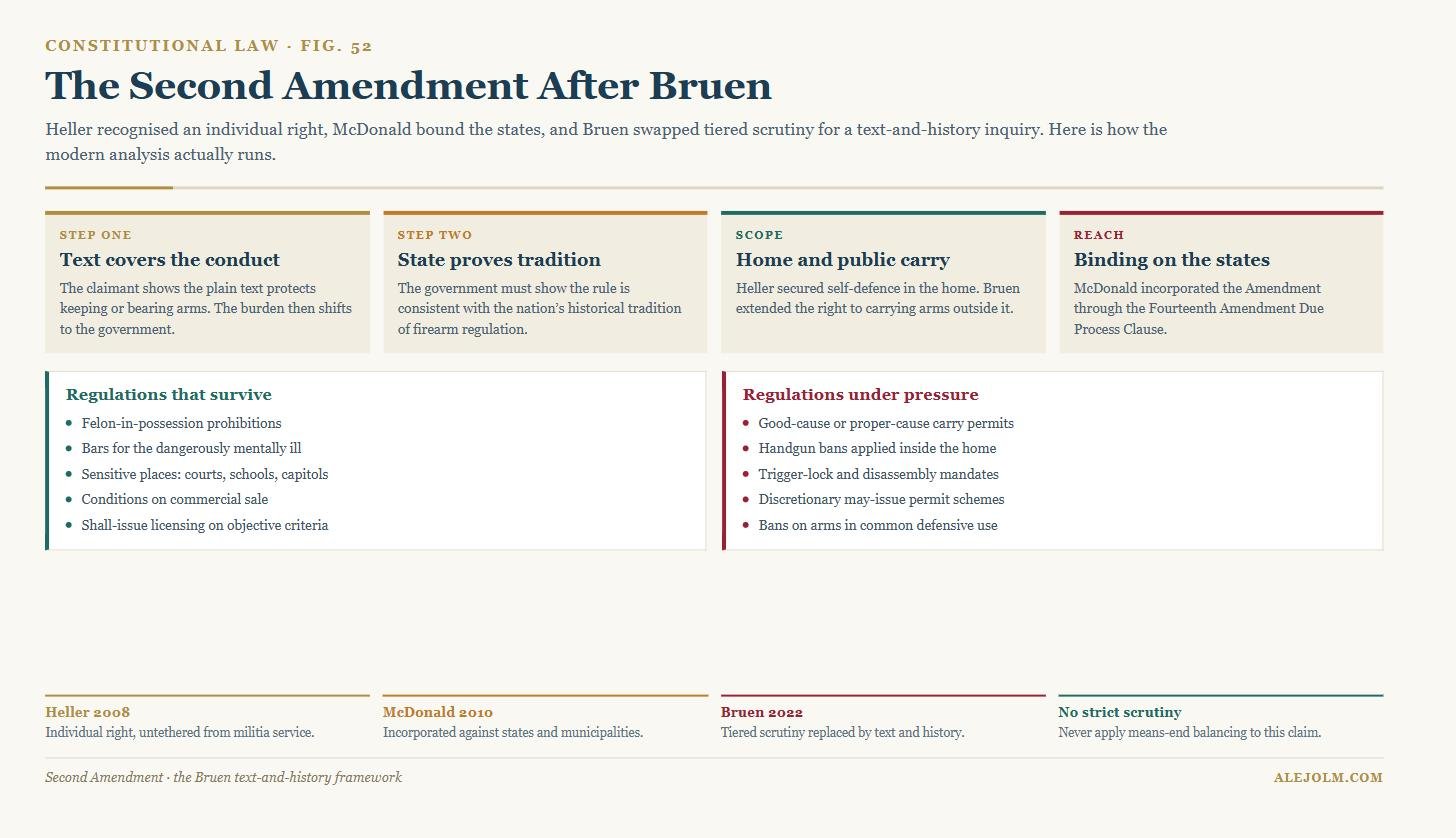
What the Amendment actually protects
The text reads: “A well regulated Militia, being necessary to the security of a free State, the right of the people to keep and bear Arms, shall not be infringed.” The interpretive fight has always been about the relationship between those two halves. The first is prefatory, announcing a purpose. The second is operative, conferring the right.
The pre-2008 consensus treated the preface as a condition: arms were protected only in connection with organised militia service. The Supreme Court rejected that reading, holding that a prefatory clause may announce a purpose without narrowing the operative guarantee. The right therefore belongs to individuals and covers traditional lawful purposes, with armed self-defence at the core rather than at the margins.
That reframing does two things at once. It creates a personal right that does not depend on enrolment in any organisation, and it identifies self-defence as the interest against which regulations are measured. Both moves matter when you decide whether a challenged rule touches the centre of the right or its periphery.
Heller, McDonald and the arrival of an individual right
Heller struck down a District of Columbia scheme that banned handgun possession in the home and required lawfully held rifles and shotguns to be kept unloaded and disassembled or bound by a trigger lock. Because the District is a federal enclave, the decision spoke only to federal power. It confirmed an individual right and invalidated a total ban on the most popular class of defensive weapon, but it left the incorporation question open.
McDonald closed that gap two years later, applying the Amendment to states and municipalities through the Due Process Clause of the Fourteenth Amendment. The practical consequence was immediate: city handgun ordinances became vulnerable on the same terms as federal ones. It is also worth remembering that this was the most recent addition to the list of incorporated guarantees, which is why the Second Amendment case law feels comparatively thin next to speech or search-and-seizure doctrine.
How the Bruen test replaced tiered scrutiny
Between 2010 and 2022, lower courts converged on a two-step method: ask whether the regulation burdened conduct within the scope of the right, then apply a tier of means-end scrutiny, usually intermediate. Bruen rejected the second half of that method outright. Balancing, the Court said, is not how enumerated rights are administered.
The replacement runs as follows. If the plain text covers the conduct the claimant wants to engage in, the conduct is presumptively protected and the burden shifts. The government must then demonstrate that its regulation is consistent with the nation’s historical tradition of firearm regulation, pointing to founding-era and nineteenth-century analogues rather than to contemporary policy justifications. Bruen also extended the right beyond the threshold of the home, holding that carrying arms in public falls within the guarantee and that a permit regime conditioned on proving a special need does not survive the historical inquiry.
The standard is genuinely awkward to apply. It is stricter than rational basis, because a legitimate public-safety rationale is no longer sufficient on its own. But it is not strict scrutiny either, because nothing turns on compelling interests or narrow tailoring. The question is historical: did this kind of regulation exist, and if the modern problem is new, is the modern response relevantly similar to something the tradition already tolerated?
Exam tip: if your answer applies strict or intermediate scrutiny to a firearms regulation, you have used the wrong framework. Name the text-and-history standard, put the burden on the government, and argue from historical analogues.
| Decision | Year |
|---|---|
| District of Columbia v. Heller | 2008 |
| McDonald v. City of Chicago | 2010 |
| NYSRPA v. Bruen | 2022 |
Regulations that still stand
Bruen did not deregulate firearms. Several categories were expressly or implicitly preserved because they have recognisable historical pedigree, and a well-organised answer separates these from the rules genuinely in doubt.
- Prohibitions on possession by convicted felons.
- Prohibitions on possession by those adjudicated dangerously mentally ill.
- Bans on carrying in sensitive places such as courthouses, legislative buildings and schools.
- Conditions on commercial sale, including dealer licensing and record-keeping.
- Shall-issue permit schemes that turn on objective criteria and a background check.
- Restrictions on weapons that are genuinely dangerous and unusual rather than in common defensive use.
What sits uncomfortably is the opposite column: discretionary may-issue permits, good-cause requirements, storage mandates that render a weapon inoperable, and prohibitions reaching arms that millions of people lawfully own. In each case the government’s difficulty is evidentiary rather than rhetorical. It must find the historical analogue, and for twentieth-century regulatory innovations there often is not one.
Sensitive places and the open questions
The sensitive-places exception is the most heavily litigated escape hatch, and it is easy to overstate. The Court has endorsed the category while warning against defining it so broadly that an entire city becomes a sensitive place. A courthouse qualifies. A polling station probably qualifies. An entire transit network, a whole downtown district, or all private property open to the public are far harder to justify on the historical record.
Other questions remain genuinely unresolved: how closely an analogue must match, which century supplies the relevant tradition, whether the founding era or Reconstruction controls where the two diverge, and how the framework handles technologies with no historical counterpart. Acknowledging that indeterminacy is not a weakness in an answer. It is accurate, and it lets you argue both sides on the historical record instead of pretending the test yields one obvious result.
Worked example
State H requires a permit to carry a loaded firearm in public and grants one only to applicants who demonstrate good cause, defined as a particularised threat to personal safety. Possession inside the home is untouched. A resident applies, cannot identify any specific threat, is refused, and sues.
Start with the text. Carrying a firearm in public is bearing arms, so the conduct is presumptively covered and the burden shifts to State H. The state will point to nineteenth-century surety statutes and to historical restrictions on carrying concealed weapons. The claimant answers that surety laws imposed a bond after a specific complaint rather than a prior licence conditioned on proving need, and that where states restricted concealed carry they generally left open carry available. Because the good-cause requirement makes an ordinary citizen’s exercise of the right contingent on official satisfaction with his reasons, it does not match the tradition and the scheme falls.
Change one fact. Suppose State H issues a permit to any applicant who is over twenty-one, passes a background check and completes a safety course, with no showing of need. That is a shall-issue regime resting on objective criteria, and the historical record supports licensing of that kind. The same statute, stripped of official discretion, now survives.
Common mistakes that cost points
- Applying strict or intermediate scrutiny. Bruen abolished means-end balancing for this right; there is no tier to select.
- Treating the individual-right reading as timeless. It dates from 2008 and displaced two centuries of contrary understanding.
- Confining the right to the home. Heller arose from a home-possession ban, but Bruen makes clear that public carry is protected.
- Forgetting incorporation and analysing only federal power. McDonald means city ordinances and state statutes are equally exposed.
- Leaving the burden on the claimant at step two. Once the text covers the conduct, the government must justify the regulation.
- Substituting policy for history. A strong public-safety rationale is not an argument under this standard unless a tradition supports it.
- Treating sensitive places as an open-ended exception that swallows the rule.
Frequently asked questions
Does the Second Amendment protect any weapon a person wants?
No. The protected class is arms in common lawful use, particularly for self-defence. Weapons that are both dangerous and unusual fall outside the guarantee, which is why handgun bans fail while restrictions on genuinely exotic ordnance do not.
Can a state still require a permit to carry in public?
Yes, provided the permit turns on objective, non-discretionary criteria such as age, a background check and training. What fails is a scheme that requires the applicant to prove a special need and leaves the decision to official judgement.
Which tier of scrutiny applies to firearms regulation?
None. That is the whole point of the 2022 change. The court asks whether the regulation is consistent with the nation’s historical tradition of firearm regulation, and the government carries that burden.
The Second Amendment in California and Los Angeles County, 2026
No state has been more affected by New York State Rifle & Pistol Association v. Bruen (2022) than California. Bruen discarded means-end scrutiny in favour of an enquiry into text, history and tradition, and it invalidated discretionary good cause requirements for carry permits. California’s long-standing may-issue system fell as a result, and the Legislature responded with a statute converting the regime to shall-issue while adding character requirements, training obligations and a lengthy list of sensitive places where carry is prohibited.
In Los Angeles County, concealed carry licences are issued by the Sheriff’s Department and by chiefs of police in incorporated cities, and application volumes rose sharply after Bruen. Because much of California’s firearms code is under active challenge, the practical position changes as injunctions are granted, stayed and appealed, so any statement about what is currently enforceable needs verification against California appellate opinions and current Ninth Circuit orders before you rely on it.
The California-specific landscape:
- Sensitive places doctrine is the main battleground. Restrictions covering parks, hospitals, transit and places serving alcohol have been challenged as so broad that they swallow the right.
- The handgun roster limits what may be sold. California permits retail sale only of models meeting certification requirements, a scheme repeatedly litigated.
- Magazine and semi-automatic rifle restrictions remain in litigation. Both have moved between injunction and enforcement, so check the current posture.
- Ammunition purchases require background checks. California is unusual in regulating ammunition sales directly.
- Waiting periods and registration apply. Transfers run through licensed dealers with a statutory waiting period.
- Restraining orders trigger prohibitions. Domestic violence and gun violence restraining orders issued in the Los Angeles Superior Court remove firearms rights, and United States v. Rahimi (2024) sustained the analogous federal prohibition.
In 2026, argue history rather than public safety balancing, and always confirm the live status of the provision. Read with the incorporation doctrine and substantive due process.
Next steps
The Second Amendment is best studied alongside the mechanism that made it binding on the states, so work through incorporation and then substantive due process, which supplies the vehicle. It also helps to revisit the levels of scrutiny precisely so you can recognise when not to use them, and procedural due process for the licensing questions that permit schemes generate.
For primary sources, the full opinions are available at Justia, an annotated overview of the clause sits at Cornell Legal Information Institute, and current examination requirements are published by the State Bar of California.
Related guides
 Commercial Speech and the Central Hudson Four-Part Test
 Partner Liability and Authority Under RUPA Explained
 Personal Jurisdiction: The 3-Step Bar Exam Framework
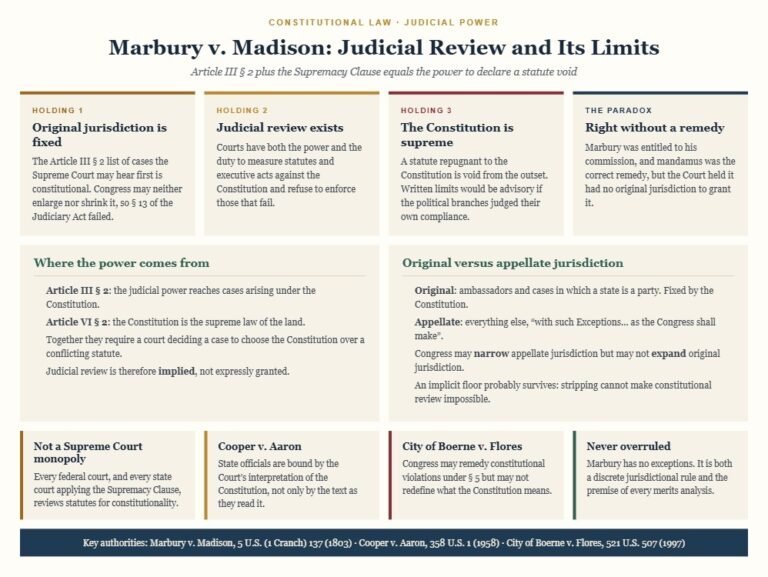 Marbury v. Madison and the Power of Judicial Review
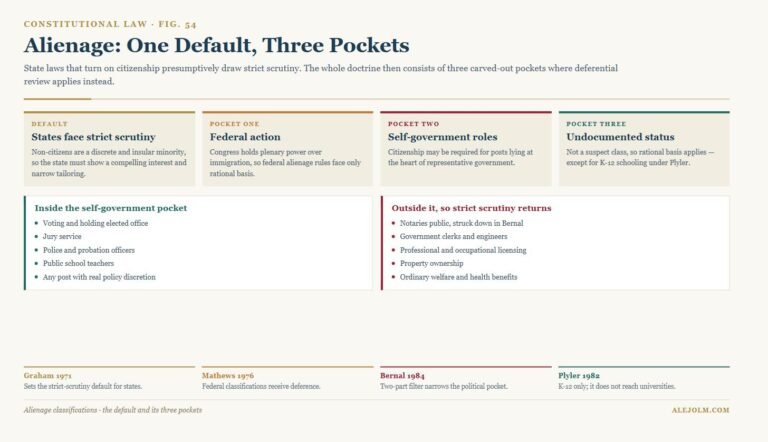 Alienage Classifications: Strict Scrutiny and Its Pockets
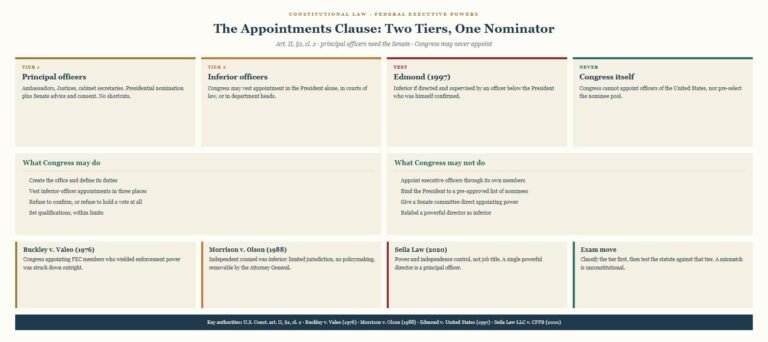 The Appointment Power: Principal and Inferior Officers
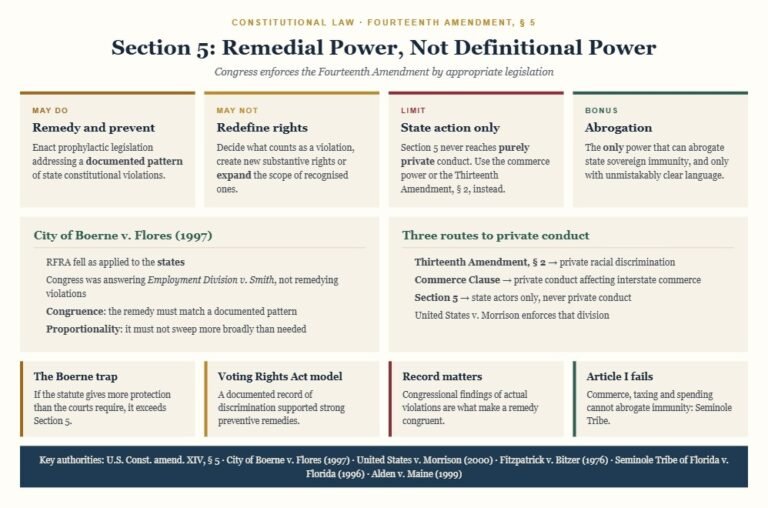 Section 5 Enforcement Power: Remedy, Do Not Redefine
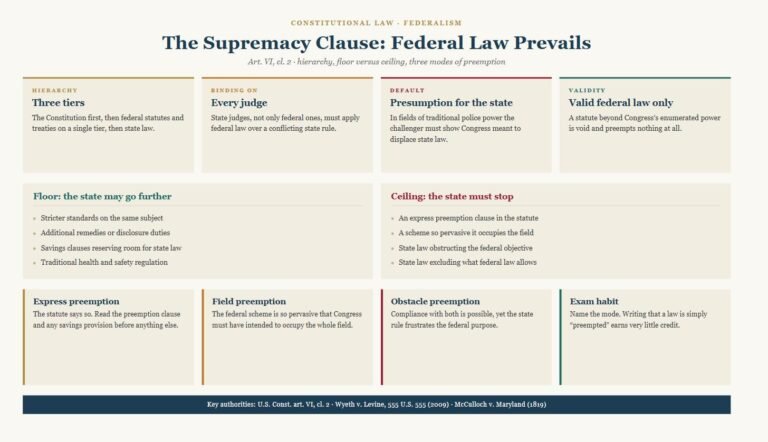 The Supremacy Clause: Floors, Ceilings and Preemption
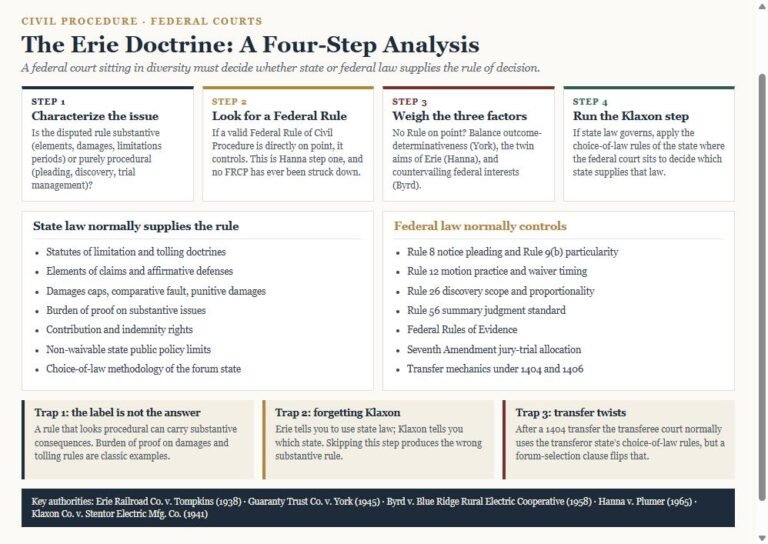 The Erie Doctrine Explained: A 4-Step Bar Exam Guide
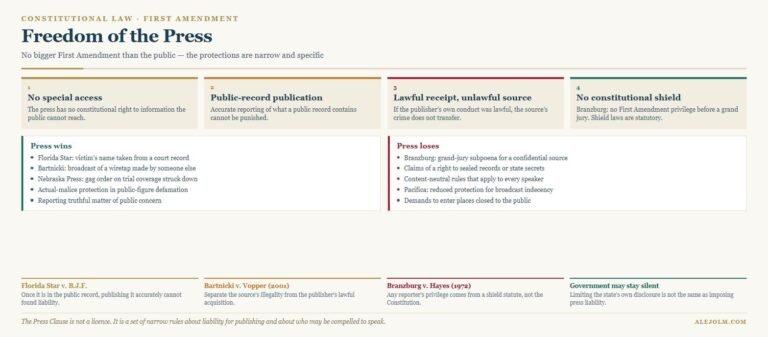 Freedom of the Press: Publication Liability and Limits
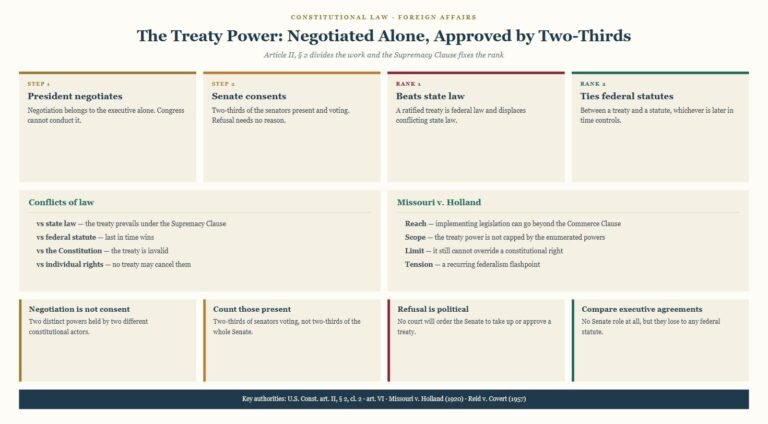 The Treaty Power: Senate Advice and Consent Explained
 3 Levels of Scrutiny in Constitutional Law Explained