
Transferring a Duty, Not a Right
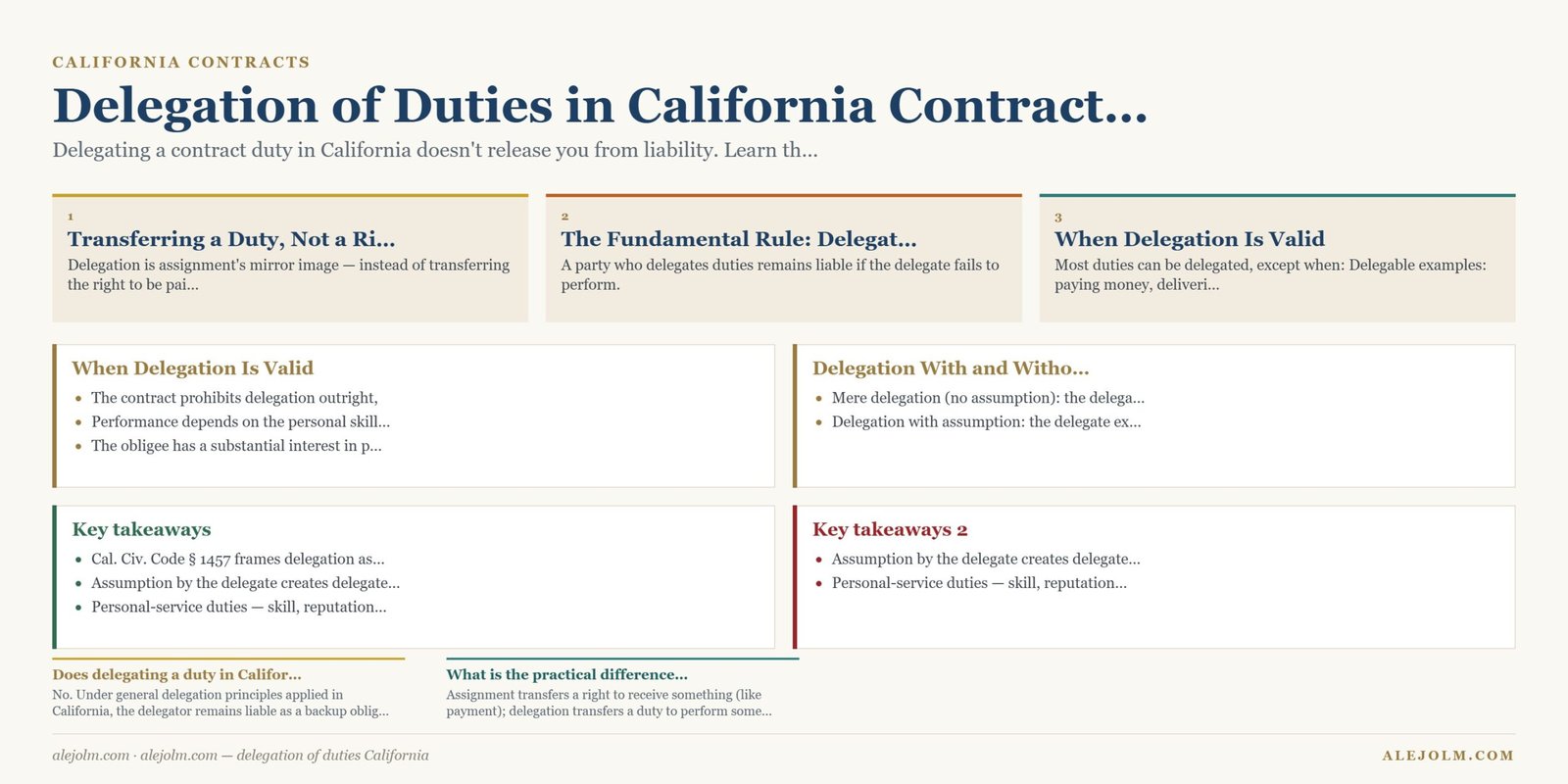
Delegation is assignment’s mirror image — instead of transferring the right to be paid, a party transfers the duty to perform. The rule that trips up almost every Bar candidate: delegating a duty does not get you off the hook.
A delegation of duties is a transfer of a party’s obligation to perform under a contract to a third party, the delegate. Unlike an assignment, the original obligor (the delegator) remains liable as a backup even after delegating, unless every party agrees to a novation releasing the original obligor.
The Fundamental Rule: Delegation Does Not Release the Delegator
A party who delegates duties remains liable if the delegate fails to perform. The obligee can sue either the delegator or the delegate, depending on how the delegation was structured. The only way to release the original obligor is a novation — a new agreement among all three parties (obligee, delegator, and delegate) that the delegate replaces the delegator entirely.
When Delegation Is Valid
Most duties can be delegated, except when:
- The contract prohibits delegation outright,
- Performance depends on the personal skill, reputation, or unique talent of the original obligor (a surgeon can’t delegate surgery to an unknown physician), or
- The obligee has a substantial interest in personal performance by the original party specifically.
Delegable examples: paying money, delivering standard goods, painting a house to clear quality standards. Non-delegable examples: surgery, legal representation, a specific artist’s performance.
California’s Consent Twist: Cal. Civ. Code § 1457
Here’s where California’s statutory text is stricter, on its face, than the Restatement’s freely-delegable default. Cal. Civ. Code § 1457 provides that “the burden of an obligation may be transferred with the consent of the party entitled to its benefit, but not otherwise” — meaning the obligee’s consent is the starting point under the California statute, rather than free delegability subject to exceptions. In practice, California courts still treat most ordinary commercial duties (payment, standard goods, routine services) as delegable absent an objection or a personal-performance interest, and the delegator remains liable regardless — but the statutory framing is worth citing on a California-specific essay to show you know the Civil Code doesn’t simply mirror the Restatement’s default rule.
Delegation With and Without Assumption
- Mere delegation (no assumption): the delegate makes no promise to the obligee and has no contractual liability to the obligee. Only the delegator remains liable.
- Delegation with assumption: the delegate explicitly or implicitly promises to perform for the obligee’s benefit. The delegate becomes liable to the obligee (as a third-party beneficiary of the assumption agreement), and the delegator remains liable as a backup.
Anti-Delegation Clauses
A clause stating “this obligation cannot be delegated” is respected by courts — a delegation attempted in violation of it is ineffective, and the obligee can refuse to accept performance from the delegate. A clause against “assignment” is typically read to include delegation too, since assigning an entire contract implicitly delegates its duties.
Comparison Table: Assignment vs. Delegation
| Feature | Assignment | Delegation |
|---|---|---|
| What transfers | A right (to receive performance) | A duty (to render performance) |
| Original party’s liability | May end entirely | Continues as backup, absent novation |
| Governing California statute | Cal. Civ. Code § 954 | Cal. Civ. Code § 1457 |
| Released by | Nothing further needed | Only a novation |
Worked Hypothetical
Facts: Contractor contracts with Homeowner to remodel a kitchen for $50,000. The contract has no anti-delegation clause. Contractor delegates the work to Subcontractor, a skilled kitchen specialist, without telling Homeowner. Subcontractor performs perfectly. Homeowner, upset that Contractor didn’t do the work personally, refuses to pay.
Analysis: Subcontractor cannot sue Homeowner directly — Subcontractor never assumed the obligation to Homeowner and isn’t a party to the original contract. But Contractor remains liable to Homeowner, and Homeowner must pay Contractor (who then pays Subcontractor). The delegation itself was valid: no anti-delegation clause exists, and kitchen remodeling depends on quality standards, not Contractor’s personal identity or unique skill. Homeowner’s objection that Contractor didn’t personally do the work is not a valid defense to payment once the delegation was proper and performance conformed.
Frequently Asked Questions
Does delegating a duty in California free the original party from liability?
No. Under general delegation principles applied in California, the delegator remains liable as a backup obligor unless all three parties agree to a novation releasing them.
What is the practical difference between assignment and delegation?
Assignment transfers a right to receive something (like payment); delegation transfers a duty to perform something. They follow different rules, and only delegation leaves the original party on the hook by default.
Can a surgeon delegate a scheduled operation to another doctor?
No. Personal-service obligations depending on a specific individual’s skill or reputation are non-delegable, because the obligee’s interest in that particular performer is material to the deal.
Key Takeaways
- Delegation transfers duties; assignment transfers rights — don’t conflate the two mechanisms.
- The delegator always remains liable as a backup unless a novation releases them.
- Cal. Civ. Code § 1457 frames delegation as requiring the obligee’s consent, a stricter statutory starting point than the Restatement’s freely-delegable default.
- Assumption by the delegate creates delegate liability to the obligee; mere delegation without assumption does not.
- Personal-service duties — skill, reputation, unique talent — generally cannot be delegated.
This article is educational and is not legal advice. Consult a licensed California attorney about your situation.
Related guides
- assignment of contract rights
- third-party beneficiaries in California contracts
- remedies for breach of contract