
What Is Substantial Performance?
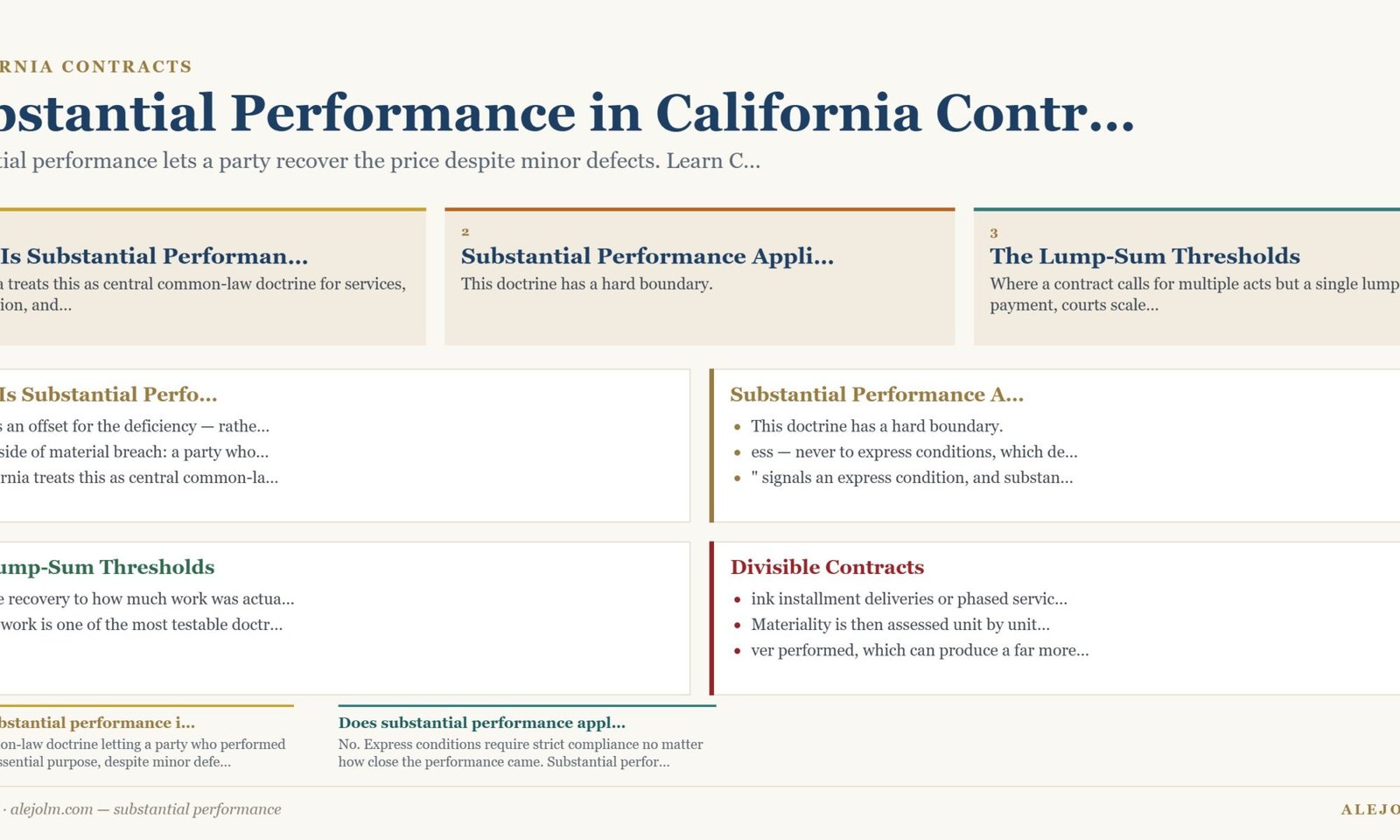
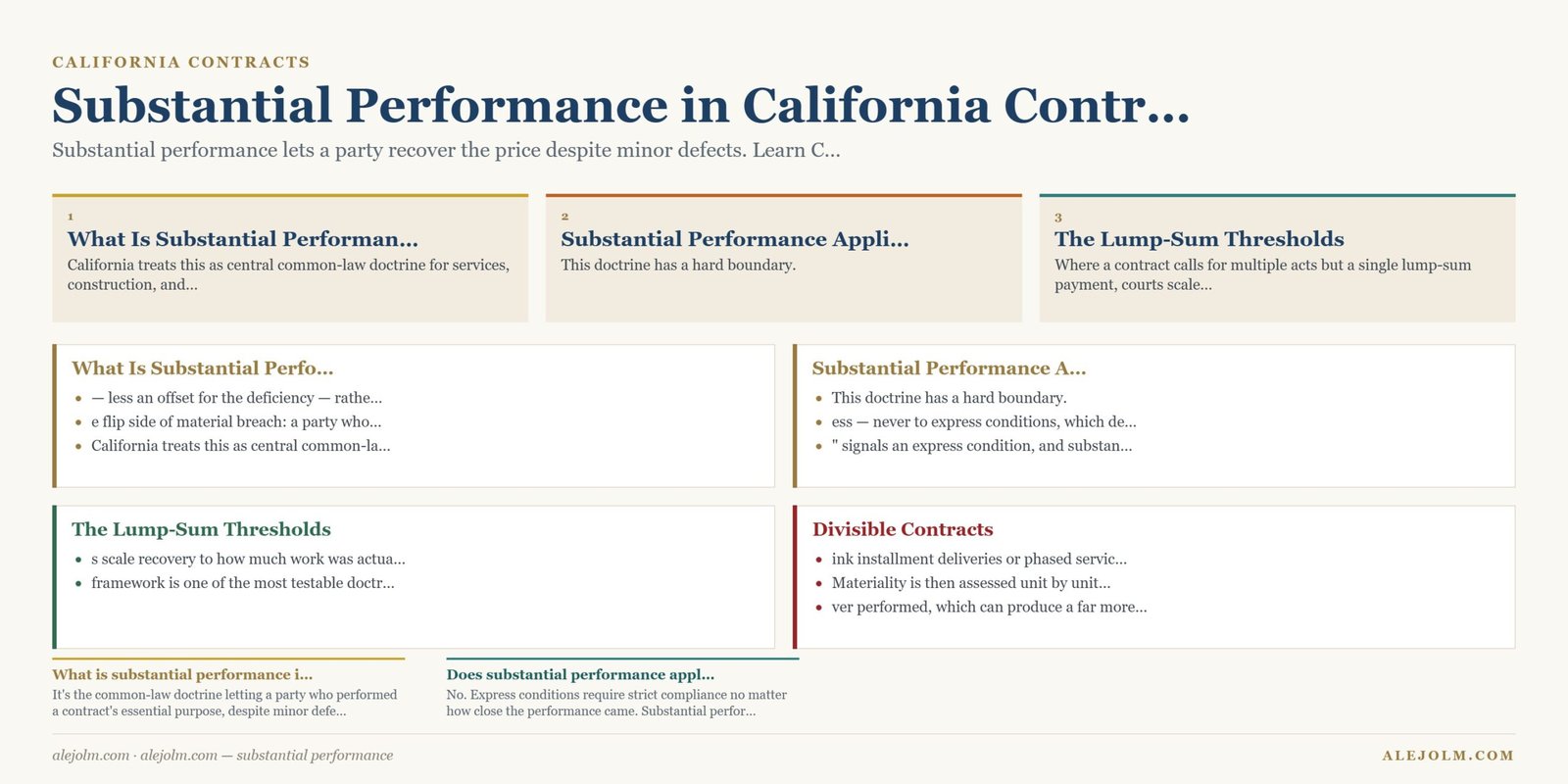
Substantial performance is the common-law doctrine that lets a party who performed the essential purpose of a contract, despite minor defects or deviations, still enforce the contract and recover the contract price — less an offset for the deficiency — rather than forfeiting payment entirely as if it had materially breached. It’s the flip side of material breach: a party who substantially performs has, by definition, not materially breached.
California treats this as central common-law doctrine for services, construction, and real estate contracts.
Substantial Performance Applies Only to Implied Conditions
This doctrine has a hard boundary. Substantial performance applies to implied or constructive conditions, judged by reasonableness — never to express conditions, which demand strict compliance no matter how close the performance came. Language like “if,” “provided that,” or “on condition that” signals an express condition, and substantial performance won’t rescue a party who missed it, even by a hair.
The Lump-Sum Thresholds
Where a contract calls for multiple acts but a single lump-sum payment, courts scale recovery to how much work was actually completed, since the payment doesn’t get prorated automatically.
| Performance completed | Legal consequence | Recovery |
|---|---|---|
| Less than half | Generally material breach | Quasi-contract only, capped at unjust enrichment |
| More than half, less than all | Case-by-case; often substantial performance | Contract price minus damages for the shortfall |
| Full performance | No breach | Full contract price |
This numerically precise framework is one of the most testable doctrines in the substantial performance area — know the thresholds cold.
Divisible Contracts
A divisible contract is one whose performances can be split into corresponding pairs — think installment deliveries or phased service work — that the parties would have regarded as agreed equivalents. Materiality is then assessed unit by unit, not for the whole contract. A party who completes one unit satisfactorily can recover for that unit even if later units are never performed, which can produce a far more generous outcome than an ordinary substantial-performance analysis.
Jacob & Youngs v. Kent: Cost of Completion vs. Diminution in Value
The landmark case Jacob & Youngs, Inc. v. Kent (1921) illustrates the doctrine’s underlying policy. A contractor installed a different (but equal-quality) brand of pipe than the specifications called for — a trivial, unintentional, good-faith deviation. Forcing forfeiture of the entire contract price to correct a purely cosmetic or technical defect would be wildly disproportionate. The court awarded the contract price less the (nominal) diminution in value, rather than the drastically higher cost of tearing out and redoing the work.
That cost-of-completion-versus-diminution-in-value distinction is the highest-yield takeaway: when correcting conforming, high-quality work would be economically wasteful and disproportionate to the actual harm, courts award diminution in value instead of full correction costs.
Substantial Performance and California Law
Substantial performance is a common-law doctrine, not a California Commercial Code concept — it governs services, real estate, and construction contracts, not goods sales. Goods contracts use the stricter perfect tender rule instead, tempered by the seller’s statutory cure right. There’s no separate California statute displacing the common-law substantial-performance framework; California courts apply the same Restatement § 237 approach and the same Jacob & Youngs cost-versus-value reasoning as other common-law jurisdictions.
Worked Example
A builder contracts to construct a custom home in Marin County for a lump-sum price of $400,000, with specifications calling for Kohler-brand bathroom fixtures throughout. In good faith and without the owner’s knowledge, the builder installs fixtures from a different manufacturer of materially identical quality, price, and function, due to a supplier substitution. After the home is otherwise fully and properly completed, the owner discovers the substitution and refuses to pay any part of the $400,000, demanding the fixtures be torn out and replaced.
Analysis: The builder substantially performed. The fixture substitution was a trivial, good-faith, non-willful deviation that didn’t deprive the owner of the essential benefit of the bargain — a fully functional, properly built home with equivalent-quality fixtures. This isn’t a material breach, so the owner’s duty to pay isn’t excused. The owner must pay the $400,000 contract price, offset only by any diminution in value caused by the substitution — likely nominal here — rather than the drastically disproportionate cost of ripping out completed work over a brand preference.
Common Mistakes
- Applying substantial performance to express conditions, which demand strict compliance regardless of how close the performance came.
- Ignoring the precise lump-sum thresholds (less than half, more than half, full) in multiple-act contracts.
- Treating a divisible contract as one unified whole, missing the unit-by-unit recovery advantage.
- Awarding full cost-of-completion damages when Jacob & Youngs calls for diminution in value instead, given the disproportionate waste of tearing out conforming work.
FAQ
What is substantial performance in contract law?
It’s the common-law doctrine letting a party who performed a contract’s essential purpose, despite minor defects, still recover the contract price minus an offset for the deficiency, rather than forfeiting payment entirely.
Does substantial performance apply to express conditions?
No. Express conditions require strict compliance no matter how close the performance came. Substantial performance applies only to implied or constructive conditions.
How did Jacob & Youngs v. Kent shape the substantial performance doctrine?
The case established that when correcting a trivial, good-faith deviation in otherwise conforming work would be economically wasteful, courts award the diminution in value rather than the full cost of completion.
Key Takeaways
- Substantial performance lets a party who performed the essential purpose of a contract recover the price, offset by damages for the deficiency.
- It applies only to implied/constructive conditions, never to express conditions demanding strict compliance.
- Lump-sum, multiple-act contracts follow precise thresholds: less than half is material breach, more than half is often substantial performance, full performance earns the complete price.
- Divisible contracts allow unit-by-unit recovery even if later units are never performed.
- Jacob & Youngs v. Kent favors diminution-in-value damages over wasteful cost-of-completion awards for trivial deviations.
This article is educational and is not legal advice. Consult a licensed California attorney about your situation.
Related guides
- material breach
- conditions subsequent
- contract damages in California
- consideration in California contracts