
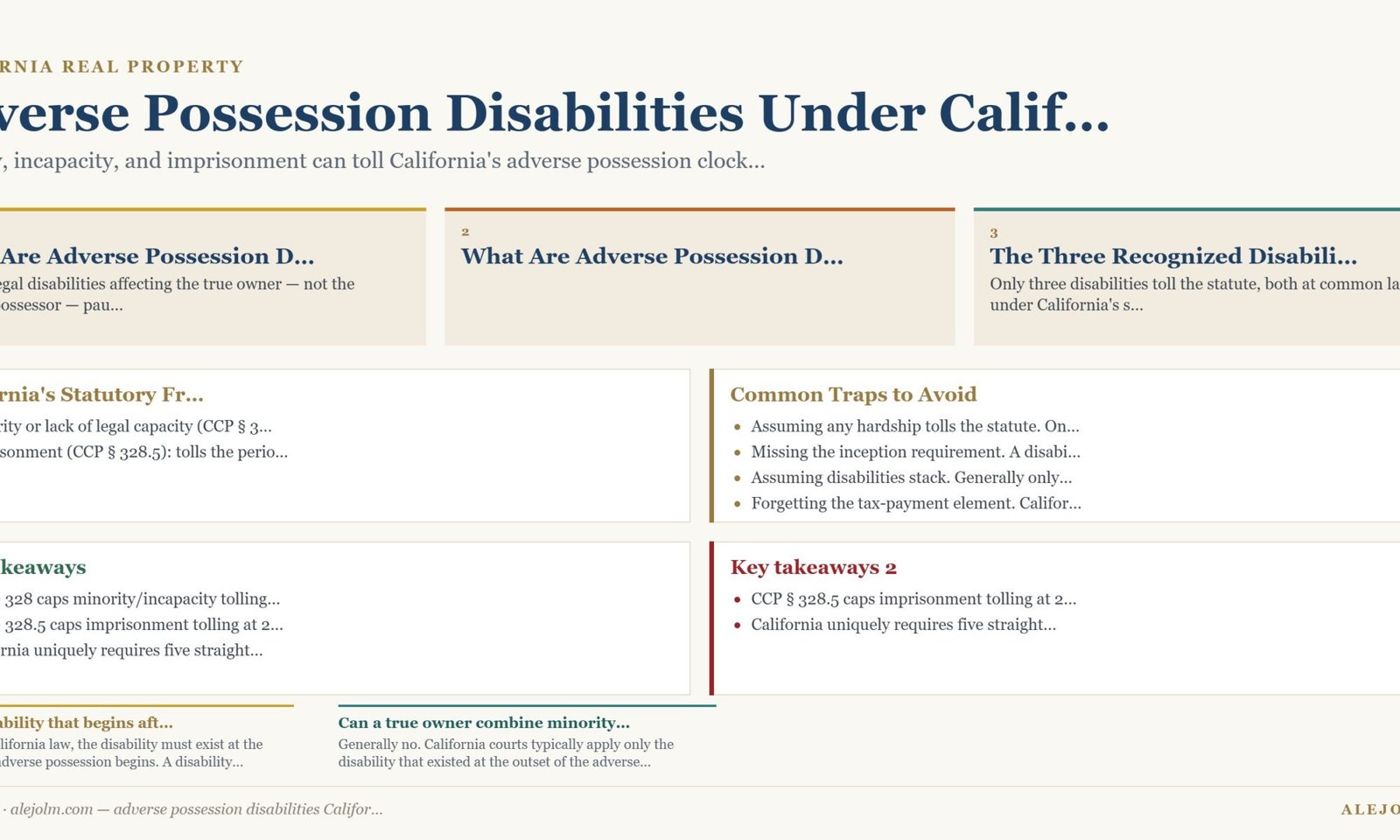
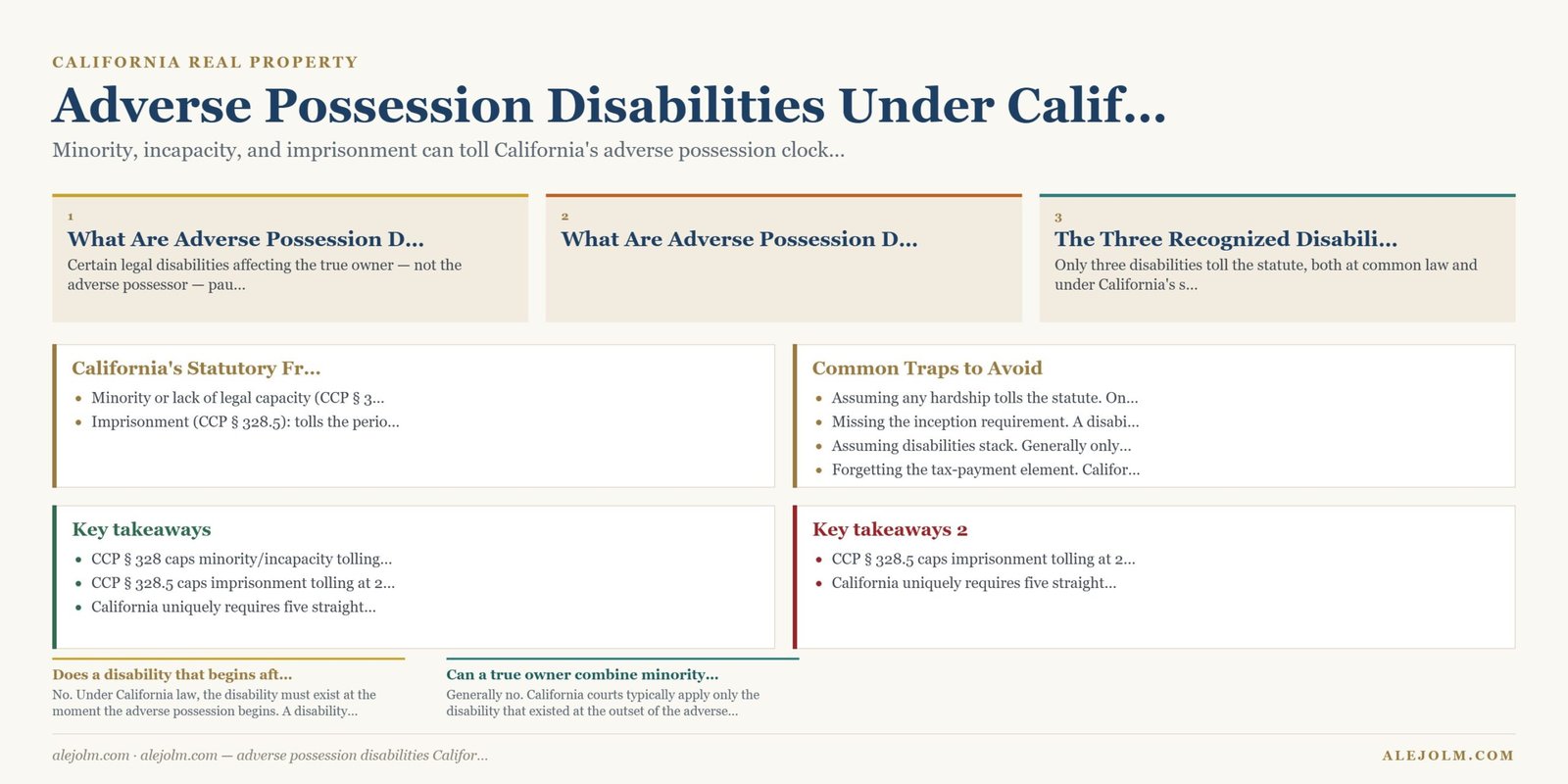
What Are Adverse Possession Disabilities?
Certain legal disabilities affecting the true owner — not the adverse possessor — pause, or “toll,” the running of the adverse possession statute of limitations, giving that owner extra time beyond the ordinary statutory period to sue and reclaim the land. Understanding exactly which disabilities count, and when they must exist, is one of the more technical corners of California real property law and a recurring California Bar Exam trap.
What Are Adverse Possession Disabilities? (Featured Definition)
Adverse possession disability tolling is the rule that pauses the statute of limitations on a true owner’s ejectment claim when that owner is a minor, mentally incapacitated, or imprisoned at the moment the adverse possession began — giving the owner extra time to sue after the disability ends.
The Three Recognized Disabilities
Only three disabilities toll the statute, both at common law and under California’s statutory scheme:
- Infancy (minority);
- Mental incapacity (lacking legal capacity to manage one’s affairs, historically termed “insanity”); and
- Imprisonment.
Nothing else counts. Poverty, illness, ignorance of the law, or simple absence from the state do not toll the statute, no matter how sympathetic the true owner’s circumstances.
California’s Statutory Framework: CCP §§ 318, 325, 328, and 328.5
California’s adverse possession statute has its own independent baseline requirements before disability tolling even becomes relevant. Under Code of Civil Procedure § 325(b), a claimant must show actual, open, notorious, hostile, and continuous possession under claim of right or color of title for a five-year period — and, distinctively, must also have timely paid all property taxes levied on the land during that entire five-year window, provable through certified county tax-collector records. This tax-payment element is a purely statutory add-on that most other states don’t impose, and bar examiners test it constantly.
On disability tolling specifically:
- Minority or lack of legal capacity (CCP § 328): tolls the five-year period, but the tolling is capped at 20 years, and the true owner must sue within five years after the disability ends (or, if the owner dies while still disabled, within five years of the death).
- Imprisonment (CCP § 328.5): tolls the period, capped at 2 years of tolling, with the owner given five years after release to sue.
As at common law, the disability must exist at the moment the cause of action first accrues — that is, when the adverse possession begins.
| Disability | Governing Statute | Tolling Cap | Time to Sue After Disability Ends |
|---|---|---|---|
| Minority / lack of legal capacity | CCP § 328 | 20 years | 5 years |
| Imprisonment | CCP § 328.5 | 2 years | 5 years |
The Inception Rule: The Trap Bar Examiners Love
The single most important limitation is this: the disability must have existed at the very moment adverse possession began. If the true owner was fully competent and free when the clock started, a disability arising later — even years into the adverse possessor’s occupation — provides no protection whatsoever and does not extend the period by even a day. The rationale is simple: the owner could have sued on day one, since no disability stood in the way then, so a later-arising condition changes nothing about the owner’s original opportunity to act.
Multiple successive disabilities generally do not stack. Only the disability that existed at inception controls; a second disability arising later — even while the first is still ongoing — typically adds no additional time beyond what the first disability alone provides, absent a specific statute saying otherwise.
Worked Example: The Alvarez Family Land
An adverse possessor begins openly farming an unfenced parcel outside Bakersfield in 2015. The true owner, fourteen-year-old Sofia Alvarez, inherited the land from her grandfather that same year. Sofia turns 18 (reaching majority) in 2019. Under CCP § 328, Sofia’s minority tolled the statute from the moment the adverse possession began in 2015; she then has five years after reaching majority — until 2024 — to sue for ejectment, even though five years of open, continuous possession (2015–2020) would otherwise have run against a competent adult owner well before then.
Now change the facts: suppose the adverse possession instead began in 2010 against a fully competent adult owner, and that owner didn’t become mentally incapacitated until a car accident in 2016. That later-arising incapacity provides no tolling at all — the clock ran uninterrupted from 2010, because the owner wasn’t disabled when the possession began.
Common Traps to Avoid
- Assuming any hardship tolls the statute. Only infancy, incapacity, and imprisonment count; nothing else does.
- Missing the inception requirement. A disability arising after the adverse possession clock starts is legally irrelevant.
- Assuming disabilities stack. Generally only the first-existing disability controls the tolling period.
- Forgetting the tax-payment element. California claimants must prove five straight years of property tax payments under CCP § 325(b) — a claimant who nails every possession element but never paid taxes still loses.
- Using a generic “one-year grace period.” California’s periods are statute-specific: five years after the disability ends (capped at 20 years total tolling) for minority/incapacity, and five years after release (capped at 2 years total tolling) for imprisonment.
FAQ
Does a disability that begins after the adverse possession starts extend the statute?
No. Under California law, the disability must exist at the moment the adverse possession begins. A disability arising later provides no additional time to sue, no matter how disabling it becomes.
Can a true owner combine minority and imprisonment to get more time?
Generally no. California courts typically apply only the disability that existed at the outset of the adverse possession; a later disability, even one arising before the first ends, usually does not add stacked additional time.
What must an adverse possession claimant prove in California beyond common-law elements?
Beyond actual, open, notorious, hostile, and continuous possession for five years under claim of right or color of title, a California claimant must also prove timely payment of all property taxes assessed on the land throughout that five-year period, per CCP § 325(b).
Key Takeaways
- Only infancy, mental incapacity, and imprisonment toll California’s adverse possession statute — nothing else qualifies.
- The disability must exist at the moment the adverse possession begins; later-arising disabilities never toll the period.
- CCP § 328 caps minority/incapacity tolling at 20 years, giving the owner five years after the disability ends to sue.
- CCP § 328.5 caps imprisonment tolling at 2 years, giving the owner five years after release to sue.
- California uniquely requires five straight years of property tax payment under CCP § 325(b), on top of the common-law possession elements.
This article is educational and is not legal advice. Consult a licensed California attorney about your situation.
Related guides
- California adverse possession requirements
- tacking in adverse possession claims
- adverse possession against a co-tenant
- marketable title in California