

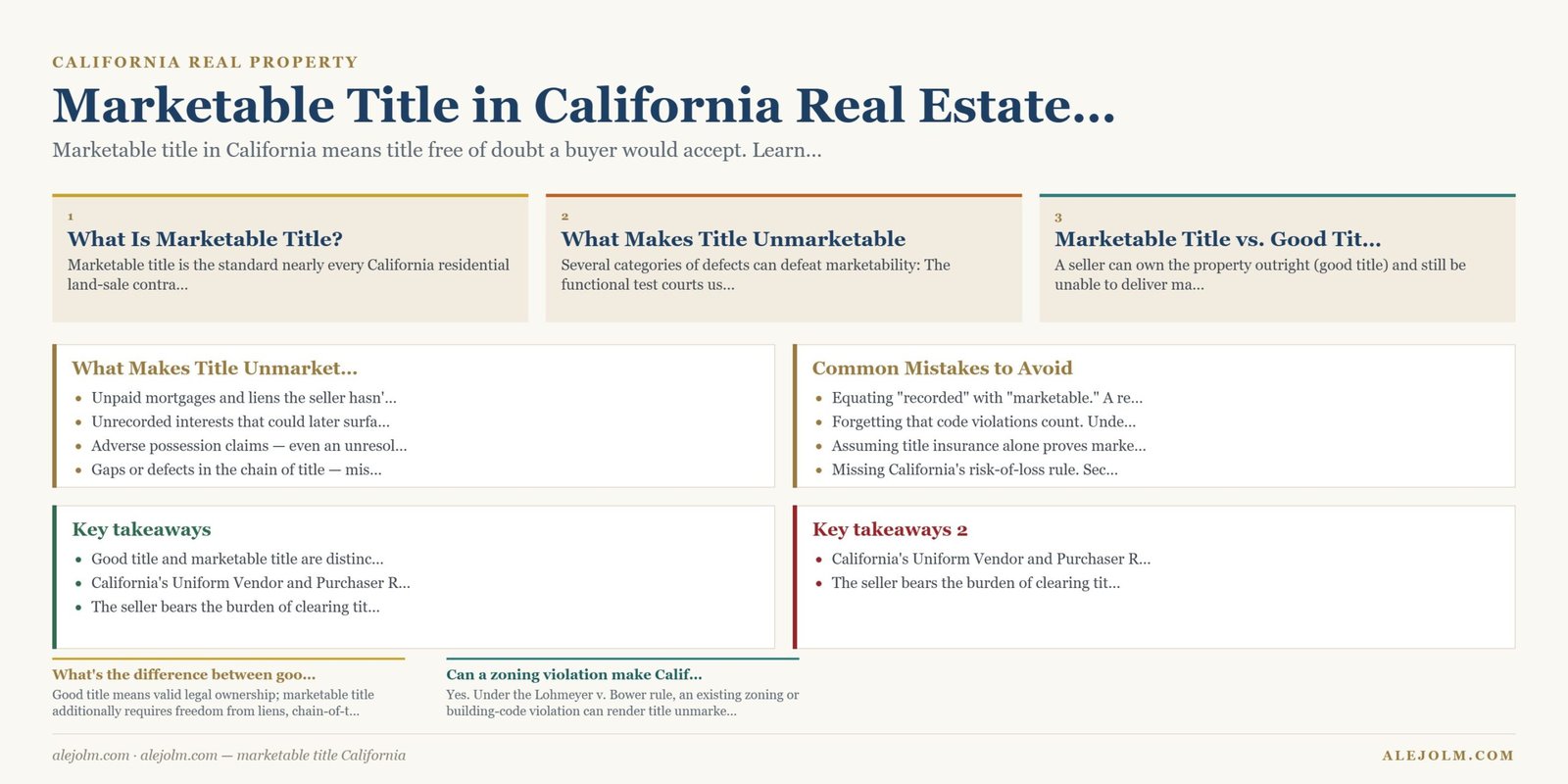
What Is Marketable Title?
Marketable title is the standard nearly every California residential land-sale contract implicitly requires a seller to deliver at closing — title free enough of doubt that a reasonably prudent buyer would accept it, and a title company would be willing to insure it.
Marketable title, defined in one sentence: it is title reasonably free from doubt, meaning free of undisclosed liens, encumbrances, chain-of-title defects, and outstanding claims that would expose a buyer to litigation or loss, such that a title insurer would issue a policy without unusual exceptions.
The concept sits at the intersection of contract law and property law, and it is the reason nearly every California purchase agreement includes a title-review period before closing.
What Makes Title Unmarketable
Several categories of defects can defeat marketability:
- Unpaid mortgages and liens the seller hasn’t satisfied — a buyer shouldn’t have to take subject to the seller’s debt unless the contract says so.
- Unrecorded interests that could later surface — an unrecorded easement, lease, or option.
- Adverse possession claims — even an unresolved, unsuccessful claim clouds title.
- Gaps or defects in the chain of title — missing grantees, forged signatures, or a “wild deed” recorded outside the proper chain.
- Existing code or zoning violations — under Lohmeyer v. Bower, even an unrecorded building-code or zoning violation can render title unmarketable because it exposes the buyer to forced remediation or municipal liability.
The functional test courts use: would a title insurance company issue a policy on this title without demanding unusual exceptions? If the answer is no, the title likely isn’t marketable.
Marketable Title vs. Good Title
| Concept | What It Means | Can Exist Without the Other? |
|---|---|---|
| Good title | The owner genuinely holds valid legal ownership | Yes — an owner can have good title but unmarketable title |
| Marketable title | Title is reasonably free of doubt and a buyer would accept it | No — marketable title presupposes good title, plus freedom from defects/liens/clouds |
A seller can own the property outright (good title) and still be unable to deliver marketable title because of an outstanding lien, an unresolved boundary dispute, or a code violation.
Recording Acts and Marketability
A properly recorded, unbroken chain of title generally supports marketability — but recording alone doesn’t guarantee it. A missing link in the chain, even if every individual deed is recorded, breaks marketability because a subsequent purchaser cannot verify continuous ownership. An unrecorded encumbrance — an easement or covenant the seller never disclosed — also clouds title even though it wouldn’t bind a bona fide purchaser without notice; the seller still must resolve or disclose it before closing to avoid a marketability objection.
Worked Example
Buyer Tomás signs a purchase agreement for a house owned by Seller Grace. A title search reveals a $40,000 judgment lien recorded against Grace from an unrelated lawsuit three years earlier, plus a building permit violation for an unpermitted room addition built by the previous owner.
Can Tomás refuse to close? Yes, on both grounds. The judgment lien is a straightforward encumbrance Grace must clear — typically by paying it off from sale proceeds — before delivering marketable title. The permit violation is a subtler issue: under the Lohmeyer v. Bower rule, an existing code violation can independently render title unmarketable, even though it isn’t a recorded lien, because it exposes Tomás to potential forced remediation costs or municipal enforcement after closing. Grace bears the burden of clearing both defects, or the contract must be renegotiated (price abatement, seller credit, or an “as-is” amendment) before Tomás is required to proceed.
Risk of Loss Before Closing: California’s Rule
California follows the Uniform Vendor and Purchaser Risk Act, codified at Cal. Civ. Code § 1662 — a minority approach that keeps the risk of loss (fire, earthquake damage, etc.) on the seller until legal title passes or the buyer takes possession, whichever happens first. This differs from the majority “equitable conversion” rule some other states apply, under which risk shifts to the buyer at contract signing. On the Bar Exam, always check which rule the fact pattern signals — California’s statute is a frequently tested deviation from the majority approach.
Common Mistakes to Avoid
- Equating “recorded” with “marketable.” A recorded deed can still carry unresolved liens or chain-of-title gaps.
- Forgetting that code violations count. Under Lohmeyer, an unresolved building or zoning violation can independently defeat marketability.
- Assuming title insurance alone proves marketability. Insurers often issue policies with specific exceptions the buyer must still evaluate and accept.
- Missing California’s risk-of-loss rule. Section 1662 keeps risk on the seller until closing or possession — a minority rule students often misremember as the majority approach.
FAQ
What’s the difference between good title and marketable title in California?
Good title means valid legal ownership; marketable title additionally requires freedom from liens, chain-of-title defects, and clouds that would make a buyer or title insurer hesitate.
Can a zoning violation make California real estate title unmarketable?
Yes. Under the Lohmeyer v. Bower rule, an existing zoning or building-code violation can render title unmarketable even without a recorded encumbrance, because it exposes the buyer to potential forced compliance costs.
Who bears the risk of loss if a house burns down before closing in California?
The seller, generally, under Cal. Civ. Code § 1662 (the Uniform Vendor and Purchaser Risk Act) — risk stays with the seller until legal title passes or the buyer takes possession.
Key Takeaways
- Marketable title means title reasonably free from doubt — the standard a prudent buyer or title insurer would accept.
- Liens, unrecorded interests, adverse possession claims, chain-of-title gaps, and code violations can all defeat marketability.
- Good title and marketable title are distinct; an owner can have one without the other.
- California’s Uniform Vendor and Purchaser Risk Act (Civ. Code § 1662) keeps risk of loss on the seller until closing or possession.
- The seller bears the burden of clearing title defects before closing, absent an “as-is” agreement.
This article is educational and is not legal advice. Consult a licensed California attorney about your situation.