
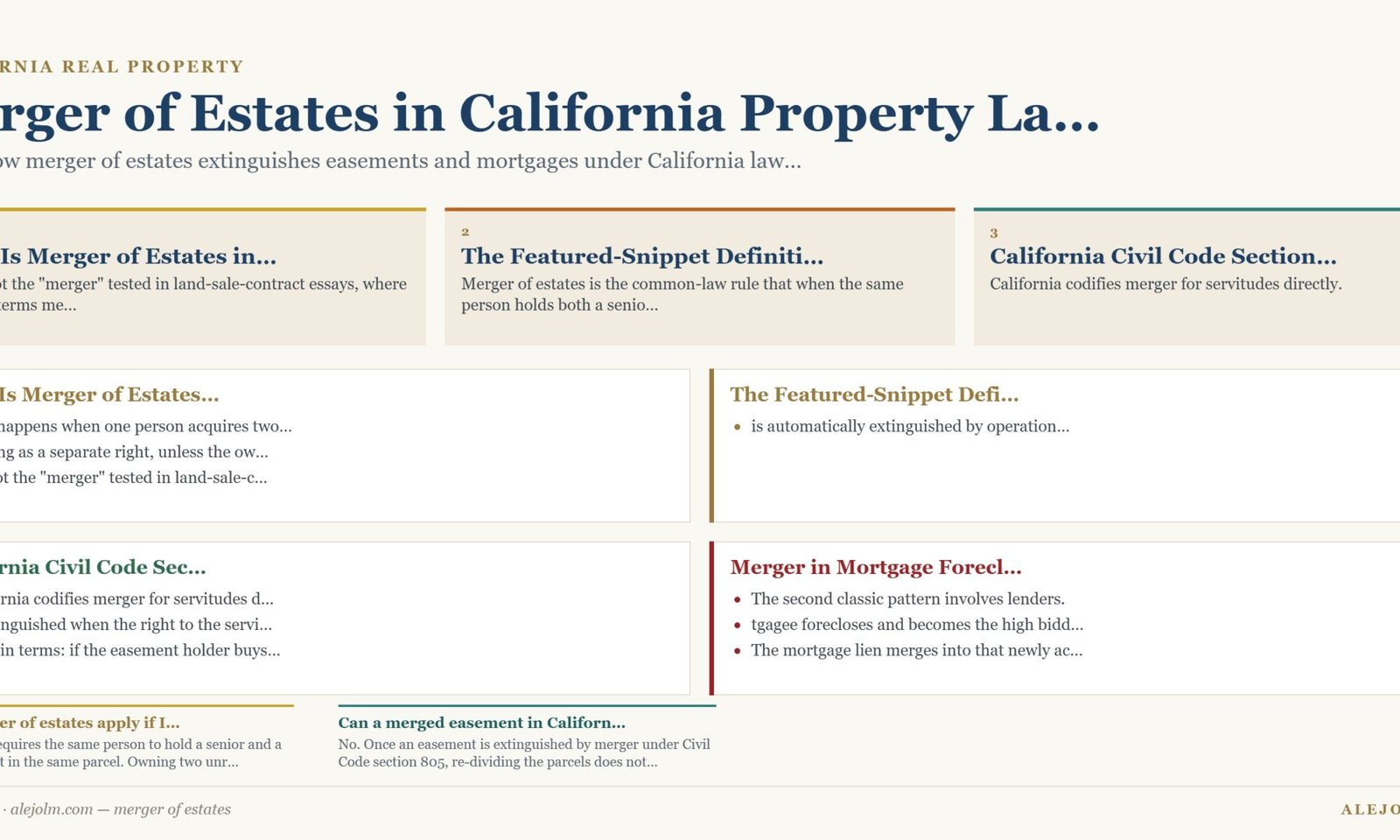
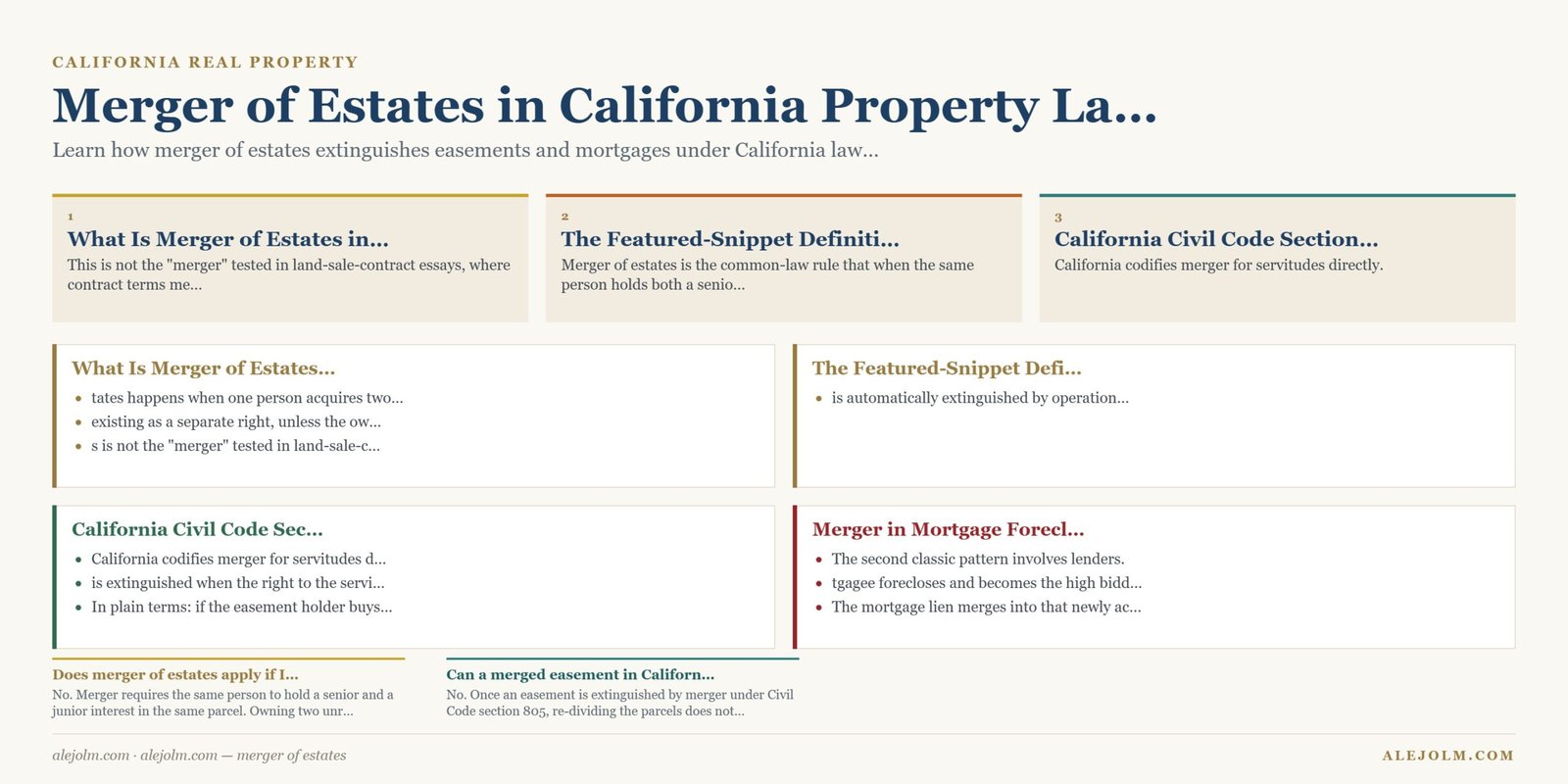
What Is Merger of Estates in California Property Law?
Merger of estates happens when one person acquires two interests in the same parcel — a senior interest and a junior one. California treats this as an automatic event: the junior interest is swallowed by the senior interest and stops existing as a separate right, unless the owner clearly intends to keep them apart or equity requires otherwise.
This is not the “merger” tested in land-sale-contract essays, where contract terms merge into the deed at closing. This is a distinct doctrine about ownership stacking up in one set of hands. It shows up constantly on the California Bar Exam in three fact patterns: mortgage foreclosures, easements, and future interests.
The Featured-Snippet Definition
Merger of estates is the common-law rule that when the same person holds both a senior and a junior interest in one parcel — for example, a fee simple and an easement, or a fee and a mortgage — the junior interest is automatically extinguished by operation of law, absent contrary intent or equitable reasons to preserve it.
California Civil Code Section 805: Merger of Easements
California codifies merger for servitudes directly. Civil Code section 805 provides that a servitude — which includes an easement — is extinguished when the right to the servitude and the right to the servient tenement vest in the same person. In plain terms: if the easement holder buys the land the easement burdens, the easement disappears.
This rule has a harsh consequence that examiners love to test. If the dominant and servient parcels are later re-divided and sold separately, the easement does not spring back automatically. Merger is permanent. A brand-new express grant is required to recreate it, and buyers who rely on old, pre-merger deeds can be badly surprised.
Merger in Mortgage Foreclosure: Why the Lien Disappears
The second classic pattern involves lenders. When a mortgagee forecloses and becomes the high bidder at its own foreclosure sale, it now owns the fee simple outright. The mortgage lien merges into that newly acquired title and ceases to exist as an independent encumbrance.
This matters for priority disputes later. Once merged, the mortgage cannot be revived even if the mortgagee’s new title turns out to be defective or clouded. The former lender is now simply an owner, subject only to liens that were senior to the now-extinguished mortgage — not to its own former lien.
Merger of Future Interests: Life Estates and Remainders
The third context involves possessory estates and future interests. If a life tenant buys out the remainderman’s interest, the life estate and the remainder merge into a single fee simple. The artificial division between present and future interests disappears, and the person now owns the property outright.
The reverse can also occur. If a fee owner loses a sliver of title — say, to adverse possession — and later reacquires that sliver, the resulting future interest merges back into the fee, restoring unified ownership.
When California Courts Refuse to Apply Merger
Automatic merger is the default rule, but it is not absolute. Courts will preserve a junior interest instead of merging it away when equity demands it — most often to protect an intervening lienholder who would be unfairly prejudiced.
A common scenario: a foreclosing mortgagee buys at its own sale, but the sale process violated a procedural requirement. A court may refuse to merge the mortgage into the new title so that junior lienholders retain the protection they were entitled to. This exception is narrow but shows up in nuanced bar exam essays.
| Merger Context | What Merges | What’s Extinguished | California Authority |
|---|---|---|---|
| Easement + servient fee | Easement + fee simple | Easement (permanently) | Civil Code § 805 |
| Mortgage + fee (foreclosure) | Mortgage lien + fee simple | Mortgage as separate lien | Common-law merger doctrine |
| Life estate + remainder | Life estate + remainder | Separate present/future split | Common-law merger doctrine |
Worked Example: The Re-Divided Parcel
Dana owns Lot A and holds a recorded express easement across Lot B (owned by Marco) for driveway access. In 2020, Dana buys Lot B from Marco outright. Under Civil Code section 805, the easement merges into Dana’s new fee ownership of Lot B and is extinguished.
In 2025, Dana sells Lot A to a buyer named Priya, who reviews the old recorded deeds and assumes the driveway easement across Lot B still exists. It does not. Because merger permanently destroyed the easement in 2020, and Dana never re-granted it when selling Lot A, Priya has no easement rights over Lot B unless Dana (who still owns Lot B) executes a new express grant. Priya’s title company should have caught this gap during a title search under California’s recording acts — it is exactly the kind of defect owner’s title insurance is meant to catch.
Common Mistakes on Merger of Estates
- Confusing estate merger with contract/deed merger. These are two separate doctrines with different triggers — one is about ownership consolidation, the other about a closing extinguishing pre-closing contract warranties.
- Assuming merged rights automatically revive on re-division. They don’t. A new grant is always required.
- Missing the senior/junior hierarchy. Merger always absorbs the junior interest into the senior one, never the reverse.
- Ignoring equitable exceptions. Automatic merger can be displaced when an intervening lienholder would be prejudiced by it.
FAQ
Does merger of estates apply if I own two separate properties?
No. Merger requires the same person to hold a senior and a junior interest in the same parcel. Owning two unrelated lots, even with different types of interests in each, does not trigger merger.
Can a merged easement in California ever come back automatically?
No. Once an easement is extinguished by merger under Civil Code section 805, re-dividing the parcels does not restore it. The parties need a brand-new express easement, recorded against the servient parcel.
Why does merger matter in a mortgage foreclosure?
Because it determines what happens to lien priority. If the foreclosing lender buys the property itself, its own mortgage disappears into the fee — it cannot later “revive” that lien to jump ahead of other creditors.
Key Takeaways
- Merger of estates extinguishes a junior property interest when the same person acquires the senior interest in the same parcel.
- California Civil Code section 805 codifies merger for easements and other servitudes.
- Mortgages merge into the fee when a foreclosing lender buys its own collateral at sale.
- Life estates merge into remainders when one person acquires both.
- Merged interests do not automatically revive when property is later re-divided — a new grant is required.
- Courts can refuse to apply merger where equity requires protecting an intervening lienholder.
This article is educational and is not legal advice. Consult a licensed California attorney about your situation.