
What Was Destructibility of Contingent Remainders?
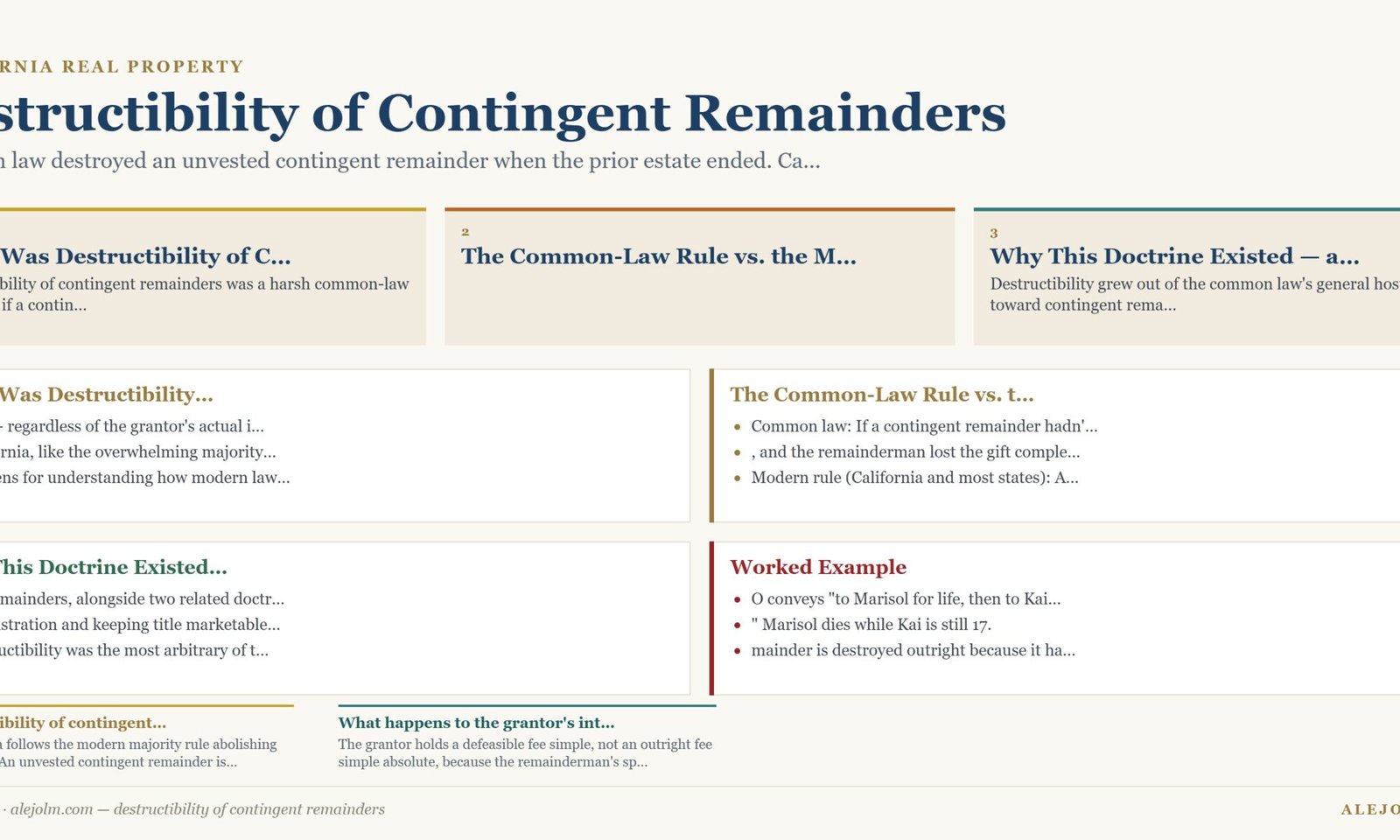
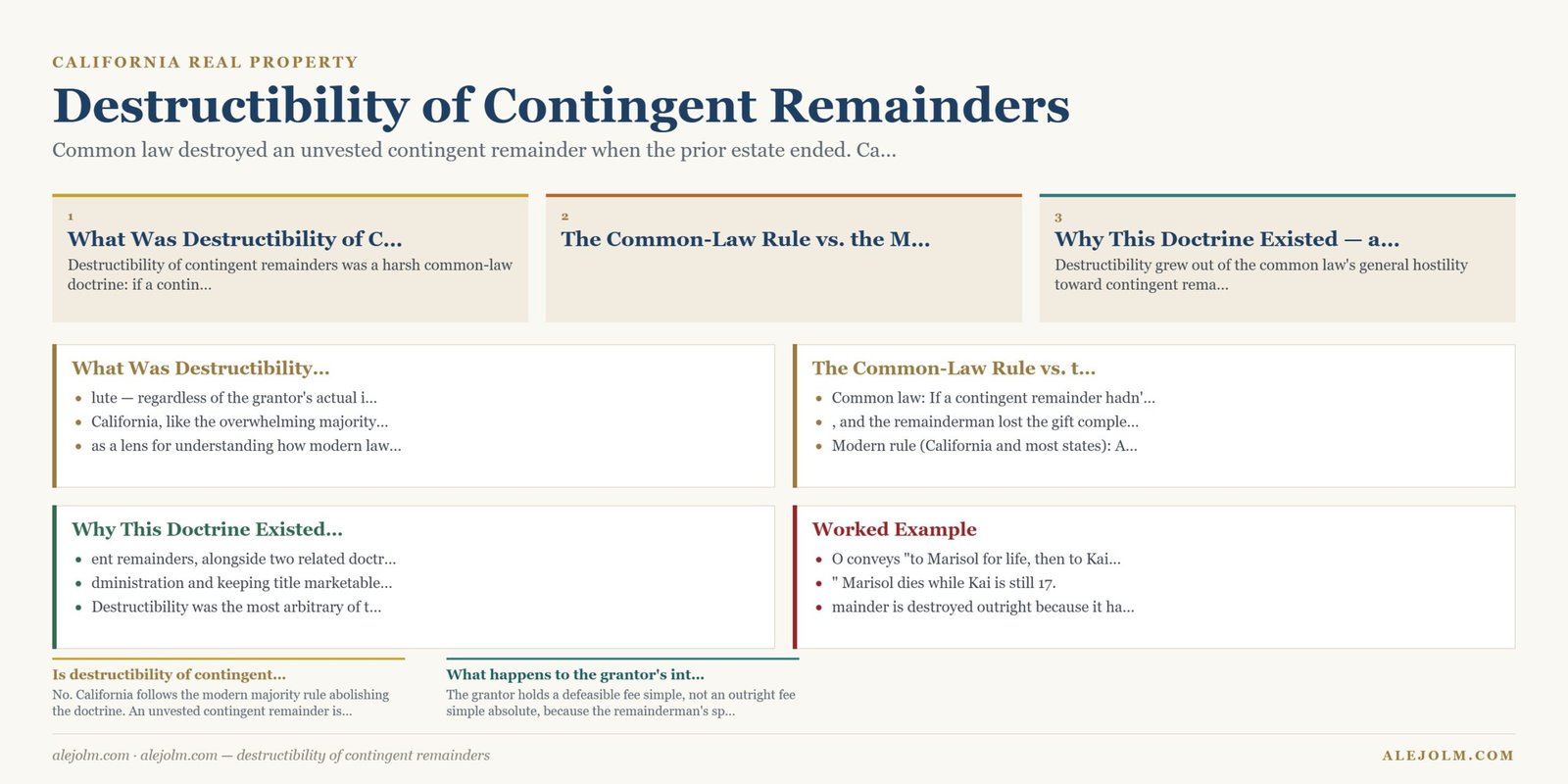
Destructibility of contingent remainders was a harsh common-law doctrine: if a contingent remainder had not vested by the moment the preceding freehold estate ended, the remainder was wiped out entirely, and the land reverted to the grantor in fee simple absolute — regardless of the grantor’s actual intent or how close the remainderman was to satisfying the condition.
California, like the overwhelming majority of modern jurisdictions, has abolished this doctrine. But the concept still matters, both as a bar exam trap and as a lens for understanding how modern law recharacterizes old-fashioned “gap” problems in a chain of estates.
Destructibility of contingent remainders, in one sentence: it was a common-law rule that automatically destroyed an unvested contingent remainder in land the instant the prior freehold estate terminated, a doctrine now abolished in California and most U.S. jurisdictions.
The Common-Law Rule vs. the Modern (California) Rule
Common law: If a contingent remainder hadn’t vested when the prior estate ended, it died on the spot. The grantor (or the grantor’s heirs) took the property back in fee simple absolute, and the remainderman lost the gift completely — even if the condition would have been satisfied a week later.
Modern rule (California and most states): Abolished. Instead of destroying the interest, the grantor’s estate is recharacterized as a fee simple subject to a springing executory interest held by the remainderman. If the condition is later satisfied, title springs automatically to the remainderman, divesting the grantor. Nothing is lost merely because the timing didn’t line up perfectly with the prior estate’s termination.
Why This Doctrine Existed — and Why It Was Scrapped
Destructibility grew out of the common law’s general hostility toward contingent remainders, alongside two related doctrines: the Rule in Shelley’s Case and the Doctrine of Worthier Title. All three were aimed at simplifying estate administration and keeping title marketable by eliminating uncertain, unvested interests as quickly as possible.
Destructibility was the most arbitrary of the three. It didn’t ask whether the remainderman was likely to satisfy the condition — it simply looked at a clock (the end of the prior estate) and killed the interest if vesting hadn’t happened by then, no matter how close. Modern courts and legislatures concluded that arbitrarily destroying a beneficial interest based purely on timing frustrated grantors’ intent far more often than it served any legitimate purpose, which is why the doctrine has been abolished nearly everywhere.
Worked Example
O conveys “to Marisol for life, then to Kai if Kai reaches age 21.” Marisol dies while Kai is still 17.
Common-law result: Kai’s contingent remainder is destroyed outright because it had not vested — Kai wasn’t yet 21 — when Marisol’s life estate ended. Title reverts to O (or O’s heirs) in fee simple absolute. Kai takes nothing, even four years later when Kai turns 21.
Modern/California result: The destructibility rule does not apply. O (or O’s heirs) holds the property, but subject to Kai’s springing executory interest. When Kai turns 21, title springs automatically out of O’s estate to Kai, divesting whoever held it in the meantime.
RAP Still Lurks in the Background
Recharacterizing the grantor’s interest as defeasible, subject to Kai’s springing executory interest, changes the perpetuities analysis. Under the old common-law rule, the grantor’s reversion was never subject to RAP. Under the modern rule, Kai’s springing executory interest is subject to RAP, because it’s a third-party interest, not a grantor-held one. If Kai’s condition (reaching 21) could not possibly be satisfied within the perpetuities period, the springing interest itself would be void under RAP — though in California, the 90-year USRAP window under Cal. Prob. Code § 21205 gives it a second chance before a court concludes it fails outright.
Common Law vs. Modern Rule at a Glance
| Feature | Common Law | Modern (California) |
|---|---|---|
| Unvested remainder at termination of prior estate | Destroyed outright | Survives as a springing executory interest |
| Who takes if the condition is never met | Grantor, automatically | Grantor, but only if the condition truly fails |
| Grantor’s interest characterized as | Fee simple absolute (reversion realized) | Defeasible fee, subject to divestment |
| Subject to RAP? | Grantor’s reversion — no | Remainderman’s springing interest — yes |
Common Mistakes
- Defaulting to the common-law rule without checking the jurisdiction. Always confirm whether destructibility has been abolished before applying it — in California, it has.
- Forgetting to recharacterize the grantor’s interest under modern law. It isn’t a clean reversion anymore; it’s a defeasible fee subject to a springing executory interest, which has RAP consequences.
- Confusing destructibility with the basic vesting requirement. A remainder that vests exactly at, or before, the prior estate’s termination is simply a vested remainder — no destructibility issue arises at all.
- Skipping the RAP analysis on the recharacterized interest. Once the destructibility rule is abolished, the resulting springing executory interest must still be tested against RAP (and California’s 90-year backstop).
FAQ
Is destructibility of contingent remainders still good law in California?
No. California follows the modern majority rule abolishing the doctrine. An unvested contingent remainder is not destroyed when the prior estate ends; it converts into a springing executory interest.
What happens to the grantor’s interest once destructibility is abolished?
The grantor holds a defeasible fee simple, not an outright fee simple absolute, because the remainderman’s springing executory interest can still divest the grantor if the condition is later satisfied.
Does abolishing destructibility eliminate all perpetuities concerns for the remainder?
No. The recharacterized springing executory interest is still subject to the Rule Against Perpetuities (with California’s 90-year USRAP savings period as a backstop), even though the old common-law reversion never was.
Key Takeaways
- At common law, an unvested contingent remainder was destroyed the instant the preceding freehold estate ended.
- California has abolished this doctrine; the grantor instead holds a defeasible fee subject to the remainderman’s springing executory interest.
- This doctrine was one of three historical rules disfavoring contingent remainders, alongside the Rule in Shelley’s Case and the Doctrine of Worthier Title.
- The recharacterized springing interest is subject to RAP — unlike the old-fashioned reversion it replaces.
- Always confirm the jurisdiction and era a bar question is testing before applying the common-law destruction rule.
This article is educational and is not legal advice. Consult a licensed California attorney about your situation.
Related guides
- the rule against perpetuities in California
- executory interests, shifting and springing
- the Rule in Shelley’s Case
- the Doctrine of Worthier Title