
What Is a Fee Tail?
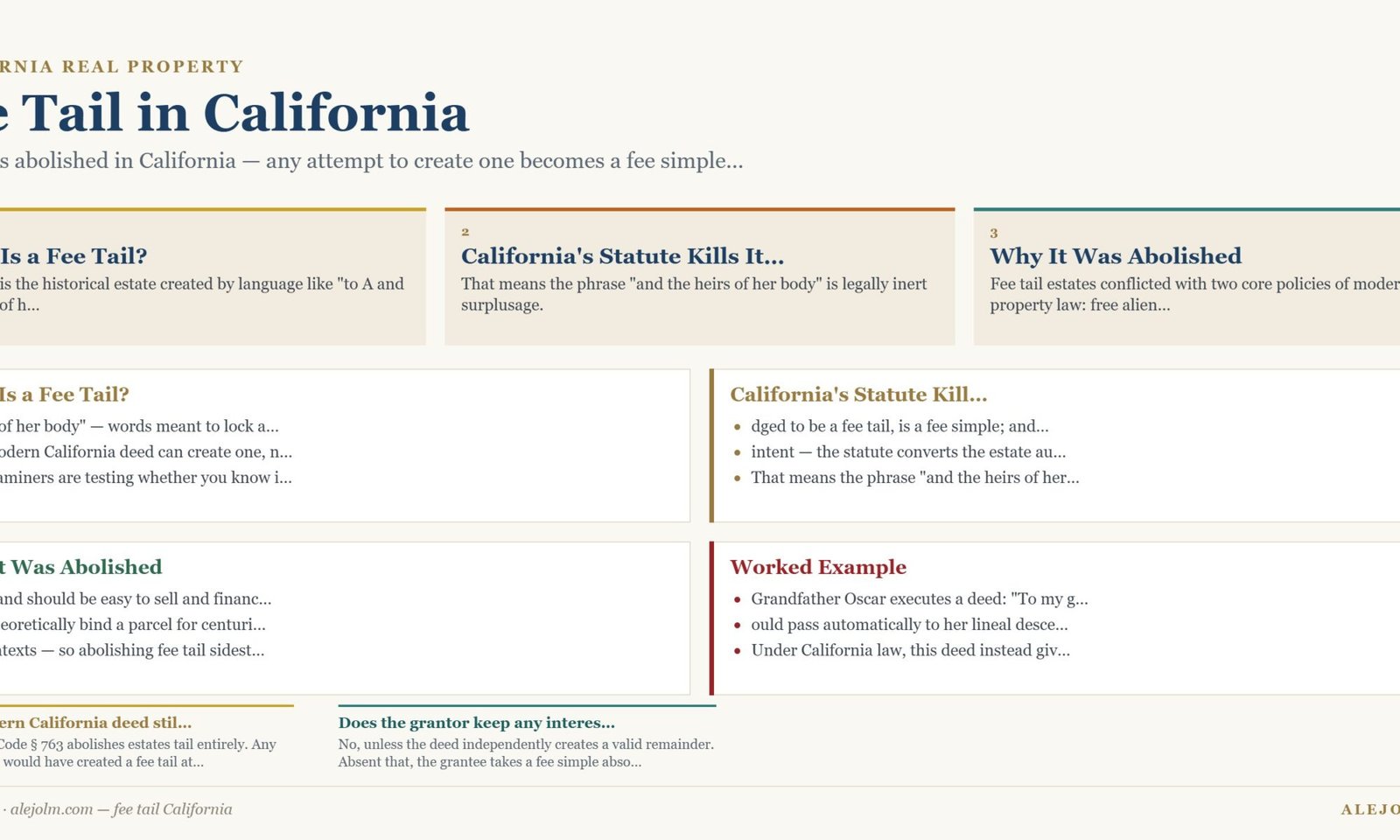
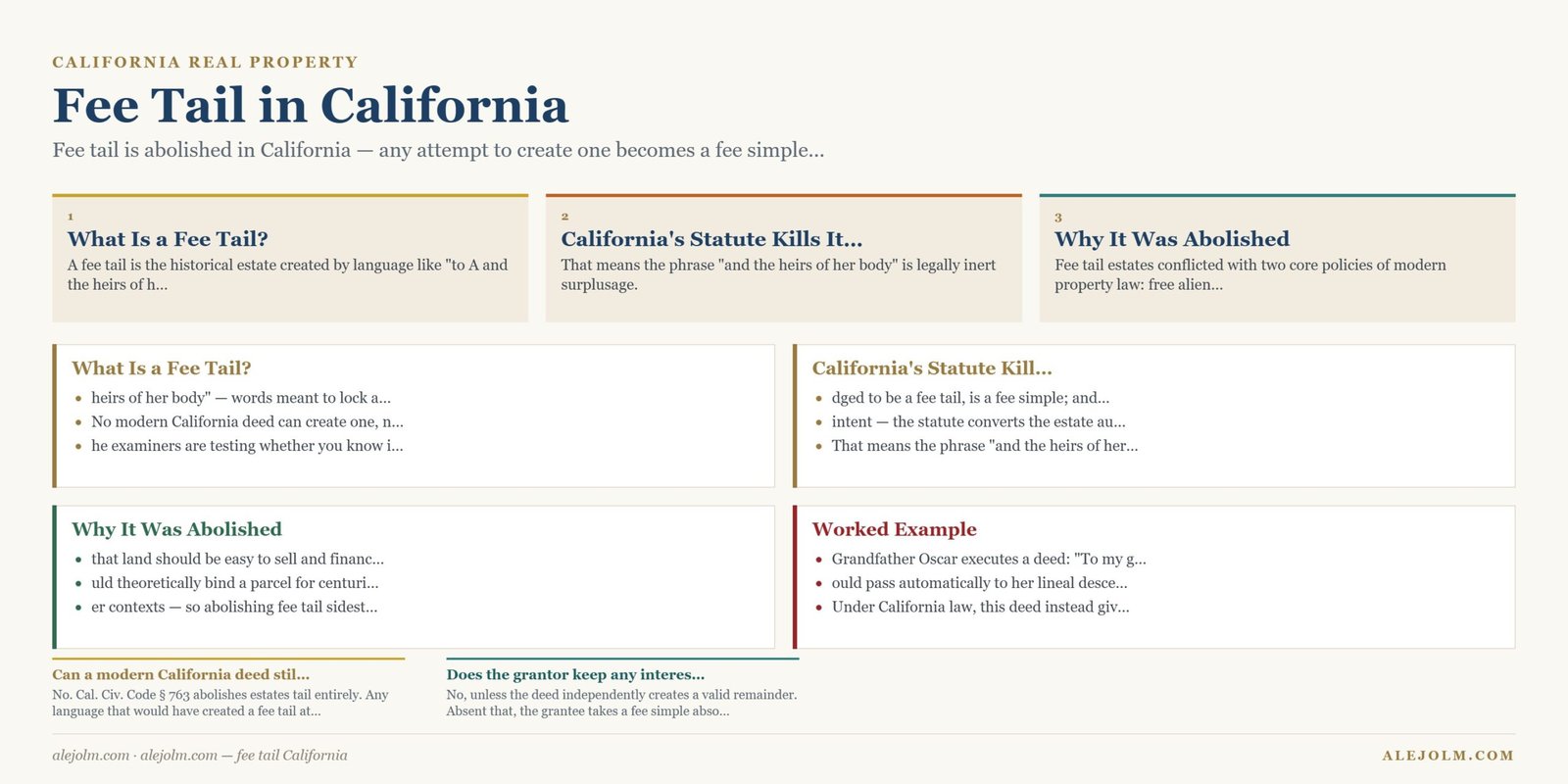
A fee tail is the historical estate created by language like “to A and the heirs of her body” — words meant to lock a property inside one bloodline forever, generation after generation. It is a relic. No modern California deed can create one, no matter how the grantor phrases it.
If you’re studying for the California Bar Exam, this concept shows up as a trap: the fact pattern plants “heirs of her body” language, and the examiners are testing whether you know it does absolutely nothing today except create a fee simple absolute.
Fee tail, in one sentence: it’s an obsolete freehold estate historically limited to a grantee’s lineal blood descendants, abolished in California and virtually every U.S. jurisdiction, so any modern attempt to create one instead produces an ordinary fee simple absolute in the named grantee.
California’s Statute Kills It Outright
Cal. Civ. Code § 763 is direct: “Estates tail are abolished, and every estate which would be at common law adjudged to be a fee tail, is a fee simple; and if no valid remainder is limited thereon, is a fee simple absolute.” There’s no ambiguity and no room for a court to honor a grantor’s contrary intent — the statute converts the estate automatically, by operation of law, the instant the deed is executed.
That means the phrase “and the heirs of her body” is legally inert surplusage. It doesn’t restrict who can inherit, doesn’t create a life estate, and doesn’t leave the grantor with any future interest. The grantee simply owns the property outright, free to sell, mortgage, devise, or give it away to anyone — including a total stranger to the bloodline the grantor tried to protect.
Why It Was Abolished
Fee tail estates conflicted with two core policies of modern property law: free alienability (the idea that land should be easy to sell and finance) and hostility toward perpetual restraints tied to bloodlines. A fee tail, left intact, could theoretically bind a parcel for centuries, since it passes automatically to lineal descendants without end. That is exactly the kind of indefinite restriction the Rule Against Perpetuities was later designed to prevent in other contexts — so abolishing fee tail sidesteps a whole category of perpetuities problems before they can arise.
Worked Example
Grandfather Oscar executes a deed: “To my granddaughter Priya and the heirs of her body.” At common law, this would create a fee tail — Priya could possess and use the land for life, but ownership would pass automatically to her lineal descendants forever, and she could never sell it outside the family line.
Under California law, this deed instead gives Priya a fee simple absolute, immediately. Ten years later, Priya sells the entire parcel to a developer, Wei, with no involvement from her children. Priya’s adult son later sues, arguing the land should have passed only to Oscar’s bloodline and that Priya had no power to sell it away.
Result: The son loses. Cal. Civ. Code § 763 converted the fee tail language into a fee simple absolute the moment Oscar’s deed took effect. Priya owned the whole interest outright and could freely convey it to Wei. Oscar’s attempt to keep the land “in the family” has no legal effect.
Common Law Fee Tail vs. Modern California Result
| Feature | Common-Law Fee Tail | Modern California Result |
|---|---|---|
| Who can inherit | Only lineal blood descendants | Anyone — no restriction |
| Grantee’s power to sell | Cannot sell out of the bloodline | Full power to sell, devise, or mortgage |
| Grantor’s retained interest | Reversion once the bloodline dies out | None — no reversion, no reverter, no right of entry |
| Governing authority | Old common-law doctrine | Cal. Civ. Code § 763 |
Don’t Confuse Fee Tail With a Life Estate or a Defeasible Fee
Fee tail language (“heirs of her body”) is not the same as a life estate (“to A for life”) or defeasible language (“to A so long as used for farming” or “to A, but if A has no children”). A life estate ends at the life tenant’s death; a defeasible fee is conditioned on an event. Fee tail purported to restrict inheritance itself along a bloodline — a different mechanism entirely, and one California no longer recognizes at all.
Common Mistakes
- Treating “heirs of her body” as an enforceable restriction. It never is, in California. Convert it to a fee simple absolute every time.
- Confusing fee tail with a life estate. A life estate ends at one death; a fee tail (had it survived) would pass through an unlimited line of descendants.
- Assuming the grantor retains something. There’s no reversion, no possibility of reverter, no right of entry after fee tail abolition — the grantee takes everything.
- Missing the drafting alternative. A grantor who genuinely wants to keep property in the family today needs a trust or a carefully drafted life estate with a remainder — not fee tail language, which does nothing.
FAQ
Can a modern California deed still create a valid fee tail?
No. Cal. Civ. Code § 763 abolishes estates tail entirely. Any language that would have created a fee tail at common law instead creates a fee simple absolute in the grantee.
Does the grantor keep any interest after fee tail language is used?
No, unless the deed independently creates a valid remainder. Absent that, the grantee takes a fee simple absolute with no reversion, reverter, or right of entry left in the grantor.
What should a grantor use instead if they want property to stay in the family?
A properly drafted trust, or a life estate followed by a remainder to specific named or ascertainable beneficiaries, accomplishes what a fee tail once tried to do — without running into the abolition statute or perpetuities problems.
Key Takeaways
- A fee tail was historically created by “to A and the heirs of her body,” restricting inheritance to lineal descendants forever.
- California has abolished fee tail under Cal. Civ. Code § 763; the language now creates a fee simple absolute.
- The grantee gets full ownership — power to sell, devise, or mortgage — with no restriction and no retained interest for the grantor.
- The bar exam plants this language to test whether you correctly convert it, not whether you enforce it.
- Fee tail is distinct from a life estate and from defeasible-fee conditional language — don’t conflate the three.
This article is educational and is not legal advice. Consult a licensed California attorney about your situation.
Related guides
- life estates and remainders in California
- the rule against perpetuities in California
- executory interests, shifting and springing